Jan 22, 2011

Happy Birthday, David Lynch

On the occasion of David Lynch's 65th birthday, Flavorpill posts 65 little known facts about the director. Ten of the best:—

1. The script for Eraserhead is only 21 pages.

2. On his 15th birthday, Lynch worked with his fellow Virginia Eagle Scouts seating VIPs in the bleachers outside the White House at John F. Kennedy’s inauguration.

3. He claims to have eaten lunch at Bob’s Big Boy in Los Angeles nearly every day for eight years straight, from 1976 to 1984.

4. He voices the character of Gus the Bartender on The Cleveland Show.

5 He is a fan of the Bourne trilogy. He likes the first one the best.

6. For part of the 5-year-long Eraserhead shoot, Lynch supported himself with a paper route, delivering the Wall Street Journal.

7. Childhood friend Toby Keeler once asked Lynch what Wild at Heart is about. Lynch responded, “It’s about an hour and forty-five minutes.”

8. Lynch always buttons the top button of his shirt, because he feels too vulnerable with the top button open.

9. He has written two comedy features, Dream of the Bovine and One Saliva Bubble, both of which remain unproduced.

10. Lynch on the real life inspiration for the opening of Lost Highway: “I woke up one morning and the intercom rang, and a man says, ‘Dave!’ and I said, ‘Yeah,’ and he says, ‘Dick Laurent is dead.’ And I said, ‘What?’ And there was no one there… I don’t know who Dick Laurent is. All I do know is he’s dead!”

From a new series of photographs, People and Places, by Jasper James

Jan 19, 2011

Pre-order 'In The Rooms'

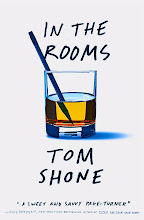
As of this week you can pre-order my novel, In The Rooms — "a sweet and savvy page-turner", Gary Shteyngart, "a cocktail with bite", Helen Fielding — at Amazon here. The above painting, Bar Shrine II, is by Dan Witz.

Jan 18, 2011

Ask and you shall receive

James Wolcott takes the measure of Piers Morgan

"the throbbingly virile replacement who intends to snap Larry King's suspenders with one flex of his Superman chest. In his first week of CNN celebrity interviews (all of them pre-taped for that special tin-can freshness), he reportedly asks what it would take hypothetically for a man to seduce her, which won't do much for the dead children of Iraq, but is what the late Phil Hartman would call quite "a splash of sassy." Unlike King, who hung upside down from the ceiling in the studio suspended in cobwebs like Spiderman's uncle, Morgan is leaning forward in the motorcycle as he races through the first weeks of meetings and tapings like a man possessed, alloted only fifteen minutes to shower before a GQ party by his whiplash assistant."

Morgan, who seems to have been advertising his show for most of the last year, was just on The Situation Room ('on' or 'in'?) bragging to Wolf Blitzer about his first big interview, Oprah Winfrey, whom he managed to open up about her teenage suicide attempt. Blitzer pretended to be impressed. Ah yes, that Salingeresque recluse Oprah Winfrey, so sparing with her personal details, a veritable Garbo of clam-tight reserve. How will he crack this nut? Deadline Hollywood:—

"After months of hyping his provocative style, Morgan spent the hour worshiping at the church of Oprah, calling her queen/American royalty, the most powerful woman in America, world's most famous interviewer, etc. and throwing mostly soft-ball questions at her. Morgan was also hurt by the long time gap between the taping of the interview at the very beginning of the year and its air date. Winfrey had since appeared publicly at other places, including before the TV critics as part of her new cable network OWN's portion of the winter TV Critics Assn.'s press tour. In fact, whole segments from Morgan's interview, including the first 10 minutes, were exact replicas of Winfrey's TCA session, with Winfrey repeating some of her answers almost verbatim."

In this, at least, he is a worthy successor to King who specialised in giving publicity to those brave souls who summoned the temerity to ask for it.

Jan 17, 2011

SO GLAD I DON'T HAVE TO READ*

"In Pilcrow we followed our narrator John Cromer from early infancy and the crippling onset of Still's disease through various formative experiences, some intellectual, some gastronomic and some sexual, and came to admire his courageous tenacity.... Cedilla is even longer and stranger than its predecessor, Pilcrow, and it is just as unsettling, disarming, and compellingly readable.... On what grounds can you reproach or disbelieve such a storyteller? You cannot mug a boy in a wheelchair."— Margaret Drabble, The Gaurdian

One what grounds? How about: On the grounds that he's told a bad story? In theory at least it ought to be as possible to reproach or desbelieve a storyteller who hails from any walk of life — fat stockbrokers, pale-faced serial killers, whimsical cripples — although the news that The Guardian gives an immediate free pass to all narrators who happen to be sat in a wheelchair is encouraging news. I have hereby decided to populate my second novel entirely with double-amputees, all of them engaged in a charitable sporting activity of some sort, possibly a Polo match, their thrilling rise to the top of the Argentinian first division narrated by a lightly-fictionalised Stephen Hawking. That way, my reviews are bound to be glowing, at least in the Guardian. Drabble appears to have confused two things: 1) delivering an opinion of a novel about someone in a wheelchair and 2) delivering an actual opinion of a person in a wheeelchair sat opposite you, their hopeful face ready to dissolve in tears at the slightest harsh word. Who knows, maybe Adam Mars-Jones book is so blindingly good it's difficult to tell the difference, although Iif I think of some of the best novels I've ever read — Little Dorrit, Anna Karenina, Lolita — I can't recall ever having actually mistaken their protagonists for actual people whose feelings I might hurt if I don't happen to like the novels they're in. And those writers were writing at a level of literary endeavour a shade or two above Mars-Jones, I'm going to take the liberty of assuming. But even assuming Cedilla is as good as War & Peace, it would surely help its cause with readers to know that a bad book on the subject of wheelchairs were even possible? There does exist the unfortunate prejudice that a novel about someone confined to a wheelchair might be as confining, aesthetically, as being sat in a wheelchair yourself. For Drabble, that is exactly as things should be:—

"We are also taken through pages of painful surgery to adapt John's body for the adapted Mini, to create the functional Adlerian synthesis. Mars-Jones puts us through a great deal of pain, and at times one must wonder if there is a gratuitous or sadistic pleasure in inflicting it upon us. But somehow the question seems presumptuous. John had to put up with it, and so must we."

Must we? Some might argue with the idea that a description of a painful surgical procedure ought to be as actually painful as the procedure itself on the grounds that it would result in a sharp decline in book sales as people learnt to stay away from any book about the birth of a child, a liver transplant, an untimely death by electrocution, a war scene or even any scene involving a mild grazing during a polo match (there goes my second novel) on the not unreasonable grounds that people don't read novels to be put through actual physical or mental suffering if they can avoid it. Now I know that this is not an uncontrovertible opinion and that there exist small swathes of the reading public who are gluttons for punishment — Paul Auster readers, Anita Shreve fans, the first-response reading teams who supply the Nobel prize committee with contenders — but most of them would baulk, I think, at a description of cataract surgery that filled them with the sensation of someone slicing off the top of their eyeball and poking around in there with a scalpel (is that how cataract surgery is performed? Must research this in time for my second novel, the world of Argentinian polo having made way for the cloak-and-dagger world of Nicaraguan cataract surgeons). Drabble's criteria for literary amnesty is decidedly spotty, one can't help but feel, especially when it comes to the book's conclusion,

" a gripping and perilous scene on a sacred Indian mountain featuring a holy cow. In literary terms, it is impossible for this scene to succeed, particularly for a reader uninterested in Hindu thought and the concept of the Dark Age of the 432,000 years of the Kali Yuga, in which, apparently, we live. It cannot work, but it does. I give up."
That much was clear from the start. The Guardian books pages seem to be doing for the world of letters what Time Out did for film reviewing in the 1990s: creating a inverted Bizarro-world simulacrum of the world of letters, such that were you to take any one of their reviews, hold it upside down, read it back to front and and then take it as gospel, your book shelves would spill over with nothing but great literature all year round. No sooner have we wept hot tears of relief to have spared Cedilla, on the grounds that 1) the reviwer believes it is actually, physically impossible to write a bad book about someone in a wheelchair and 2) Mars-Jones book ends with " a gripping and perilous scene on a sacred Indian mountain featuring a holy cow". That pit of possible turgidity safely sidestepped, we now read, in the very same week's book section, of a second novel from Carol Topolski. To recap, for those unfamiliar with The Grim Topolski's work:—
Monster Love, Carol Topolski's debut novel, shocked and impressed in equal measure. Longlisted for the Orange prize in 2008, it told the horrifying story of a couple who leave their daughter in a cage to die, exploring through a medley of voices what led them to infanticide.
How often have I risen from my downy pillow in the morning, thrown the bedcovers asunder and exclaimed, to my wife, or if she happens to have departed for work, to no-one in particular, "by God if the only thing the world needs more than a novel exploring infanticide is a novel exploring infanticide through a medley of voices, and I don't give a damn who knows it!" But hold it. If Lebowski's follow-up is as good as the Guardian says it is, I will henceforth have to amend my morning cry to include novels about gynaecologist who go out of their way to maim new mothers.
Virginia is a gynaecologist, committed, brilliant and respected, if a bit of an enigma. But squirming within her is a writhing mess of sickness and hatred, of hidden periods of gluttony followed by starvation, of self-mutilation and bondage, all the product of her extraordinarily unhappy childhood. This blossoms into bright, dangerous rage when she believes a woman does not deserve to be a mother. "Every time I hold a woman's womb in my hands, I struggle not to destroy it… I want to wrench it out of her. I want to smash it. I can. I have the power to kill it off and the skill to cover my tracks," she says.
Much as one loves an enigma, especially one in the gynaecological trade, capable of blossoming into a bright dangerous rage at the drop of a hat, the question nags: has Lebowski managed to explore this rich seam with her usual medley of voices, or has she gone solo, so to speak?

Motherhood, good and bad, lies at the heart of Do No Harm, and at the heart of the sickening death with which it starts and ends. Told, as was Monster Love, from a multitude of perspectives

Oh delight untramelled and joy unbounded!

The novel again sees Topolski – a practising psychoanalytic psychotherapist – looking at the why behind the crimes. It's not a race-to-save-the-day sort of a thriller: we know from the second page that someone has been killed, that there's no saving her. Instead Topolski quotes Solzhenitsyn as her epigraph – "the line dividing good and evil cuts through the heart of every human being. And who is willing to destroy a piece of his own heart?" – and goes on to show how Virginia, repellent in many ways but struggling to be good, ends up on one side of the line.

Or, as Stevie Wonder once sang, "There's good and bad in everyone. We learn to live, we learn to give each other. What we need to survive. Together alive." Lebowski is free to use that as an epigraph for her third novel, a comedy of manners set in the world of basement abortionists, if she wants.

* An occasional column devoted to those books, movies and art exhibits which would, on balance, better serve us by remaining unread, unwatched and unvisited, based on the principle that the reactions we have to absent art works can be every bit as enriching as to those demanding our urgent personal attention

Best (and worst) of the Golden Globes

"What can be the silliness of the Golden Globes matched up with the seriousness of the critics on Sunday night as the Social Network took the prize for best drama..." — New York Times
I love that "what can be the silliness of the Golden globes" as the writer takes the impetuous thrust of judgment and submits it to the tempered sobriety of the Old Grey Lady. He'd love to write "the silliness of the golden Globes," of course, but some sub-editor would invariably point out that while the Golden Globes have on occasion been found "silly" they haven't been found so on a 24-hour, round the clock, 7-day-a-week basis. It might be argued of course that, in the interests of objectivity, even a temporary attack of silliness requires further explication. On what occasions has silliness descended? Having descended, might it not one day depart? And in whose eyes? Might it be the case that what one person finds silly, another person finds jolly? Perhaps the sentence should read, "What can be, on occasion, and in the eyes of some beholders inclined to judge such matters in a less than flattering right, the silliness of the golden globes...." But even that leaves a few cracks through which the fog on incomprehension might creep. Best leave well alone, I think, and get on with the bestowal of TBTTM's own gong-show gongs.
Heedless irony of the evening: E Entertainment's 'Black Swan' make-up tip segment enabling viewers to transform themselves with "that magical black swan ballerina look," thus reversing the entrenched war against death-by-prettification waged by Aronofsky and his movie. More apropos, of course, would have been some Barbara Hershey toe-nail clippers and Portman-patented hangnail strippers, designed to leave each of your limbs a bloody stump whose rorschach spatter patterns symbolise the rape of innocence by the Greek god Zeus. Even Portman herself seemed to have defied her director's purdah-like edicts on the color pink and slipped into a diaphanous pink Dior gown. We can only pray that her punishment will be swift.

Weirdest speech: Robert De Niro. He doesn't say anything for 40 years, doesn't crack a smile let alone a joke, and when he does finally open his mouth he launches into a rusty old Rupert Pupkin monologue stocked with leering, year-late references to Megan Fox's hotness? The promo reel looked suitably mythic; the speech lanced the myth.

Worst Speech: David Fincher. Some teenage breast-beating about how"misanthropic" and "pitch-black" he usually is, together with some unconvincing snarls about how little public approbation means to him. Stay home, then.

Most revealing cutaway: The look on the faces on Fincher's actors to see their captain ("Oh captain my captain") stammer and blush, debutantishly, at the podium as he told everyone how little they meant to him. It was rather like the look on Dorothy's face when the curtain is drawn back by Toto to reveal Oz as a huffing, puffing, tinpot imposter.

Worst Hair: a close contest between Annette Bening, who looked as if she had recently stuck her fingers into an electrical socket and Al Pacino who should be congratulated for the safe haven he offers passing families of nestless rodents.

Favorite thank-you: Bening thanking "the winner of the 1962 Golden globe for best newcomer of the year," aka Warren Beatty.

Classiest speech: Aaron Sorkin, for his courtesy to Mark Zuckerberg, his boosterism for elites and smart women.

Worst news for Ricky Gervais: even Hanks went after him.

Jan 14, 2011

Attack of the Green Meanies

"Political Theme, T-Shirts at Memorial?" — Drudge Report
Yes, that's right. "Togetherness' has been deemed "political" by Matt Drudge. What next? the socialist scourge of "niceness"? The Marxist conspiracy that lurks in "so-called" "common courtesy"? If Obama said "hello, nice to meet you," Drudge would presumably snarl "and what do you mean by that exactly?" and leap like a scalded a cat to the corner of the room to better submit the poor snivelling specks that constitute the rest of humanity to the shriveling rigor of his gaze. The resemblance of the Republican platform to "New And Exciting Ways To Be Especially Mean" increases daily. Togetherness? Humbug! Tenderness? Hogwash! Friendliness? Go Screw Yourself! As my mother used to tell me, you'll never get anything with a face like that.

Jan 13, 2011

How hard it must be to hate him

"He spoke as a son--I couldn't help but think of his personal regret over not being by his mother's side when she passed as he said, "Did we spend enough time with an aging parent, we wonder." You could see the devastation insinuate itself onto, and then be quietly willed away from, his face. He spoke as a brother to his fellow public servants, killed and wounded in the events--an eager brother bringing the glad tidings the Gabrielle Giffords had opened her eyes. He repeated it, joyously, three times. But most of all, he spoke as a father--rising to a glorious peak describing the departed 9-year-old, Christine Taylor Green, a girl near the age of his daughters, whose own deaths, perhaps in the line of fire, he had so clearly been thinking about. And he spoke, more broadly, as the head of our national family, comforting, uplifting, scolding a little, nudging us toward our better angels." — Joe Klein

Watching President Obama's almost unbearably moving oration at the Tucson memorial service last night, his best speech since winning the White House, I found myself thinking, as I often do when listening to him, of how the speech was going down with those who hate him, and what superhuman effort it must take, in the face of all the irrefutable evidence to he man's rationality, wisdom, empathy and so on to simply not see it — what backbreaking contortions of illogic, what self-hemorrhaging internal rearrangements, equivalent to the effort required to recolocate your stomach somewhere in your shoulder blades, or knees, or the exertions of a drunk to block the dawn's light from his window, or Othello to disbelieve Desdemona.


How exhausting, above all. It helps explain the extremity of the reaction to him, I think. The implausibility of doubting such an obviously reasonable, moderate-seeming man, necessitates painting him as a shape-changing demon, who's every word is salted with duplicity —"you lie!" — whose very decency is nothing but the most nefarious of tricks. And the more reasonable Obama seems, the more devious must be the con, until he stands next to Hitler — no Satan himself — as sulphurous evil incarnate. For only someone so evil could seem so good.

Palin through the looking glass

“It was inappropriate at the outset to blame Sarah Palin and others for causing this tragedy or for being an accessory to murder,” Abraham Foxman, the group’s national director, said in a statement. “Palin has every right to defend herself against these kinds of attacks." But Mr. Foxman added that “we wish that Palin had not invoked the phrase ‘blood-libel.’ ” He called it a phrase “fraught with pain in Jewish history.” — New York Times

Everything comes full circle in the carnival going on inside Plain's head. Those who assert a link between targeting a congresswoman with rifle sights and the actual assassination of that congresswoman are committing "blood libel," a term reserved for the defamation of the Jews by Christians. One of the people asserting such a link is the assassinated congresswoman herself, who warned in March that such violent rhetoric "has consequences." Thus, does a Christian accuse a jew of blood libel. Voila! As Alice once said, "If I had a world of my own, everything would be nonsense. Nothing would be what it is, because everything would be what it isn't. And contrary wise, what is, it wouldn't be. And what it wouldn't be, it would. You see?”

Jan 11, 2011

Where did all the "Oscar" films go?

“As we’re learning from the Academy, ‘Hurt Locker’ is suited for Academy taste. ‘Inglorious Basterds’ – you would never 10 years ago say, that’s going to get eight Academy nominations. So I think today that stereotype of the classic movie is gone.” — Harvey Weinstein
"The reality is that there is no “Oscar-type” of movie anymore. It is no longer good enough to make a movie that simply checks off the boxes of things that pull at the heartstrings of voters — period pieces, costume dramas, Holocaust movies, etc. The Academy has never been younger, hipper, more diverse (in terms of age and race/ethnicity), or more in-tune with critics than they have been over the past decade" — Scott Feinberg
I agree with the observation but not the explanation. As I wrote here last year, Oscar winners used to be readily identifiable, almost a genre unto themselves, the kind of film with
a symphonic score, great landscapes, heroes who run the four minute mile, or go off to lead the Bolshevik revolution, free India from the English, or atone for the sins of the white man. There was a high likelihood of them wearing linen. If reduced to a movie pitch it might go something like: one individual, making a difference, in costume.

No longer. Somewhere between the moment when Leonardo Di Caprio’s brain matter hit the elevator wall at the end of The Departedand the first strangulation performed by Javier Bardem in No Country for Old Men, the profile of your typical Best Picture winner has changed. And it ain’t Ghandi.

This isn't because the Academy got hip. Much as I would like to believe that it is now made up of hip, young, finger-snapping racially diverse thirtysomethings, their cahiers du cinema tucked under their arm, who know their Denby from their Lane and see Coen-esque blood spatters in their latte foam, such unicorns are not the reason Hollywood has abandoned the high-filigree ponies that used to high-step through the winners paddock. The reason is because Hollywood stopped making that type of film, as was first noticed by Spielberg in 1997.
"It is getting to the point where only two kinds of movies are being made, the tentpole summer or the Christmas hits or the sequels, and the audacious Gramercy, Fine Line or Miramax films. It’s kinda like India where there's an upper class and a poverty class and no middle class. Right now we are squeezing the middle class out of Hollywood and only allowing the 70 million plus films or the 10 million minus films."
That middle-class that he talks about — the $50-70 million movie — that's the exact pumpkin patch where Hollywood used to grow it's prize winners — its Platoons, its Driving Miss Daisies, its Dances With Wolves. They starved out the Oscar-winner as a genre. When you do come across them nowadays — the old liberal weepies like Invictus, The Blind Side, Conviction — they play like slightly undernourished b-list versions of themselves, donkeys not horses.

INTERVIEW: Michelle Williams

“What happened change my relationship to the entire world,” she says. “Everything is different. I’m very conscious of the fact that when I’m working, my daughter is not with one of her parents. When I was making this film in Toronto I would come home and kiss her on the head, and I would smell this whole day on her that I hadn’t been there for: chlorine, her babysitters perfume, a new shampoo. Her entire day was a mystery to me, that I would have to untangle in the morning. I’d get photographs of her and piece it together. I thought about my life at work, and how much of a mystery it is to her, but one day she going to see these movies, so my hope now is that the work makes her proud and that she sees the reason I was gone.” This story, almost heartbreaking in its poignancy, delivered to the corner of the room in a long impassioned stream, could almost have slipped from the pages of Mary Oliver, one of Williams favorite poets — or for that matter, from one of her own films, which are filled with such moments combining the elegiac and the everyday. While shooting Brokeback Mountain, Williams devoted most of her energies to her meaty dialogue scenes, only to find that it was the scenes that only showed up in he script as a single line — “she drives the car”, “she looks out the window” — that packed the biggest punch. In last year’s Wendy and Lucy, where Williams played a drifter, cut loose from her family, performing her ablutions in a gas-station washroom, she made an entire movie of such moments. “She’s like a classic silent movie actress,” says Blue Valentine’s director, Derek Cianfrance. “She has such a rich internal world, you feel like there’s a thousand storms and secrets raging inside that woman, and when you put a camera on her, they’re all there.” — from my interview with Michelle Williams in The Daily Telegraph

Jan 10, 2011

All good things

"We never ever, ever intended it to be gun sights," she said in an interview with talk radio host Tammy Bruce Saturday. "It was simply crosshairs like you'd see on maps." Bruce suggested that they could, in fact, be seen as "surveyor's symbols." — Palin spokeswoman Rebecca Mansour

Ah "surveyor's symbols". Of course. "Crosshairs like you'd see in a map." You know, the ones that feature "bullseyes" that you shoot bullets at, thus requiring you to "reload." How dangerous the job of cartographer has grown recently! Personally, I think it's a terrible shame. I was keenly looking forward to that presidential run of hers, regarding it as the greatest boon to this great nation since the hey-day of Bob Hope. 'Tis no more, I fear.

Jan 7, 2011

Marilyn Monroe in the Grand Central Subway station on March 24, 1955, courtesy The New York Times. I like that she is standing the same scaredy-cat distance from the edge of the platform that I do.

Jan 5, 2011

Malick gave Good Will Hunting its ending

During a recent interview with Matt Damon for The Times, I spoke at length about the writing of Good Will Hunting. The script arose, he said, from the stew of mixed feelings he had first as a Cambridge townie resentful of Harvard students, then as a Harvard undergraduate himself experiencing first hand the life he had been envying from afar.

“I think for us, coming from Cambridge, and living in a neighbourhood that was very much dwarfed by Harvard and MIT, we would look at these other people, these students who came in every September and think 'it's our city not yours' — all of those issues were very much a part of our lives and all the kids we knew and grew up with. And then I went to Harvard, and suddenly I was friends with all these people, and not seeing them as some strongman antagonist. Perfectly wonderful people too. So what does that mean? All that stuff bottled up in Good Will Hunting. Ben's father was the janitor. At Harvard. In fact his girlfriend at the time was the janitor in my dorm in my freshman year, which made it even more bizarre. So when on Friday night the kids would get too drunk and throw up all over the place, I knew who was going to clear it up and it was someone I considered a friend. That kind of shift came out, I think, in the soup of Good Will.”

After an intense bidding war ginned up by their agent, the script — which at that point included an action-filled sub-plot involving the CIA — was sold to Castle Rock.

"The original script that we sold had this high concept thing where the government was trying to get Will. Rob Riener sat with us for script meeting and said ‘why don’t you guys take all that stuff out?’ Wait a minute. We can do that? 'Yeah its enough just to make the movie about these guys. That’s a really good movie. That's what we really love about it. And we said 'we thought there was this whole high concept thing.’ ‘No you don’t need any of that’. At one point after Gus [Van Sant] became involved I was shooting The Rainmaker in Memphis and everyone came down for a script meeting. Gus came down and said 'I want to do a draft where Chucky, Ben's character, dies on the construction site.' And Ben and I were just mortified. 'What are you talking about’ ‘I want him to get crushed like a bug.’ We said ‘Gus what are you talking about? You cant just fucking smush Ben. That’s a terrible idea.’ Gus said 'no I really want to see what would happen.' So we did a whole new draft on weekends of The Rainmaker, when I wasn’t working, we would write, Ben and I did a whole draft, with a wake and everything. It took a left turn and went into this other place. The scenes in a vacuum I thought were good, but we still didn’t like the idea, then Gus read it said ‘okay its a terrible idea let's go back to what we had’.”

The idea for the ending was given them by Terrence Malick, who happened to be best friends with Affleck's godfather.

“We just asked if we could have a meeting with him. We went to Boston to see him. And we had it in the script that my character and Minnie's left together at the end of the movie. Terry didn’t read the script but we explained the whole story to him, and in the middle of the dinner, he said, 'I think it would be better if she left and he went after her.’ And Ben and I looked at each other. It was one of those things where you go: of course that ‘s better. He said it and he probably doesn’t even remmber that he said it. He started talking about Antonioni. 'In Italian movies a guy just leaves town at the end and that enough.’ And we said of course that's enough. That's where we come from. If you just leave that's a big enough deal. It doesn’t have to build up to anything more."

Jan 3, 2011

IN THE ROOMS: reviews

"In a sharp, funny, and ultimately touching debut novel from a British film critic and journalist, Patrick Miller, a literary agent transplanted from London to New York, sees the opportunity of a lifetime when he spots his novelist hero, the reclusive Douglas Kelsey, on the street. He follows Kelsey into what turns out to be an AA meeting. Despite not being an alcoholic himself, Miller begins attending meetings to befriend Kelsey, with the hope of getting him to publish again, with Miller as his agent. Shone's depiction of AA meetings and their attendees is darkly humorous. His gradual revelations about Miller's real character are what keep the book humming along until a surprising and satisfying ending. Along the way, Shone also introduces us to Felix the eccentric and Lola the love interest, both strong supporting characters. VERDICT Recommended for readers of Nick Hornby and Joshua Ferris." — Amy Watts, Library Journal Reviews
"Shone's comic tone keeps a happier than expected ending free of mawkishness and offers some guarded optimism and self-acceptance, notions that work their way into Patrick's character with a hard-earned grace." — Publisher's Weekly

"Best known for his long tenure with the Sunday Times, British film critic Shone (Blockbuster: How Hollywood Learned to Stop Worrying and Love the Summer, 2004) brings together breakneck comic dialogue and a British comic’s irreverent attitude toward America’s sacred cows in his debut novel. A comedy that is tangentially about alcoholism, the book has that hazy, thick-minded sensation of a hangover. Shone’s mirror on New York City is Patrick Miller, a British refugee from the London publishing scene who has fled to the new world after a horrendously bad breakup. This is a bloke so damaged he flees his own countrymen. “Even the Samoans had their flag-waving day, the Puerto Ricans their march,” Miller bemoans. “You never heard a peep out of the British. All we got was the chance to look vaguely apologetic on July 4. We were the guys everyone had come here to get away from. Our mere presence canceled out the point of the place.” Miller plots a Hornby-esque second chance when he spots Douglas Kelsey, a legendary two-fisted novelist whose seminal novel made him a man of American letters before he flamed out over a war of words with his publisher. Naturally, Patrick can’t just slide up to Kelsey, though. He has to stalk him all the way into an AA meeting, where he feigns being a drunk in order to cozy up to his next paycheck. The dichotomy between the two—Patrick the anxious neophyte who’s way out of his league and Kelsey the grizzled eccentric—is endearing, more so than the clumsy romance that Shone throws in for balance. And there’s a little truth beneath its glossy sheen, too. “It’s not alcoholism that creates great novels,” Kelsey explains. “And it’s not sobriety. It’s denial.” — Kirkus Reviews

Music on my ipod at the moment

1. How Do We Know?
— Katie Costello
2. Zorbing
— Stornoway
3. Kickstarts
4. If I Rise
— Dido
5. Treat Me Like You Do
6. All Roads
7. The Bump
8. Animal
9. Rope and Summit
10. Hold My Hand