Dec 24, 2010

SO GLAD I DON'T HAVE TO SEE: Gulliver's Travels*

I'm not one for literary snobbery at the movies and tend to grow very bored very quickly when people complain that such-and-such a film is 'not like the book' or 'traduces' this or that classic. If you have to adapt a work of literature, make it a bad one like The Godfather or Jaws, and when it comes to literary classics, the more disrespect the better, in my view. So I don't want to be one of those people who complain that Swift's misanthropic masterpiece has been turned into a Jack Black comedy. I like Jack Black, up to a point, and think he should be allowed to make the best Jack Black movie he possibly can. In which case: why choose Gulliver's Travels? The plot is episodic at best, hopping from island to island, offering zero possibility of involvement, let alone romantic entanglement, with any other character, or any kind of plot development at all. Dramatically, it's one long solo, not a direction in which Black needs to be encouraged. The only point of adapting Gulliver's Travels, really, is little people. And big people. That's the only point, really. So why rope in Swift at all? Why not just take the idea of big and little people and make your own big/little people movie, one that allows Jack Black to meet Emily Blunt, lose her when they revert to their normal sizes, get her back again, etc. At least that way you don't get boatloads of Swift fans baying for blood. As it is, they've managed to offend both contingents that make up this film's potential audience — the literary and popcorn crowds. Quite a trick.

*An occasional series devoted to the films, books, or other works of art for that matter, which make us grateful there are no laws governing cultural consumption.

Dec 23, 2010

The real war on Christmas

"One reason Washington attacked on Christmas was specifically because (English) American colonists didn't celebrate the holiday. The German Hessian mercenaries did, though, and so would be hung over and vulnerable when Washington and his army made their surprise attack. In other words, at the time of the Revolution Christmas was unAmerican. The people who fight back against the alleged War on Christmas by saying "Jesus is the reason for the season" know even less about Christian history than they do about American history. Christians celebrate Jesus' birth in late December (or early January, for the Eastern Orthodox) because there were already seasonal celebrations there that were thematically appropriate, especially the Birth of the Unconquered Sun. The season itself is the reason; Jesus became attached to it, not the other way around. The Christmas tree, the presents, the lights, the foods -- none of these are in origin Christian." — Obsidian Wings

THE YEAR IN INTERVIEWS

My best 'get' was Philip Roth, my interview with whom was suitably terrifying. Surprises included his voice, which turned out to be unexpectedly beautiful — rich, low and sandy, his career as a seducer of women instantly explicable. I was also struck by the speed with which the charm could vanish from his eyes: one minute twinkly and avuncular, the next beady and blackly unimpressed, behind them that brain ticking over, taking you in, taking notes. I was all too aware that he could write me better than I could write him. Even in conversation, I felt like I was in his medium. The one who sang loudest for his supper was Jeff Bridges, whom I caught during the tail end of last year's Oscar campaign and turned out to be one of the most physically affectionate men I've ever met: leaning in, sharing a joke, touching my knee, then my elbow, acting out his stories with gusto. That's my overriding impression: a sand-washed version of a movie star and a big, warm bear-hug of a man. Ben Stiller radiated the matte blandness of many off-duty comedians, the wildness of his act having bled him of lesser extremities, his conversation leached of all judgment, positive, negative, or otherwise. Finding himself in a sentence that would require him to pass judgment on someone or thing, he would stop, back up and start again. I liked him, though, or maybe I just felt his pain: a sensitive, intelligent, talented person negotiating the honeytrap of fame. My least favorite interviewee was probably Bret Easton Ellis who managed to be both dizzyingly defensive and heartbreakingly lost in space. Nothing came out of his mouth that wasn't an outright lie, or something said just to fuck with my head, or contradict something I'd said for the sheer hell of it. He spends so much time doubling back on what he thinks your impression of him is, he almost ends up agreeing with himself. I've never met anyone with less sense of who they are — he's completely lost in there. Isabella Rossellini was graciousness personified, happy to talk about just about anything — Scorsese's near overdose, her mother's naivety, Lynch's inner contentedness — in that blithe, leathery way of survivors that renders them a little opaque, even to themselves. I sensed naivety and sharp elbows. Someone who knows exactly who she is, almost to a fault, was Emily Blunt, a foghorn blast of unpretentious gaity of the kind John Betjeman used to fall in love with — all those doctor's daughters from Aldershot, sun-kissed in tennis whites, swiping at the rhodendruns with their rackets (“lucky rhododedruns"). So English I got homesick. I was also very taken with Kirsten Dunst, a thrift-store sphinx and white-liar extraordinaire, not letting on about a hundred and one things, but very charming about it. Rachel Weisz razzed me pretty good with some x-rated conversation about mathematicians and masturbation — very Weisz — but her Cambridge undergrad, Jolly-Hockeysticks persona still shines through loud and clear, enough to make me wonder anew about Black Swan. Sam Rockwell seemed a little befuddled that I wanted to interview him — a sweet, sweet man, with a surfer's courtesy and a rich internal landscape, with a raised-by-wolves quality that may have been amped up a little for my benefit: he drank his soup direct from the bowl. He had a little-brotherish devotion to his friend Jeremy Renner whom I met later in the year and understood instantly what Rockwell meant: a true alpha dog, Renner is the kind of man who, if he were English, would be streaking up a soccer pitch having just buried a cheeky goal in the back of the net — but so devoid of interest in the process of being interviewed as to be a little heartbreaking. You want to catch him off-duty, I think — I sensed riots, just tucked out of sight. The Coens were much more approachable than billed: Ethan the more combative, emotional one of the two, Joel the cooler, more laconic one who looks like he should be playing bass for Patti Smith. They speak in half-sentences even when the other one isn't finishing up. I couldn't get a handle on Jake Gyllenhaal at all: so smooth he seemed to slide right by. The same applied for for James Franco, although for different reasons. He had all the hallmarks of an egomaniac except the need to be flattered; I sensed a refreshingly untortured capacity to be happy. A cat in sunlight. My favorite interviewee of the year, though, has to be Mark Ruffalo, for all the reasons that are hardest to convey on the page — humility, honesty, sense of humor, all round good eggishness — but which make the life so much more endurable the further into it one pushes.

QUOTE OF THE DAY: Larry David

"THERE is a God! It passed! The Bush tax cuts have been extended two years for the upper bracketeers, of which I am a proud member, thank you very much. I’m the last person in the world I’d want to be beside, but I am beside myself! This is a life changer, I tell you. A life changer! To begin with, I was planning a trip to Cabo with my kids for Christmas vacation. We were going to fly coach, but now with the money I’m saving in taxes, I’m going to splurge and bump myself up to first class. First class! Somebody told me they serve warm nuts up there, and call you “mister.” I might not get off the plane!... Life was good, and now it’s even better. Thank you, Republicans. And a special thank you to President Obama and the Democrats. I didn’t know you cared." — Larry David, New York Times

Dec 21, 2010

Spring Movies 2011: Actresses

Michelle Monaghan in Source Code, Saoirse Ronan in Hanna, Michelle Williams in My Week With Marilyn, Reese Witherspoon in Water For Elephants, Mia Wasikowska in Restless, Juliette Binoche in Certified Copy, Jessica Chastain in The Tree of Life

BEST PERFORMANCES of the 1990s

1. Ralph Fiennes, Schindler's List (1993)
2. Juliette Binoche, The English Patient (1996)
3. Daniel Day-Lewis, Last of the Mohicans (1992)
4.
Annette Bening, The Grifters (1990)
5. Nicolas Cage, Leaving Las Vegas (1995)
6. Nicole Kidman, To Die For (1995)
7.
Emma Thompson, Sense & Sensibility (1995)
8. Ray Winstone, Nil By Mouth (1998)
9.
Gabriel Byrne, Miller's Crossing (1990)
10.
Marisa Tomei, My Cousin Vinny (1992)

Dec 17, 2010

INTERVIEW: James Franco

'There’s a weird vibe in the room, as if a team of pranksters had departed just seconds before us stepping into it. At first I put it down to Franco’s tiredness. He answers my questions at length but a little abstractly, all the while maintaining almost hypnotic amounts of eye contact, tilting his head back at this weird Cabinet-of-Dr-Caligari angle until he is staring at me down the chiseled planes of his face. I half expect a maniacal laugh to escape his lips as it did when he played the Green Goblin in Spiderman 3.

“….the video diaries were set up in a way that in diegetic terms he’s addressing his family,” he is saying, “so its almost like a first person experience, but without breaking the 4th wall….”

Suddenly he stops.

“Excuse me,” he asks, “but was my hand wet when you shook it?”

“Maybe a little.”

“I’m sitting here, talking, and all I’m thinking about is, ‘I just gave the guy a wet handshake’.”

“Don’t worry about it.”

“I just wanted to get it out in the open rather than have to think about it all the time.”

“That’s healthy.”

“Anyway.”

“You were saying…”

Franco cracks a big grin that seems to stretch from ear to ear. The ice has been broken. He’s always a little weird upon first meeting strangers, I later find out. “When we first met him, we thought he was stoned,” says director Danny Boyle, who cast Franco in his new movie, 127 Hours on the strength of his performance as a stoner in Pineapple Express. “I remember speaking to this casting director at Fox in and she said, ‘don’t be put off by that. He does that to keep you at a distance at the beginning, so that he can suss you out’. You think he’s sleeping, but in fact he’s hyperactive. He never rests.”' Franco would seem to have just two gears, catatonic or hyperactive, or more accurately he seems to have forged some hitherto unknown third gear, combining the ease of one with the intensity of the other. “He kind of surfs into scenes, on a wave of relaxation,” says Boyle.

—From my interview with James Franco in The Daily Telegraph

Dec 16, 2010

The View from Abroad: why Boehner cries

"Listen, I hold these values dear because I've lived them," Boehner told the GOP crowd at a downtown Washington hotel, beginning to sniffle. "I spent my whole life chasing . . . the American dream."
What gets newly elect Speaker of the House John Boehner crying, people have noted, is any mention of the American Dream, but it's more specific than that: it's the crappy time he's had chasing the American Dream. To any Englishman raised in the public school system, his tears are immediately understandable. They are the tears of a man who waxes sentimental over the thing that has once oppressed him; in the same way that Englishmen of Certain Generation will defend to the death the very system which whipped, buggered and beat the into the petrified curs they are today, so too Boehner tears up at the thought of all the floors he's swept, johns he's cleaned and asses he's had to wipe. What a recommendation for the American Dream: it'll break you. It's rather like the way new parents wish parenthood on their friends, not because the experience is so wonderful but because they haven't had any sleep in 72 hours and fail to see why anyone else should.

BEST PEFORMANCES of the 1970s

1. Gene Hackman, The French Connection (1971)
2. Jane Fonda, Klute (1971)
3. Robert De Niro, Mean Streets (1973)
4. Ellen Burstyn, Alice Doesn't Live Here Anymore (1974)
5. Al Pacino, Serpico (1973)
6. Dustin Hoffman, Straight Time (1978)
7. Jack Nicholson, Five Easy Pieces (1970)
8. Richard Dreyfuss, Jaws (1975)
9. Robert Duvall, Apocalypse Now (1979)
10. Isabelle Adjani,
The Story of Adele H (1975)

Dec 11, 2010

BEST MOVIE SCENES OF THE YEAR

Howard Hawks once said that you only needed three or four good scenes in a movie for the movie to be good — the rest was just filler — and we are inclined to agree with him. For all our admiration of narrative architecture here at TBTTM, we must admit that movies can be won or lost in the space of a single scene, or even moment; Hawks himself was a master of such moments, having Lauren Bacall on hand, which always helps. Here, with a big SPOILER ALERT, is a selection of our favorite such scenes from the last year, bearing no or little relation to our opinion of the film as a whole, and collated by means of that rigorous, scientific method known as sitting down at a desk and seeing what comes to mind first. Any other suggestions?

1. TRUE GRIT
The horse-ride home. A case of a single scene making a whole movie, all the cussedness and cruelty of the Coens wild west falling away for a single act of selflessness, as Rooster scoops up Maddie and drives his horse through sleet and snow, day and night, to get her back home. Even the back-projection felt magical, with a touch of Night-of-the-Hunter to it.

2. LOVE AND OTHER DRUGS
The scene where Jake Gyllenhaal seduces Anne Hathaway by reassuring her that yes, he is indeed a shithead, as advertised. "Do you promise?" "I promise." A wonderfully sexy, inverted premise, worthy of Wilder, perfectly realised by the actors: saying those words Gyllenhaal looked, for the first time in his life, as if they might not be true.

3. THE SOCIAL NETWORK
The very first scene not the break-up scene, but the running-through-Harvard-at-night to Trent Reznor's zombie minuet. I treasure film beginnings the way some people collect endings, and this one gave me goose-bumps: you don't know what is going on, or even what this film could be about. You just know you will not be moving for the next two hours.

4. THE TOWN
Jeremy Renner's death scene. It begins with Jon Hamm blowing Jem's cover — "Officer?..... officer?.... Coughlin!" — and ends with a slurp of coke, snatched behind a mailbox, before heading into a hail of bullets. Who dies at the movies any more? The intimations of Butch-and-Sundance felt fully-earnt.

5. KNIGHT AND DAY
The sequence in which Cruise and Diaz escape — via a helicopter, a skydive, a speedboat, a jungle, a jeep — but all from the point of view of Diaz, who is drugged. A great gag at the expense of senseless action sequences. Would that the rest of the movie had taken heed.

6. SHUTTER ISLAND
The lake scene. Eerily prefigured throughout the movie — all credit to Thelma Schoonmaker's slights of hand and eye — by the time we got to that jade-colored lake it had the technicolor intensity of remembered trauma.

7. TOY STORY 3
Lotso's backstory, as narrated by Chuckles the Clown. A dexterous genre parody, plucking at the heart-strings, served up with mordant deadpan — Chaplin meets Bogart. Who knew that the most efficient spelunker of our Jungian movie unconscious, besides Martin Scorsese, would turn out to be Pixar?

8. FISH TANK
The climactic dance-off between mother and daughterunexpected, transfixing, and oddly moving. A kind of mother-daughter version of the Maori Hukka. You couldn't tell whether they were coming together, or formalising their determination to part.

9. THE KIDS ARE ALRIGHT
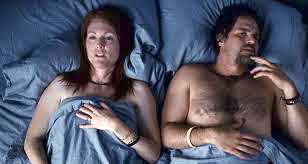
My colleague James Wolcott has jogged my memory about another of my favorite movie scenes — I told you this wasn't scientific! — so it's goodbye to the exploding-brunch from Inception, I'm afraid, and make way for Mark Ruffalo and Julianne Moore's sex scene in The Kids Are Alright, a riotous mixture of white-flanked awkwardness and lusty, ass-grabbing gumption.

10. BLUE VALENTINE
The end credits — a montage of the relationship we have just born witness to, over a scrim of fireworks, set to a song by Grizzly Bear. One of the few relationship montages to pull its weight. One imagines it was conceived as a way to leaven the bleakness of the ending, but it releases the feelings of the film so beautifully as to becomes a new ending in its own right.