Feb 29, 2012

Werner Herzog on the 2012 Academy Awards

The day after the Oscars, I interviewed Werner Herzog for The Daily Telegraph about his death row documentary, Into the Abyss. The acclaimed German filmmaker had some words of praise for the ceremony which I thought worth posting in full; they came midway through a discussion of his reputed eccentricity.

"I read it all the time — that I am some sort of maverick filmmaker. No. I am not a maverick. All the rest of Hollywood or the film industry worldwide — these are the mavericks. I am dead centre. Everyone else is eccentric. I occupy the centre, the centre of our time, the centre of our cultural climate, the centre of vision, the centre of storytelling in every single aspect, I know I am dead centre. When you look at the academy awards last night you know that this is rather eccentric. And then you look at me.”

"You may have a point.”

“Not 'may'. Do Have. In capital letters. I DO HAVE a point. It’s the pageantry of the industry, the self-celebration of the industry. It's always better if it gets really eccentric. The more eccentric it gets the better the academy awards are. Yesterday wasn’t so bad. The previous year was kind of boring. This year was really good — much, much better. If the presenter doesn't sing or do some hoofing*, some tap dancing, it's off-target somehow. Hugh Jackman singing and dancing, that was a good one. To see Cirque du Soleil flying around representing the collective fantasy of show-business — Cirque du Soleil has nothing to do with movies, and yet it was exactly right. And the tearful speeches. If anything it wasn’t tearful enough. But there is something very enjoyable about it. Its not a coincidence that the entire world watches it — I say 'entire' in quotes. I see the importance in every day culture, before the Oscars even start: who is wearing what, who is in company with whom. It's just good stuff.”

"It reminds me of an old quote of yours: 'Movies come from the country fair and circus, not from art and academicism'."

“Yes, the country fair and circus. Its an integral part of the cultural climate of the movies. Yesterday night's was quite a good show. I've seen some nagging reports in the German press that it was vulgar, the singing presenter and so on, and I thought that was the good part of it."

* To get the full sardonic effect, your best Werner Herzog impression will be required for the word "hoofing", substituting a soft 'k' for the 'g'—"hoofink"

Feb 28, 2012

MOST PROMISING FILMS of 2012


May 11

Dark Shadows
Warner Bros.

The Dictator
Paramount


May 18

Hysteria
Sony Classics


May 25

Moonrise Kingdom
Focus Features
Amour Michael Haneke
June 8
Prometheus
Fox

June 15

Rock of Ages
Warner Bros.

June 22

Brave
Disney
IFC Films


June 29

Magic Mike
No distrib.
Take This Waltz
Magnolia


July 6

Savages 
Universal Pictures


The Amazing Spider-Man, Marc  
July 20

The Dark Knight Rises
Warner Bros.


August 3

The Bourne Legacy
Universal Pictures


August 10

Great Hope Springs
Columbia


Sony Pictures


August 31

The Wettest County
Weinstein Co.


Sept 7
Anna Karenina, Joe Wright  
Sept. 14

Argo
Warner Bros.


October 19

Not Fade Away, David Chase
Gangster Squad
Warner Bros.


To Rome With Love
October 26

Rust And Bone, Jacques Audiard
November 9

Skyfall
Sony


November 21

47 Ronin, Carl Rinsch
Gravity
Warner Bros.

December 7
Hyde Park on Hudson, Roger Michell

December 19

Zero Dark Thirty
Columbia


December 21

Life of Pi 
Fox 2000


This is Forty, Judd Apatow
December 25

Django Unchained
Weinstein Co.

The Great Gatsby
Warner Bros.

No release date yet:

The Master, Paul Thomas Anderson (TBA)
On the Road, Walter Salles (TBA)
Untitled Terrence Malick Film (TBA)
Only God Forgives, Nicolas Winding Refn (TBA)
The Place Beyond the Pines, Derek Cianfrance (TBA)
Fork in the Road, Alexander Payne (TBA)
Nailed, David O. Russell (TBA)
Gotti: Three Generations, Levinson (TBA)
My Wild Life, Noyce, Kidman (Universal, TBA)
Take This Waltz — Rogen, Williams (Magnolia, TBA)

Feb 27, 2012

REVIEW: The 2012 Oscar telecast

Something about the coy, deep-suction wonder with which Meryl Streep greets the attention being paid her makes it almost impossible to actually pay her that attention without feeling beside the point somehow, like a crack-dealer watching their customer get high. Maybe in 30 years time Emma Stone will be exactly the same way but last night, her bright, vivacious presentation was easily the highlight of the show — a vivid flash of adorable flesh tones. But it's weird how the Academy's fierce determination to win the all-important youth demographic translates — by some infernal game of chinese whispers — into a droopy, rheumatic telecast hosted by an over-rouged Billy Crystal, whose face is so round and lifted this days it looks like one of those optical illusions that would register as a human face equally well hung upside-down. Count in wins for Christopher Plummer (82), Meryl Streep (her third), two cinematic tributes to the silent era, a fabulously long 'In Memoriam' section, and it was hard to shake off the odor of camphor and mothballs clinging to the whole enterprise. You felt like getting up and walking around in the ad breaks just to check your circulation, or that no-one had died. Imagine what would happen if the producers ever decided to 'go old.' Thank God for Stone, Chris Rock and Sacha Baron Cohen, the win for A Separation, for the editing Oscar given to The Girl With the Dragon Tattoo's Kirk Baxter and Angus Wall, the clips from Bridesmaids, for Dujardin's sacre-bleu freak-out, for Plummer's poise, Gwyneth's dress, Angelina's leg, and the electrical pulses that seemed to shoot between Colin Firth and any of the female nominees he happened to be addressing, but particularly Michelle Williams. I half expected her to bat her eyes and reveal the words "I-love-you" stenciled on her eyelids in Chanel mascara.

Feb 26, 2012

Oscar Predictions 2012: The Artist

Best Film: The Artist
Best Director: Michel Hazanavicius
Best Actor: Jean Dujardin
Best Actress: Viola Davis
Best Supporting Actor: Christopher Plummer
Best Supporting Actress: Octavia Spencer
Best Screenplay: Woody Allen
Best Adapted Screenplay: The Descendants
Animated Feature: Rango
Art Direction: Hugo
Cinematography: The Tree of Life
Costume Design: The Artist
Film Editing: The Artist
Foreign Language Film: A Separation
Original Score: The Artist
Original Song: Man or Muppet
Documentary Feature: Undefeated
Documentary Short: Saving Face
Animated Short Film: The Fantastic Flying Books of Mr. Morris Lessmore
Live Action Short: The Shore
Sound Editing: Hugo
Sound Mixing: Hugo
Visual Effects: Rise of the Planet of the Apes
Best Make-Up: The Iron Lady

Feb 20, 2012

QUOTE OF THE DAY: Marilynne Robinson

"Modern discourse is not really comfortable with the word "soul," and in my opinion the loss of the word has been disabling, not only to religion but to literature and political thought and to every humane pursuit. In contemporary religious circles, souls, if they are mentioned at all, tend to be spoken of as saved or lost, having answered some set of divine expectations or failed to answer them, having arrived at some crucial realization or failed to arrive at it. So the soul, the masterpiece of creation, is more or less reduced to a token signifying cosmic acceptance or rejection, having little or nothing to do with that miraculous thing, the felt experience of life, except insofar as life offers distractions or temptations." — Marilynne Robinson

Feb 19, 2012


I'd almost forgotten this note – of fond-fraternal foxy-paternal Costner-patented chivalry. But now it all comes back to me — high fibre, good Scotch, Oswald acting alone, the small of a woman's back, long, slow, deep, soft kisses, etc etc

Jan 30, 2012

INTERVIEW: Ethan Hawke on 'Before Sunrise', 'Before Sunset' and beyond

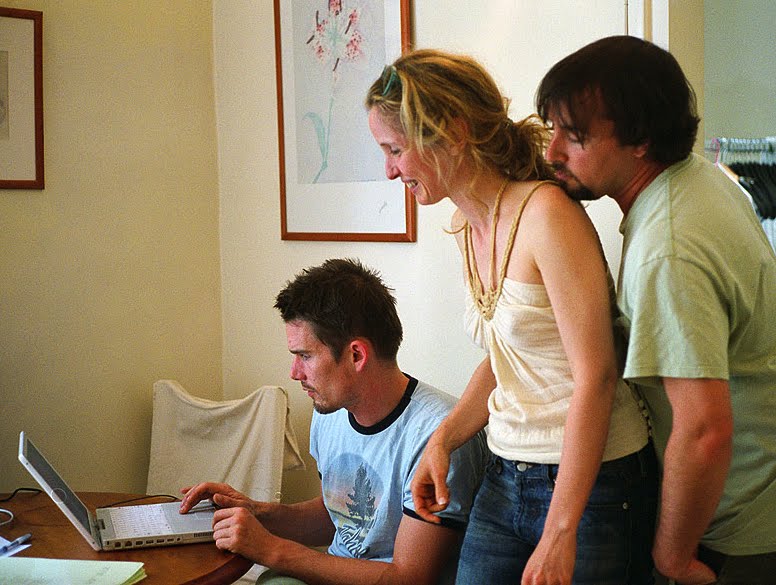
In a recent interview with Ethan Hawke for The Guardian, I talked a lot about the making of Before Sunrise, Before Sunset and the plans for a third film, which is currently in the "daydreaming" phase. We first talked first about the period in the early nineties when Hawke first met Linklater. "I was obsessively watching Five Easy Pieces, Antonioni movies, and obsessively studying Jack Nicholson's career 1970-80. I was almost two full decades late. I was a little behind. The one person I met me who was like-minded was Richard Linklater. I thought if Fassbinder were working today or Godard were working today they'd work together, they'd be in a band so to speak. Working with Rick was the smartest thing I ever did.”

He made you audition, is that right? “I was expecting an offer. I had offers for all these other things. We met one night. He came to see this play. We were each other's foil. We talked all night and had a great time. You know you have that feeling like when you might have made a friend: wow I really got along with that guy. He sent me the first script for Before Sunrise which at that time was a wildly different film — it took place in San Antonio, the guy was a rabid film fanatic who talked all the time about film — I read it and I was about to give him all my notes bout it, when I realised that it wasn’t an offer, that he wanted me to audition. So I came in with everybody else and auditioned. And then he wanted me to do it. And then I gave him all my notes about the screenplay."

The level of naturalism is exceptional, from the writing through the performances. How did you achieve the illusion of spontaneity? “What's great about Rick at his best is you just can't see him working at all, as opposed to a lot of other great directors — David Fincher, whoever — who are very popular right now. Rick has another set of abilities and one of them is: in the text of those movies, like real conversations, we often will bring up [topics of] conversation that get dropped. Rick used to joke that we would fail every screenwriting class in America. None of the rules work. But the major, major thing about those movies that Rick was onto was that, if people see you acting at all, then they're going to notice that there's not a plot. The whole game rests on that this is really happening: that’s the achievement. So we don’t need a fancy shot, we don't need the light to be great; we don't need anything except what it feels like to connect with another human being. What that feels like. That feels magical. And it happens not as much as we want. And that’s what the movie is. So as soon as Julie or I posture or pose or do a really funny line reading the air goes out of the sails a little bit. I used to joke that Rick taught me not to do what every other director wanted me to do: look intense, look broody, look this way, concentrate on the lighting... It was the first time I'd heard someone speak that way: 'it looks like a fucking Heineken ad, get it out of here. Real light is good enough...' I remember Julie saying, I think the movie needs to be funnier, I think I need more jokes, you need to write more jokes. And Rick said to her, 'I've been working with you for nine weeks. I find you absolutely and completely intriguing, beguiling and hypnotic. If we can get the real essence of you in front of a camera and they can't give a shit for two hours then I'm not interested in them as an audience.' She was like 'okay but its going to be bor-ing….”

Jessie performs for her, after a fashion. “We had to keep a little of the Tom Sawyerish, performance aspect in the movie. Boys do that. They perform for girls and girls are always kind of sitting still going: really? When are you going to stop doing that? One of the most fun [experiences] I ever had in my life was working on the scene where I was talk her into getting off the train. How does that happen? Julie was going 'I would never get off the train with some guy.' We had this long day of doing controlled improvs about what a person might say that would work and it was just: gong, gong, gong, gong. Because you can't come on too strong but if you're too much a eunuch, she's never going to go with it. You have to be self-depracating but upfront, do you know? It captures all these things. She was finally like ‘he would have to show me that he was really smart, he has to be smart and funny, that's the only way I would get off the train.’ We finally came up with this idea that I was a time-traveller*. She was like….. 'okay that I would get off the train for.' We were like: yaay. We knew we had it.”

* The filmed speech goes like this: "Think of it like this: jump ahead, ten, twenty years, okay, and you're married. Only your marriage doesn't have that same energy that it used to have, y'know. You start to blame your husband. You start to think about all those guys you've met in your life and what might have happened if you'd picked up with one of them, right? Well, I'm one of those guys. That's me y'know, so think of this as time travel, from then, to now, to find out what you're missing out on. See, what this really could be is a gigantic favor to both you and your future husband to find out that you're not missing out on anything. I'm just as big a loser as he is, totally unmotivated, totally boring, and, uh, you made the right choice, and you're really happy."

Did you have second thoughts about putting all the stuff about Jessie contemplating adultery in the second movie, given what had happened in your personal life? “I had all these thoughts. I wasn’t sure, Rick wasn’t sure. I ultimately feel that for the performance and writing to have something to offer you have to stumble cross something true. I had to make it real for myself. Selfishly as a writer, I felt like the movie needed an obstacle. They couldn’t be free to get back together. It's too easy. The funny thing about those movies is people have this idea that Julie writes Julie's part and I write mine and Rick oversees it. It’s a little bit like that and it’s a little different than that; it's much more like playing in a band. There are huge aspects of Julie's character that she writes but she also has terrific insight into Jessie. And Rick and I also provide that for Julie and Rick gets to use aspects of himself in both Celine and Jessie. So it’s not like I had some personal agenda, wanting to put autobiography into the movie. But [Jessie] kinds says my theory on it: we all have such a limited viewpoint that almost anything we write, even if its about elves and dwarves, is going to be autobiographical. You just need to use it to reach something universal.”

The second film was interestingly downbeat. Their idealism has taken a few knocks. “Its a hard line to walk. You know the Seven Up movies? One of the fascinating things about the Seven Up movies is that everyone seems to get worse. And one of the things that we wanted to do — we were daydreaming about whether or not there would be a third one and what it would be, and it's this thing of wanting to tell the truth about “nobody gets out for free.” Even when things go very well there's usually a price to pay; and when things go badly there's usually something gained. The trick is figuring out how to put that truth into the film. It's almost like there’s this third character in the movie, which is time.”

Does it feel different, third time around? "Certain people had discovered the first one, it had it's own little cult following but really it’s the smallest grossing film of all time to ever garner a sequel. We were doing it for us, as part of a life project, and because of that we felt no pressure, we weren't really worried about ruining the first movie. Now we feel those two movies are part of our lives work. Its important to us if we do a third one, that it not be because the three of us can't forget it, that we have something to say. A lot is happening in all our lives. If we're going to make a third one, I want it to be be the best, like the first two were prologues. Rick wants to treat it much more like John Updike's Rabbit books: Each one should work on its own, should be it's own thing. The dream is: someone's going to see the third movie, flip the fuck out, and someone's going to say 'Aah I didn’t like it as much as the first two'. And they're going to go 'what first two?' That’s the dream. That’s what we want to do.”

A lot of people seem to have a lot of opinions about what to put in the third film. “We're trying to tune out of the rest of the world and figure out what we want to say. That was easy 8,9 years ago, and now its hard. I'll go meet some fancy-pants director for a movie, they’ll go ‘oh this guy wants to meet you for this, that, or the other.' Okay I meet the guy and we start talking about his movie briefly and then they go: ‘I know what the third film should be.’ And he'll go on and on abbout what the third film should be. On one level its flattering and on another we have to tune it out.”

Where might you go with it? "The first two play a lot on projections — mutual shared fantasy. They're not in reality. They're ghosts wandering through: could it be real? Could it be good? They're connecting and everything but they don't have to deal with taking their wives to work or their wife's mother has TB or whatever the hell it is. The stuff that wears people down. It's not the fantasy stuff. I don’t think you can do it a third time. We all love the idea that someone is going to sweep in, but the one thing that sucks about falling in love is eventually falling out of love. One of the great blessings of an arranged marriage in the past was that nobody ever fell out of love. You just generally grew to appreciate the person more. As opposed to being disappointed that they're not who you thought they were. You know? Which is invariably what happens to most of us. I think its one of the things I want to get into the film is an acknowledgement of — and this is everybody's struggle — how do you keep your innocence alive. How do you keep your sense or romance alive? Your sense of joy alive. But match it with realism, to get rid of all the fake naivete. To see the world for what it is, reality for what it is. It’s a very difficult aspect of life. What do you do?”

That sounds like they get together at the end of the second film and the third one starts nine years into their relationship! "I've got to stop talking about this. I got an email from Rick. I've got to shut the fuck up. He thinks it's a real problem. People can't walk into the movie knowing too much — people who love it. We want to hit them with the real thing.”

Jan 29, 2012

REVIEW: The Grey (dir. Carnahan)

Is Liam Neeson's the last voice you'd want to hear before you die? An early scene in Joe Carnahan's tough, magnificent film The Grey, answers that question, although the title is ambiguous. After much consultation with my date, I have decided it refers to either a) the soft striation of hair at Liam Neeson's temples; 2) the delicate period of mid-life at which, rather than date models or a buy a porsche, Neeson has decided to reinvent himself as an action hero; or c) the pack of ravening wolves picking off his band of air-crash survivors as they claw their way through the snowy arctic tundra. Let's try c). Next to the manufactured conflicts and airy kill-ratios of your average Hollywood thriller, The Grey is a keening, white-knuckled scrap of a film — these guys have a real fight on their hands, the wind at their backs, the wolves at their heels, and death settling on their spirits like chloroform. Joe Carnahan's film is all the things action films like to think of themselves as being — tough, edgy, flinty, gritty, etc — but mostly aren't, and adds a wind-chapped sense of Fatalism you almost don't recognise so long has it been since you felt it at the cinema: when was the last time you looked at a man on screen and thought 'that man is going to die,' and felt it, not as a brief fillip of excitement, but a marrow-deep certainty. The film's surgeon-like calm is riveting. "In about five seconds I am going to start beating the shit out of you," says Liam Neeson at one point and both the directness of the writing and Neeson's low, urgent delivery cut through the bombast of the multiplex like wire through wedding cake: the large Saturday night audience I watched it with last night sat there in something close to awe, silenced. This film was serious. It seemed to contain important information about life and death and God and the fine art of attaching shotgun shells to the end of long pointy sticks to defend yourself against a line of advancing wolves. Good to know. I could have done without the flashbacks to Neeson's father — we already have a dead wife — but otherwise: a minor classic, the first exceptional film of 2012. B+

Jan 28, 2012

ON MY IPOD: January 2012

1. You Belong In My Arms — Chairlift
2. Simple Song — The Shins
3. Going Home — Charlie Haden & Hank Jones
4. Empty Threat — Kathleen Edwards
5. Mariachi — Ani diFranco
6. Dream a Little Dream — Eddie Vedder
7. Change The Sheets _ Kathleen Edwards
8. Summertime Sadness — Lana Del Ray
9. Into Giants — Patrick Watson
10. We Take Care of Our Own — Bruce Springsteen

Most Anticipated Albums of 2012

Feb 21
Fun. — Some Nights

March 6th
Andrew Bird — Break it Yourself
Magnetic Fields — Love at the Bottom of the Sea

March 20th
The Shins — Port of Morrow

March 27th
Amidou and Mariam — Folila
Miike Snow — Happy To You
Justin Townes Earle — Nothing's Going to Change the Way You Feel About Me Now

April 3rd
Orbital — Wonky

TBA
Bruce Springsteen — Wrecking Ball
Rufus Wainwright — Out of the Game
MGMT — MGMT

Keane - Untitled
Kylie Minogue — Untitled
Linkin Park —Untitled
Muse — Untitled
The Postal Service — Untitled
Outkast — Untitled
Cat Power — Untitled
Fleetwood Mac — Untitled
Janelle Monae – Untitled
The XX — Untitled
Phoenix — Untitled

Jan 25, 2012

Those Oscar nominations in full

I was thinking of posting about the Oscar nominations, but thanks to the six month long blogathon that is the awards season these days that I almost feel like the winners have already been announced. The whole thing feels thoroughly pre-masticated. Hasn't everyone known for months now that The Artist is going to win? That Viola Davis and George Clooney are the most likely best actors, with Christopher Plummer and Octavia Spencer shoe-ins for supporting? Many of the Oscar blogs, faced with the chiselled inevitability of all this, have take on a fractious tone of late, one even asking its readers their vote for Most Likely Upset would be if the field weren't so pre-determined — like school kids dreaming up Unlikely Ends for teacher. I am glad for Rooney Mara and also for The Tree of Life — I appreciate the novelty-factor of the Academy going for someone like Malick. I'm not too outraged by Albert Brooks' omission — I found his turn in Drive a little chewy — and I applaud the snubbing of Harry Potter — an appalling series of films — but am sullen at the prospect of further glory for Scorsese's fancy dud, Hugo, disheartened by Bennett Miller's snub and even more so by the score excludees: Mychael Danna (Moneyball), Trent Reznor (Dragon Tattoo) and Cliff Martinez (Drive). Which means I don't have a horse in the race, though I would, of course, use my sofa as a trampoline if Brad Pitt won.

Jan 23, 2012

INTERVIEW: Christoph Waltz

'Over by the pool, in the shade of some lime trees, James Franco is being pitched a movie about a couple in space (“the music is going to be really important” he insists.) The hotel’s entrance, meanwhile, is being converted into a red carpet run for this evening’s party, for W magazine, at which the fanboys and paparazzi will clamor, hoping for a glimpse of Charleze Theron or Tilda Swinton (“We love you Tilda!”). It’s hard when considering the change in Waltz’ fortunes not to be awed by the sheer heft of American soft power — the entertainment industry’s ability to pluck a man from East Finchley tube station, and set him down next to Charleze Theron.

“When I say I can’t believe it, trust me: that’s the truth,” says Waltz, wearing a long grey-streaked beard, that he has grown out for a role and fondles often. “But look. I started when I was 19, now I’m 55. I didn’t come up that fast. This is very exciting and wonderful that it happens at all. If it happens to a 25 year-old or a 20-year-old and they say they can’t believe it, its kind of obvious because almost anything else would be beyond his belief as well. I have a different perspective. After 30 years if you haven’t understood certain realities in this business, you’d have a different problem.”

The Polanski film is Carnage, an adaptation of Yasmina Reza’s play, Gods of Carnage, about two Brooklyn couples — played by Waltz, Kate Winslett, John C Reilly and Jodie Foster — at war after their respective sons get into an altercation in the park. It’s basically a four-way cat fight, doused liberally with Scotch, with Waltz playing gleeful ringmaster, delighting in the thinly-veiled savagery beneath everyone’s civilized veneer. “Its my comedy,” he says. “I consider this character the only one I’ve played with his two bits together. Kate’s too a little bit. She’s more erratic but I think he’s the only one who doesn’t sway. He sticks to his reality.”

Waltz speaks in softly-accented, sibilant-heavy English, with slightly lunatic precision, his long chin lending him an air somewhere between impish and lubricious. He could be a professor of drama at an obscure redbrick university whose students speculate as to whether he pays women to walk across his back in stilletos every night. There is a distinct hint of kinkiness to Waltz who, in a Pythonesque comedy segment taped for The Jimmy Kimmel Show, filmed shortly after his Oscar win, was shown lip-syncing a lyric-less folk song (“tro-lo-lo-lo-lo”), while humping various household objects — a lamp, a telephone, a ukulele — all intercut with a fake BBC interview in which he answered sober questions about his acting career (“in a way the strive, the quest, becomes the goal…”).

A surreal send-up of actorish affectation, a neat joke deflecting the horrors in his own back catalogue, it was also completely bonkers. Imagine Ralph Fiennes doing something similar after Schindler’s List and you realize how fully Waltz takes his place at the head of an illustrious table of Teutonic eccentrics which goes back to Klaus Kinski and fellow Austrian, Egon Schiele. The news that he once played Friedrich Nietzche in a German-French co-production should come as no surprise; there’s no mistaking the megalomaniac gleam to Waltz’s eye or the imperious jut of that chin. Those 30 years spent in obscurity seem to have lent his performances — as an SS officer in Inglorious Basterds, the villain of The Green Hornet, a sadistic circus master in Water for Elephants — a jack-in-the-box floridity.

It’s not hard to see why Tarantino liked him so much. Waltz’s obscurity was key: he kept Waltz from rehearsing too much with the other actors, and when he did told him to tone down the performance. “He didn’t want the others to get too comfortable with me. He wanted this insecurity on their part.” Only when the cameras rolled did he let loose: digging into the part of polyglot SS sadist Hans Lauda as if kissing each word in the script, his performance tip-toeing up to the edge of over-acting, dancing on the line, and then, with a dainty pirhouette, swan-diving into the end-zone — postmodern caricature meets Brechtian commedia dell'arte. “I revel in his writing, I really do,” says Waltz. “You can really play. You don’t just have to say it, you can do all thing with it, turn it upside down. And it will still hold. It will not fall apart. It does not require one singular delivery on which it depends. You can’t harm it. He’s a genius. I am completely, unconditionally devoted.”

The two men are now good friends, and are often to be found around the director’s Mulholland Drive mansion watching rare 35mm prints of old films, salvaged from closed-down theatres and distribution companies. Tarantino provides the post-match commentary — “maybe the story is contrived but he’ll go ‘yes but look at this actor….’” says Waltz. Other times, “we will meet for dinner without a single sentence uttered about movies.” In LA, and around Quentin Tarantino’s house in particular, that is what is known as a ‘comfortable silence.’'
— from my interview with Christoph Waltz in The Sunday Times

Jan 22, 2012

The world in which we live in

"In a N.Y. Times interview with former Village Voice film critic Jim Hoberman, co-authors A.O. Scott and Manohla Dargis include a quote that struck a chord with me. Hoberman mentions Francois Truffaut's Shoot The Piano Player as "the first movie I really wanted to live." He meant that Truffaut's film was the first "sacred text...a kind of synthesis" that he really want to live in... I used to dream about submerging myself in the 1959 world of North By Northwest, providing I was well dressed and had lots of cash in my pockets. In the early '80s I wanted to live inside Michael Mann's Thief, and inside Heat and The Insider in the '90s. I do know that one realm I would never, ever want to live in would be the world of Jason Statham movies. That would be hell." – Hollywood Elsewhere
For me it breaks down more specifically: the russian hotel in Fincher's Benjamin Button and the writing cabin in Dragon Tattoo, Deckard's apartment in Blade Runner, the lantern-filled atrium in Raise the Red Lantern, the French's Veronique's bedroom-in-a-rain-storm in The Double Life of Veronique, the prairie house in Days of Heaven, the Parisian shopping bits of The Conformist, yes of course to the overnight train in North by Northwest, Jimmy Stewart's apartment in Rear Window, and the top floor of Katherine Hepburn's mansion in Holiday.

And the Oscar nominations (should) go to....

Best Film: Moneyball, Rise of the Planet of The Apes, Win Win, The Descendants, Beginners, The Girl With the Dragon Tattoo
Best Director: Alexander Payne (The Descendants), Bennett Miller (Moneyball), Nicolas Winding Refn (Drive), David Fincher (The Girl With The Dragon Tattoo), Mike Mills (Beginners)

Best Actor: Brad Pitt (Moneyball), Paul Giametti (Win Win), Viggo Mortenson (A Dangerous Method), George Clooney (The Descendants), Jean Dujardin (The Artist)

Best Actress: Meryl Streep (The Iron Lady), Elizabeth Olsen (Martha Macy May Marlene), Olivia Coleman (Tyrannosaur), Michelle Williams (My Week With Marilyn), Kristen Wiig (Bridesmaids)

Best Supporting Actor: Christopher Plummer (Beginners), Colin Firth (Tinker Tailor Soldier Spy), Corey Stohl (Midnight in Paris), Ralph Fiennes (Harry Potter And the Deathly Hallows), John Hawkes (Martha Macy May Marlene)

Best Supporting Actress: Octavia Spencer (The Help), Melissa McCarthy (Bridesmaids), Judy Greer (The Descendants), Melanie Laurent (Beginners), Amy Ryan (Win Win)

Best Original Screenplay: A Separation, Win Win, Midnight in Paris, Bridesmaids, Beginners

Best Adapted Screenplay: Moneyball, The Descendants, The Girl With the Dragon Tattoo, Drive, A Dangerous Method

Best Score: Mychael Danna (Moneyball), Trent Reznor & Atticus Ross (The Girl With The Dragon Tattoo), Ludovic Bource (The Artist), Harry Escott (Shame), Cliff Martinez (Drive)

Best Art Direction: Tinker Tailor Soldier Spy, Hugo, Water For Elephants, The Girl With the Dragon Tattoo, Drive

Best Costumes: A Dangerous Method, Hugo, The Descendants, The Girl With The Dragon Tattoo, The Artist

Best Editing: The Girl With The Dragon Tattoo, Drive, Moneyball, The Artist, The Descendants

Best Cinematography: Emmanuel Lubezki (The Tree Of Life), Peter Suchitzsky (A Dangerous Method), Jeff Cronenweth (The Girl With The Dragon Tattoo), Wally Pfister (Moneyball), Van Hoytema (Tinker Tailor Soldier Spy)

Best Visual Effects: Rise of the Planet of the Apes, Transformers 3, Hugo, Super 8, The Adventures Of Tin Tin

The Girl With The Dragon Tattoo (8), Moneyball (7), The Descendants (7), Drive (5), Win Win (4), Beginners (4), The Artist (4), A Dangerous Method (4), Tinker Tailor Soldier Spy (3), Hugo (3), Martha Macy May Marlene (2), Rise of the Planet of the Apes (2), Midnight in Paris (2), Bridesmaids (2)

Jan 14, 2012

Why the Golden Globes beat the Oscars

My piece about the Golden Globes for Slate:—
'Imagine a world in which most of the cosmic injustices perpetuated by the Academy of Motion Picture Arts and Sciences did not take place. I know it’s hard, with the wound of of The King’s Speech’s victory over The Social Network so fresh but imagine a world in which Fincher’s film had been victorious; a world where Brokeback Mountain did not lose out to Crash; Where E.T. beat Ghandi, where Chinatown won Best Film and Coppola Best director for Apocalypse Now. Oh, and while we’re at it, an armful of trophies for Some Like Hot and a little something for Alfred Hitchcock.

Before someone objects on the grounds of cruelty, let me reassure you: this fragrant arcadia exists. It is the world as reflected back to us in those big shiny iridescent orbs, the Golden Globes. I’ve never understood the vilification rained down on the Globes every year—"the entertainment industry's dirty little secret," "just a group of whores from other countries," “a non-event raised to epic proportions by Dick Clark getting them a network television slot,” “a scam that would make Bernie Madoff blush." Agreed, the organization comprises a deeply suspect cabal of just 83 foreign ”journalists,” writing for such illustrious journals as Malaysia's Galaxie magazine and Australia's FilmInk, who appear to dish out nominations on the basis of which star can be persuaded to get drunk with them on awards night, in return for a boost for their Oscar chances. So the Globes are venal, easily corrupted and wish for nothing more than to get drunk with Sharon Stone: so, too, do half my friends.

The scandal is not that the Golden Globes are handed out by a bunch of star-struck foreign hacks with lucrative sidelines in the world of hairdressing and personal fitness; the greater scandal is that a bunch of star-struck, scandal-ridden foreign hacks make aesthetic choices that are consistently the equal of, if not better than, those of the 6,000 members of the Academy of Motion Picture Arts and Sciences. They gave best director to Francis Ford Coppola for Apocalypse Now rather than Robert Benton for Kramer vs Kramer. They went for Tom Hanks when he was still funny, in Big, long before everyone came down with a case of the Gumps. The same for Murray, Murphy, Roberts and Carrey. And they were the only major awards group to spot Marilyn Monroe’s gifts as a comedienne, giving her Best Actress for her performance in Some Like It Hot, a film which won an armful of Globes but limped away from Academy awards with just a single lousy Oscar: best costume.

Actually what they gave Monroe was “Best Actress in a Motion Picture (Comedy or Musical),” not the sweetest of endearments, but one pointing to the single most important reason why the Globes taste profile feels so supple when compared to that of the fusty old Academy: they recognize comedy. The Oscars, on the other hand, are the place the entertainment industry goes to be reassured that it is not just in the business of entertainment. For 364 days of the year the good citizens of Hollywood graze elbows and knees in their efforts to put bums on cinema seats. Then, come January, they clutch their foreheads, stare into the middle distance, and attempt to divine whether the anti-racism tract playing on their flat screen TVs is, in fact, art—a vague and amorphous term, that strikes terror in the heart of the average studio executive. The Oscars are first and foremost designed to alleviate that terror. The question the awards are concerned with is not “what film marks the greatest artistic effort?” but “which film can best be defend against the charge of philistinism?” Hence their nose for films garlanded with extra-curricular socio-political-humanitarian importance—Ghandi, Platoon, Dances With Wolves, A Beautiful Mind, Crash — designed to Hollywood feel good about itself for one night, but which everybody else forgets almost instantaneously.

Spend some time with the list of Golden Globes winners for Best Musical or Comedy—a list which includes The Apartment, The Graduate, M.A.S.H., Tootsie, Prizzi’s Honor, Hannah And Her Sisters, Working Girl, The Player, Toy Story 2, Almost Famous, Sideways, Vicky Christina Barcelona, Lost in Translation—and it reads suspiciously like the list of films we will actually be watching in 50 years time, once Crash is but a distant blip in our rear view mirrors.

Of course, the Globes do not completely sidestep the marsh of the middlebrow. They preferred Love Story to Patton
, Gigi to Vertigo and The Greatest Show on Earth to Singing in the Rain. Notoriously, they named Pia Zadora Newcomer of the Year after her husband showered the HFPA with lavish parties. They nominated Sharon Stone in The Muse after her representative plied them with 82 gold watches. And in 2009 they nominated The Tourist for Best Motion Picture, Actor, and Actress seemingly out of nothing more than an intense desire to clap eyes on the sinuous forms of Johnny Depp and Angelina Jolie hopping tables.

“The Golden Globes are not taken seriously as artistic milestones and have a history of voting idiosyncrasies,” noted the New York Times recently. “The group tends to nominate based on star wattage instead of performance in an effort to orchestrate a red-carpet spectacle." As opposed to the rest of us, who like to take in Bresson films with the bed-sheets tucked into our armpits, sucking on a lemon. I would put this the other way around: It is in the warmth of the welcome they give movie stars that the Globes give the slip to the insincere self-admonishments of the Academy and score their deepest consonance with the viewing habits of actual live human beings. They do not worship at the altar of Star Uglification. They do not give awards to anyone found within a 20-mile radius of a fictional concentration camp. While the Academy was going bonkers for Roberto Benigni, the Globes handed best actor to Jim Carrey for The Truman Show. Nor are they in the lifetime achievement business. In 1999, while the Academy was waxing nostalgic with Michael Caine in The Cider House Rules, the Globes were too busy being electrified by Tom Cruise in Magnolia.

In other words: the Globes recognize stars quicker and earlier, while they still have some life in them. In 1995, while the Academy was coming over all mopey with Susan Sarandon for her part in the turgid death-row drama Dead Man Walking, the globes went to Sharon Stone for her part in Casino and Nicole Kidman for her frisky, star-making turn in To Die For—long before she had donned a fake nose to win the Oscar. The list of performances rewarded at the Globes but not the Oscars goes on—Melanie Griffith in Working Girl, Julia Roberts in Pretty Woman, John Travolta in Get Shorty, Cruise in Jerry Maguire, George Clooney in Oh Brother Where Art Thou, Gene Hackman in The Royal Tenenbaums, Bill Murray in Lost in Translation, Sasha Baron Cohen in Borat, Meryl Streep in The Devil Wears Prada...

It reads like a list from an alternate universe, where entertainers are rewarded, for being, you know, entertaining. If the Academy is serious about its search for younger viewers, I would suggest they take a leaf out of the Globes book, and 1) Supply more alcohol. Watching George Clooney get up and be witty on a couple of glasses of Scotch is almost exactly what Hollywood should be about. 2) Loosen the fatwa against comedy and comic performances. And 3) Don’t punish stars for ‘being themselves.’ It’s a rarer gift than mere acting. Bill Murray has won a Golden Globe. He has never won an Oscar. I rest my case.'

THE GOLDEN GLOBES’ BEST CALLS

— In the Golden Globes first ceremony in 1951, Billy Wilder wins Best Director for Sunset Boulevard. The Oscar that year goes to George Stevens for A Place In The Sun.

— East of Eden (1955) wins Best Motion Picture (Drama) and a posthumous acting award for James Dean. At the Oscars it is bested by Marty.

— Alfred Hitchcock wins the Golden Globe for Best TV Show for Alfred Hitchcock Presents (1958) — not much but it beats his zero wins at the Academy Awards.

— Some Like It Hot (1959) wins the Golden Globes for Best Motion Picture (Musical or Comedy) Best Actor (Jack Lemmon) and Best Actress in a Musical or Comedy. At the Oscars it wins only Best Costume.

—Peter O’Toole wins the Best Actor (Drama) for his role in Beckett (1964) and subsequently wins three more golden Globes. Despite being nominated for an Academy Awards 8 times he wins none, necessitating an honorary Oscar in 2003.

— Al Pacino wins Best Actor for his performance in Serpico (1973). The Best Actor Oscar that year goes to Jack Lemmon for Save the Tiger.

— Chinatown (1974) wins Golden Globes for Best Actor, Best Motion Picture (Drama), Best Director and Best Screenplay. At the Oscars it wins only Screenplay. Best Actor that year goes to Art Carney for Harry and Tonto.

— Apolcaypse Now (1979) wins Best and Best Supporting actor for Robert Duvall. The directing Oscar that year goes to Robert Benton for Kramer vs Kramer. Duvall wins the Oscar four years later for Tender Mercies.

— E.T. Wins Best Motion Picture (drama). The Best Film Oscar, like much else that year, goes to Ghandi.

— John Huston wins Best Director for Prizzi’s Honor (1985). At the Oscars, Best Director goes to Sydney Pollack for Out of Africa.

— Tom Hanks wins Best Actor in a Comedy or Musical for his performances in Big (1988). At the Oscars, Dustin Hoffman wins Best Actor for Rain Man.

— Jim Carrey wins Best Actor in a Comedy or Musical for The Truman Show (1998). That year, the best actor Oscar goes to Roberto Benigni for Life Is Beautiful

— Tom Cruise wins Best Supporting Actor for his role in Magnolia (1999). The Best Supporting Actor Oscar goes to Michael Caine for The Cider House Rules.

— Robert Altman wins Best Director for Gosford Park (2001). That year, the directing Oscar goes to Ron Howard for A Beautiful Mind.

— Brokeback Mountain (2005) wins Best Director for Ang Lee and Best Motion Picture (Drama). At the Oscars, Best Film goes to Crash.

— The Social Network wins Best Motion Picture (drama), best director and Best Adapted screenplay. At the Oscars it loses Best Film and Director to The King’s Speech.

Jan 1, 2012

REVIEW: War Horse (dir. Spielberg)

So I've seen War Horse now. Not the greatest of Spielberg's films — the central performance by Jeremy Irvine is the weak link here, with his simpering soprano voice and suspiciously smooth complexion; and who knew that 1916 Devon boasted, among its floral and fauna, such a sizeable population of 1,000-watt arc lights — but I was newly wowed by Spielberg's unembarrassable command of the big emotions: barely 20 minutes in, family honor had been restored by aploughing scene, and I was a mess. Compared to the anaemic grip on our emotions exercise by most of the year's films, War Horse exudes a muscular confidence, it's emotional power all the more to be admired given its episodic structure: every 20 minutes a new set of characters are introduced and yet you can feel the gravitational pull of each almost instantaneously. Outstanding were Benedict Cumberpatch as a superbly stiff-spined officer ("be brave!") who could have commanded me to stand to attention on my seat and I would have obeyed; also a beautifully grizzled Niels Arestrop, silver-haired and squashed of feature, with possibly the most beautiful voice in movies right now — all sand and molasses. Richard Curtis's script could have done with a prune — I remain unconvinced that "as if" was common currency in 1916 and "git" should never be used of a man heading into no man's land unless you are scripting an episode of Blackadder — but the film's so-called homage to the technicolor vistas and sweeping emotions of the 1940s and 1950s feels full-throated, unironic, immersive. There's not a wink of self-consciousness to the whole thing: it's as wholesome and stirring as a hymn. B+