Jan 21, 2010

Is Obama keeping too many of his promises?

As someone who campaigned for Obama last year in the swing state of Ohio, source of all that is bright and beauteous, (for example: my wife), I sometimes get asked what I think of the job he's doing. It's a difficult question to answer of course. How he is really doing will obviously take a little longer to determine. Certain things, however, are evident. America has returned to the rule of law — an immensely reassuring development. It sets a good example to young children if the people in high office are not internationally-wanted criminals. Ex-Presidents and vice-presidents of the United States should be able to travel without fear of being arrested! Similarly, Obama has not invaded any country under a mistaken or illusory set of beliefs. This is also important: If millions are to die a bloody, agonising death it shouldn't be solely on account of the other guy looking at you funny. US military personnel have also stopped torturing their prisoners — good. Holding power drills to the heads of foreigners is very hard to explain as a policy, particularly to their respective embassies at Christmas time. Ditto, threatening to crush the testicles of their children — a definite no no! Foreigners can be so funny about things like that, bless them! The economy was also stopped from imploding and a second great depression narrowly avoided. Good. I like the movies made during the Great Depression — Sullivan's Travels is excellent — but the diet wasn't everything it could have been, from what I can gather. Last but not least, something is finally being to the healthcare system so you don't risk bankruptcy by catching a cold. Very welcome. Buying a plane ticket to England every time I got sick wasn't going to be workable in the long term. The flak Obama has caught for doing all this is a little puzzling. He may be the first president in US history to get into trouble for keep too many of his campaign promises. According to politifact.com he's "kept" 92 of the little bastards, "compromised" on 33, with 275 still "in the works." Okay so he's also "stalled" on 87 but in real terms he has only "broken" a measly 9. It simply not good enough. The American people expect far more inaction from their presidents. Maybe Bush spoiled them in that regard, but the current will of the people, as expressed in the recent Massachussetts senate race and interpreted by those experts at Fox news, couldn't be clearer: "Stop doing all the things you said you were going to do!" Just reading The New Yorker's account of Obama's first year is enough to make you feel pooped:
President Obama forestalled a second Great Depression, turned the attention of the executive branch toward real problems, restored lawfulness and decency to foreign and domestic policy, damped down the flames of global anti-Americanism, and staffed the agencies and departments with competent, public-spirited officials who believe in the duty of government to advance the general welfare... Under his leadership, climate change, health care, and financial regulatory reform were given the central role in American policy that they deserve.

Jan 20, 2010

Song of the day: Cape Cod Kwassa Kwassa

This made me smile: a cover of Vampire Weekend's 'Cape Cod Kwassa Kwassa' by Peter Gabriel and Hot Chip. "This fees so natural, Peter Gabriel too," sings Gabriel, adding, "It feels so unnatural, to sing your own name." The effect is oddly endearing : more Being John Malkovich than pomo-pompous.

What asymmetric warfare entails, apparently

"On June 9th, 2006, [Aamer] was beaten for two and a half hours straight. Seven naval military police participated in his beating. Mr. Aamer stated he had refused to provide a retina scan and fingerprints. He reported to me that he was strapped to a chair, fully restrained at the head, arms and legs. The MPs inflicted so much pain, Mr. Aamer said he thought he was going to die. The MPs pressed on pressure points all over his body: his temples, just under his jawline, in the hollow beneath his ears. They choked him. They bent his nose repeatedly so hard to the side he thought it would break. They pinched his thighs and feet constantly. They gouged his eyes. They held his eyes open and shined a mag-lite in them for minutes on end, generating intense heat. They bent his fingers until he screamed. When he screamed, they cut off his airway, then put a mask on him so he could not cry out."
— Zachary Katznelson, lawyer of one of the three men tortured to death at Gitmo in 2006. Their deaths were presented as suicides, and thus deemed acts "assymetrical warfare" by the US military. The three men, one of whom was just 17 when captured, were never charged with any crime and had in fact been cleared for release. The story has gone unreported in the American media, distracted by the fact that a Republican has finally managed to win elective office, but the Guardian, the Telegraph, the Independent and the Irish Times have not been so obliging.

Jan 19, 2010

Best film poster of the decade? You decide


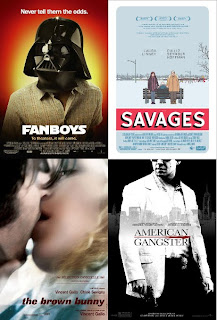
I think Funny Games is the most original, Before Night Falls is the most memorable, The Life Aquatic the most stylish, and Catch Me If You Can the best from a big studio. Judged as aa species of advertising, American Beauty is the most effective: it gets your attention, feeds your curiosity and tells you sex is in the offing, but subtly. The Almodovar brightens up my day, The Departed is pure class and Fanboys is genius. But which is the best? Glaring omissions also welcome.

Quote of the day

“No fucking discipline” — Barack Obama's verdict on the McCain campaign, as reported in John Heilemann and Mark Halperin's book Game Change

Jan 18, 2010

That Scorsese montage in full (at 1.43 mins)

There's a scene in John Carpenter's generally excellent 1982 remake of The Thing in which the survivors at the arctic base determine on a plan to work out who amongst them, if anyone, has been taken over by the aforementioned Thing. After pooling samples of their blood in a series of petri dishes Kurt Russell goes around the room, person by person, testing their blood with a small section of electrified wire: if the blood reacts in any way, it's the Thing. He lines up the petri dishes, pauses to cast a look around the room, then jabs the wire into the first dish: it makes a small, wet smoldering sound, like a cigarette being stubbed out in wine. Everyone sighs in relief. The next person: another damp fizzle. The third person: same again. About the fourth or fifth person, you're beginning to relax a little, which is of course when Russell lowers the wire into the blood and — all hell breaks loose. The blood leaps from the petri dish.... An almighty screech fills the room.... The Thing reveals itself. I thought of Carpenter's sequence last night, while watching the Golden Globes montage of Martin's Scorsese's work, wondering if Scorsese's blood would do something similar under test conditions. Call it cinema, call it rock n roll, call it some mixture of the two, but something is pumping through that guy's veins that isn't pumping through the next guy's. As Nick Hornby wrote, in another context, of a live performance by the J Geils band he once heard as a teenager:—
To me back then, this, not Tamla Motown, was the Sound of Young America — loud, baffling, exotic, cool, wild. It comes from the same place as Kramer in Seinfeld, and Surfin' Bird, and Papa-Oom-Mow-Wow, and James Brown being wrapped in a cape and being led off stage before bounding back to the microphone, and Muhammad Ali's boasts, and the insane celebrations when a contestant won a lawn mower on The Price is Right.
To which I would add the sight of Rupert Pupkin applauding himself in The King of Comedy, and the guys arguing over a what "mook" means in Mean Streets, and the kid's slapstick routines with his mother in Alice Doesn't Live Here Anymore, and Jodie Foster's pink-and-green sunglasses in Taxi Driver and Joe Pesci asking if he is funny twenty times over in Goodfellas*. Scorsese is a great reminder that no matter how sophisticated or literary a director can be, they are also, at root, sensational creatures — in his case quite literally so. After watching his movies you want to do anything — get drunk, dance, fire a gun, something, anything other than merely sit there, watching the TV, as I was last night. Maybe if I put my foot up against the screen and rocked it, like Travis Bickle, before pushing the whole thing over, I might get something like the right affect. I did no such thing, of course. That TV wasn't cheap. Instead I got up and paced around, explaining to my wife in a highly agitated manner why I was ready to concede that Scorsese might be — just might be — a genius, if that word is to be worth something after all. And then I sat down again and watched the rest of the telecast.

* Last year Intelligent Life asked me to provide an overview of Scorsese's films; this is what I said, more or less.

1. Mean Streets

Scorsese made several pictures about the mob, each more technically assured than the least, each with slightly less reason for existing. Shot for $300,000 in the summer of 1972, Mean Streets knows why it exists. It’s one of the great debuts in American cinema: boisterous, high-spirited, with a bouyancy that whisks it close to comedy, it's a cock-of-the-walk movie halfway between early Truffaut and a Ronettes song. Its got a spring in its step. Harvey Keitel’s fondness for his wastrel cousin, played by De Niro, is evident in every frame and De Niro has never been better: a long streak of nothing telling tall tales in a porkpie hat, he acts as if movemaking were a species of practical joke. He punks the movie. The scene in which they argue over the term ‘mook’ (“He called me a mook. What’s a mook?” “I dunno.” “You can’t call me a mook” etc) contains the seeds not just of Scorsese’s later career, but Tarantino’s, too.

2. Alice Doesn’t Live Here Anymore

In an alternative universe, this film would have been the harbinger of the great and varied career to come. Ellen Burstyn got Scorsese the gig; she felt that the script — about a mother and son traveling from Phoenix to Monteray in search of a better life —needed some salt and pepper. Again, it’s the rhythm of the movie that transfixes, with the backchat between Burstyn and her boy flying back and forth like Marx Brothers routines: nobody has caught the fond, fractious, flirtatious relationship between mothers and sons better. And this is Scorsese, remember. The men, meanwhile, prowl the periphery, huffing and puffing, occasionally blowing the door down, but it is Burstyn who holds firm for her Oscar. Here is one of the great facts about Scorsese, unnoticed even by him: he’s a terrific director of women.

3. Taxi Driver

For a while there, it all seemed to look so good. The beautiful Betsy (Cybill Shephard) is working as volunteer for a presidential nominee, alongside the cherubic Albert Brooks no less, when one day she is noticed by a taxi driver, a stringy looking fellow with a cheeky grin and curiously persistant manner. He is accompanied by a Bernard Hermann score that seems to swell with the size of his feelings for her. She says yes to a date. A saxophone soars. And.... they sit down to watch a porn movie featuring spermatazoa pulsing across the screen. I don't think craziness has ever been better presented on screen. Taxi Driver makes the hairs on the back of your neck stand up. Surveying the carnage of the final scene, you may at first find yourself shocked but repeat viewings reveal a pall of inevitability: but of course this is where this was going. The plot has the lopsidedness of genuine delusion. It feels flush with Travis’s fever. De Niro is perfectly matte, like Oswald. Initially overawed by her co-star, Jodie Foster was taken out to breakfast by him, every day, until he bored her awe away.

4. Raging Bull

You know it’s the masterpiece because its in black-and-white and has Mascagni on the soundtrack, but its okay: you’re allowed not to like it. Raging Bull is not a very likeable film. “Jake fought like he didn't deserve to live” said Scorsese, recovering from hospitalization himself. It’s hard not to take the film as the smuggled psychobiography of an artist-addict hitting rock bottom. From the very first scene, in which De Niro asks Joe Pesci, his brother, to hit him square in the face, this movie is going one way — down. We hear tell of La Motta’s ascent but see never feel it. De Niro comes out of the gate with the relentlessness of a rapist — a “thug Othello” in Pauline Kael’s phrase — while the supporting cast win points for their defensive skills. Joe Pesci lets lose with some brilliant filth, while Cathy Moriarty, then 19, moves with the sublunary grace of a woman who knows how not to get hit.

5. After Hours

In 2000, Scorsese wrote a fan letter to Wes Anderson, praising the then 30-year old director for the delicacy, tenderness, and grace of his first two films, Bottle Rocket and Rushmore. Some found the act of patronage unlikely —a single snort from Jake La Motta’s nostrils, after all, would destroy Anderson over-fastidious world in an instant — but behind the glower of Scorsese’s reputation, a lighter, more puckish talent has always struggled to emerge; his sense of rhythm has always been an inch away from great comic timing. The King of Comedy was mere deconstruction, but After Hours is the real deal, a screwball misadventure about a yuppie (Griffin Dunne) on a fool’s errand through lower Manhattan after dark. It was Scorsese’s first film without De Niro in over a decade and the giddiness is palpable; Roseanna Arquette delivers a marvously nutty soliloquy about sex and The Wizard of Oz — as good a summary of the film’s concerns as can be imagined. Like Illeana Douglas and Vera Farmiga after her, Arquette has that bloom to her — brainy, vulnerable, a little loose — that always draws Scorsese in.

6. Goodfellas

If Raging Bull was the purest expression of will — that sheer, bloody-minded, tyres-in-mud obstinacy that typifies an addict hitting bottom — the films that immediately followed — After Hours, The Color of Money, The Last Temptation of Christ — feel a little like creative rehab: a guy going easy on himself, trying to relax, recharge his batteries, before stepping back into the ring again with Goodfellas. It may be his best film, certainly the best treatment of his most persistent theme: ubi sunt, passing glory. Tellingly, De Niro was happy to sit on the sidelines, leaving centre stage to Ray Liotta, laughing like a hyena at the thuggery going on around him, this wife, a punchy Lorraine Bracco, and Joe Pesci whose ‘Do I Amuse you?” speech is a masterpiece of spiraling dread. This is full-tilt fimmaking, firing on all cylinders. The movie traces a perfect arc, before burning up with its own heat. Its like watching a metor self-immolate.

7. Kundun

The camera cranes its neck to catch a single rocket hurtling through the air before ploughing into the wall of a small town in the Himalayan mountains, sending smoke and debris in every direction. It may be the most startling single act of violence in a Scorsese picture if only because of the picture in question: Scorsese’s film about the Dalai Lama. Many joked about his involvement, which came his way thanks to the screenwriter Melissa Mathisson, who also wrote the largely silent E.T. but who better to register peace than the director who has spent most of his career disturbing it? The movie has a hypnotic rhythm. It doesn’t tell a story so much as leaf through a series of episodes, many of the scenes lasting only 30 seconds or so, like someone riffling through the pages of a storybook. It sounds like a recipe for distraction, but it works: the movie casts a beautifully hushed spell. Watch it in the right mood and you will be gently wowed.

8. The Aviator

Think of one of Scorsese’s trademark shots: a fast tracking shot across a room towards an actor as he barks orders, or fires a gun, and you realize just how badly suited the director is to filming epics. Scorsese is an agarophobic, a street fighter. He likes things close and tight. Give him a long shot and he can’t wait to get wriggle out of it, which makes the series of epics that he made for Harvey Weinstein in the nineties all the more misbegotten. The Aviator stood a better chance than Gangs of New York: an epic about an agarophobic. The early scenes in Hollywood are dazzling, but as Di Caprio’s Howard Hughes descends into bug-eyed paranoia, he resolutely fails to take the audience with him. The fault was not just di Caprio’s — Scorsese himself seemed unable to summon the old Djins. The spirit is willing but the flesh tones are from memory.

9. The Departed

There is a pleasing irony to be had from the fact that Scorsese's Oscar finally came ot him, not courtesy of any of the tony epics with which he spent much of the 90s trying to wow the academdy, but for a real jackal of a picture about the mob, as low and snarling as anything he has made. That it is also not even his best mob picture is a second, unwanted irony that everybody did their best to ignore. It was the Irish mob this time, given gleeful voice by screenwriter William Monahan, with Leonardo di Caprio, Jack Nicholson and Matt Damon caught up in a game of cat-and-mouse so cross-hatched with betrayal, that only the rat in the closing credits appears to know what’s going on. It’s a strange centreless movie, beset by tonal wobbles, and climaxing in a bout of blood-letting so Jacobean in its intensity as to teeter into black comedy.

Song of the day: 'Up' by Michael Giacchino


The 2010 Golden Globe Awards: almost as much fun as an earthquake

The best moment of the evening came early: Monique's powerhouse of an acceptance speech, almost as draining as watching her movie. It was pretty much downhill from there. Winning for Grey Gardens, Drew Barrymore self-deprecated so much she seemed on the point of evaporating altogether and turning into a fine mist. Ricky Gervais veered, queasily, between the mischevious and the mean-spirited. Even Tom Hanks told a dud of a joke about Alec Baldwin that had him clawing back the audience's favour. When Hanks flubs it, you know an evening is in trouble. Baldwin, meanwhile, had the smartest idea and stayed away to help the people of Haiti, the cause du jour. Clooney looked positively envious: even humanitarian catastrophe seemed preferable to an evening spent listening to James Cameron deliver updates on the state of his bladder. Twice he mentioned the illustrious organ: once, upon winning 'Best Director', to tell us it was full, and again, upon winning 'Best Drama' to inform us that he had successfully voided it. Was he expecting applause? On the plus side, Michael Giacchino won best score for his beautiful waltzes in Up — a victory I thought unlikely after the battering everyone's eardrums received from James Horner's caterwauling Avatar score. Giacchino's win provided the evening's biggest aesthetic thrill, easily. Second best was the Scorsese montage. I don't know whether it's his editing rhythms, or hustling camera movements, but man, that guy's films look good spliced together like that. I felt so razzed watching it, I had to get up and pace around my living room quaffing orange juice until I calmed down again. Christoph Waltz gave an elegant, literary speech, nicely spun around the theme of globes and globalism — nice! — with a great description of Inglorious Basterds as Tarantino's "Big Bang" of a movie; I saw Tarantino nod at that, the wordsmith in him approving. Well said, sir, well said! I can't really remember what Meryl Streep said in her speech: she must be stuck for material, having given so many of these things. Jeff Bridges was lovely. He doesn't just reel off names: he singles each person out, makes eye contact, gives props, bigs them up in front of the whole audience. "Get a shot of her," he said, directing the cameraman towards his wife. Every woman watching swooned at that moment. Sandra Bullock — can't remember. Most fascinating were the two Cameron speeches: the moment he opened his mouth, all the breathable atmosphere seemed to be sucked from the room as surely as it was from the fictional moon of Pandora, whose noxious atmosphere will put you down in one minute and stop your heart in four. People really hate the guy, huh? Cameron knew it, too, and seemed intent on correcting any impression we may have that he is a fabulous self-important asshole, primarily by the canny trick of inviting everyone else in the room to be fabulous self-important assholes along with him. “We have the best job in the world, we really do," he said. " I just want you to give it up for yourself. What we do is, we make entertainment for a global audience, and that’s what the Golden Globes mean." Announcing another win for the blue people, Julia Roberts looked like she was having a hard time keeping down her dinner.

Song of the day: 'My Way' by JJ


Jan 17, 2010

Countdown to the Golden Globes

So the Golden Globes are tonight and my wife and I are chomping at the bit to beat one another into a fine pulp. I have a slight advantage over Kate with the Globes, which are awards by the Foreign Press Association, and I am, or used to be, a member of the foreign press. She's better at the Oscars, because she has a native's radar for where the love is — who's been plugging away, who's due, etc etc. But we've both learned a lot from the other so neither win by that much: it's always a vote here, a vote there. And my votes are still entirely not locked down. Waltz and Monique for supporting, obviously. Meryl Streep for best comic actress. Best original song: The Weary Kind. Score: James Horner. Foreign film: The Prophet. Animated Feature: Up. Best screenplay: Up in the Air. Best comedy/musical: 500 Days of Summer. After that things get a bit murkier, starting with best comic actor: Damon, Day Lewis or Downey? Best actor: Bridges or Clooney? Best actress: Mulligan or Bullock? As for best film/director, does it go Avatar/Bigelow or Hurt Locker/Cameron? I've got four hours to figure it out. Kate is beetling about the apartment with great sense of purpose. I don't like it. I don't like it one bit.

"Someone sends me the links every time there's a new one. I think I've seen about 145 of them! Of course, I have to put the sound down when I watch. Many times the lines are so funny, I laugh out loud, and I’m laughing about the scene that I staged myself! You couldn't get a better compliment as a director" — Oliver Hirschbiegel, director of Downfall (2004).

Books I am looking forward to in 2010


The Dead Republic by Roddy Doyle (Viking)
Solar by Ian McEwan (Doubleday/Nan A. Talese)
The Unnamed by Joshua Ferris (Reagan Arthur Books/January)
Star: How Warren Beatty Seduced America by Peter Biskind
The Pregnant Widow by Martin Amis
, Jonathan Cape (May 11)
Innocent by Scott Turow (Grand Central Publishing)
Freedom by Jonathan Franzen (Farrar)
The Ask by Sam Lipsyte (Farrar/March)
Private Life by Jane Smiley (Knopf /May 4)
The Men Who Would Be King by Nicole LaPorte (Harcourt)
The Waterproof Bible by Andrew Kaufman (Random House/Feb)
Beatrice and Virgil by Yann Martel (Knopf Canada/April)
A Visit from the Goon Squad by Jennifer Egan (Knopf/Jun 5)

"They mostly hunt at night. . . Mostly"

"As a boy in Chippawa, Ontario, James Cameron once sent some mice over the edge of Niagara Falls in a small submersible made from old mayonnaise jars, an Erector Set and a paint bucket. Another time, he made a hot-air balloon out of a dry-cleaning bag and some candles, floating it down the street until someone reported it as a U.F.O. and called the Fire Department. Together with the young Steven Spielberg’s experiments in civic alarum-raising — locking himself in the bathroom until the Phoenix Fire Department was summoned — Cameron’s excursions suggest two interlocking propositions: (1) If you want to know who is going to grow up to be a box-office titan, check out the rec­ords of your local Fire Department. And (2) nobody should be surprised if Balloon Boy grows up to be the proud auteur behind “Terminator Resurrection: This Time With Feeling.” — from my review of The Futurist: The Films of James Cameron by Rebecca Keegan for The New York Times

First album of 2010: 'July Flame' by Laura Veirs

Laura Veirs lives in Portland, Oregon, where she teaches banjo. She started writing music while miserable in China, working as a translator with a geological expedition. Since her debut Laura Veirs in 1999, she has recorded six albums none of which I have heard, but will soon be reporting back on, since I like July Flame so much. It's consistently beautiful — my first favorite album of 2010.

Albums I am looking forward to in 2010

Sade —Soldier of Love (Feb 9th)
M.G.M.T.—Congratulations
(Spring)
Ba
nd of Horses — Night Rainbows (TBA)
The National — Untitled (TBA)

David Bryne & Fatboy Slim — Here Lies Love (Feb)
JJ — JJ no 3 (March)
Hot Chip — One Life Stand (Feb 9th)
Corinne Bailey Ray — The Sea

The Magnetic Fields — Realism (Jan 26th)
Spoon — Transference (Jan 19th)

Massive Attack — Heligoland
(Feb 9th)
Arcade Fire — Untitled (May)
The Streets — Computers and Blues (Feb 23)
Gorillaz — Plastic Beach (Mar)
Peter Gabriel — Scratch My Back (Feb 15th)
Outkast — Untitled TBA
The New Pornographers — Untitled (TBA)
Amy Winehouse — Untitled (TBD)
Goldfrapp — Head First (Mar 23rd)
Yeasayer — Odd Blood (TBA)
Elbow — Untitled (TBA)
Cat Power — Untitled (TBA)
Christina Aguilera — Bionic (March)

Jan 16, 2010

What has Bradley Cooper done for you lately?

Do you ever look for a movie to go see, realise you've seen the same actor's name poppng up again and again but can't remember when or why they became a star? You just woke up one morning and they were everywhere, like mushrooms, or moss. I have that with Bradley Cooper. Where did he spring from? Who voted him King of the Prom? Last year he had Sandra Bullock chasing after him in All About Steve, this year he has Julia Roberts hitting on him in Valentine's Day. I know he was in The Hangover, but that was just last year too: what did he do to win his current position as Hollywood's luckiest tyke? When did we get to cast our vote? I'm beginning to suspect a big case of the Ben Afflecks, wherein some goodlooking bozo sneaks into the paddock and stays, not by virture of the bond that springs up between him and the audience, but because studio heads are too scared to say he doesn't belong. I've long suspected that the star system, so hard to permate in so many ways, has a singular design flaw that is the result of Hollywood's innate inertia. Think of certain stars as like the toes on your feet. Nobody needs toes. We don't use them to pick anything up like our monkey forefathers. Evolution has long since moved on. But they stick around — why? Because they are not doing any harm. If someone were to be born without toes they wouldn't have any particular advantage over the rest of his toed friends and family. He would live his life, fending off school-yard taunts, seeking out open-minded girlfriends, before settling down with one of them. Maybe they would have 2.3 kids and one of them would have toes and the other one wouldn't. The one without would not have any special advantages and the whole evolutionary experiment thing would die out in a generation. That's Bradley Cooper. No audience ever hand-selected him the way they hand-selected Sandra Bullock or Julia Roberts. And here he is acting opposite them, neither delighting nor offending. He's not doing any harm. Nobody can think of any good reason to get rid of him. And so for a few years he flourishes until eventually someone thinks to put him in a movie to see if people will come and they don't and that's that. I feel much the same way about the British royal family.

Song of the day: 'Lewis Takes Off His Shirt' by Owen Pallett


REVIEW: Fish Tank (dir. Arnold)


Fish Tank is one of those nightmares to review because basically it gets a thousand little things right. You're reduced to making lists. Here's what my notes would have looked like, had I made notes: "that was good," "they got that right," "that's excellent," "oh I love that." For instance, the girl's dancing. She's 15 years old and lives in a tower-block. Her mother couldn't give a toss. Her sister says things like, "I like you.... I'll kill you last." So every day, Mia goes off into an empty room and blasts out hip-hop on her CD player and let's loose. The dancing is just right, which is to say it's about 75% right. She's not perfect. She's learned these moves off the TV. She has a careless grace, moving unselfconsciously with an intent look on her face, lining up the next move in her head, cursing herself when she misses her footing, but resuming again almost immediately. She's practising the one thing she can make perfect about her life. Her mother's new boyfriend Connor (Michael Fassbender) tells her she must remember to smile. My second favorite thing in the movie is the scene where he carries her to bed one night. It's a lovely sequence, the camera close on drowsy Mia, Conor's breathing deep and loud on the soundtrack; you can almost feel the rise and fall of his ribcage. You would guess that she has been treated with this sort of tenderness maybe half dozen times in her life, if that. (We never hear anything of who or where her father is, but we can guess). From here on in, you know more or less where the movie is going, but that doesn't mean you're not rapt: the train derails with enthralling precision. Katie Jarvis, who plays Mia, is mesmerising, blunt, spirited, her face passing in and out of prettiness, and pettiness, many times within the same scene. Fassbender's character could have done with a little more cross-hatching early in the movie — his niceness felt like a smudge, a trick being pulled to maximise a later twist. It's the only major slip in an otherwise terrific movie, vivid, sharp and warm. Some of the ominous stuff feels like early Ian McEwan. It's the biggest compliment I can give director Andrea Arnold that I barely felt her hand, even as the film takes the direst of turns. She's too caught up in Mia's slipstream — quite literally at times, her camera jogging along behind her — to think of playing God. As David Edelstein put it:
The final scenes have a transcendent mixture of hope and sadness. I’ve never seen anything like Mia’s final dance, or the leave-taking with her little sister that follows. In Fish Tank, nothing goes right, yet Mia’s fate never seems preordained. Her constant motion might or might not be her salvation, but it keeps you in suspense until the last frame—and beyond.

Jan 15, 2010

The best film sequels of all time I.M.H.O.*

1. Aliens (Cameron, 1986)
2. The Godfather Part II (Coppola, 1974)
3. Toy Story 2 (Lasseter, 1999)
4. Terminator 2: Judgment Day (Cameron, 1991)
5. The Empire Strikes Back (Kershner, 1980)
6. From Russian With Love (Young, 1963)
7. Before Sunset (Linklater, 2004)
8. The Road Warrior (Miller, 1981)
9. Clear and Present Danger (Noyce, 1994)
10. Stolen Kisses (Truffaut, 1968)

From a longlist that includes: Back to the Future III, The Color of Money, Bride of Frankenstein, Lord of the Rings: The Two Towers, Indiana Jones and the Last Crusade, Goldfinger, Casino Royale, Magnum Force, The Bourne Ultimatum, Superman II, Star Trek II: The Wrath of Khan, The Spy Who Loved Me, The Dark Knight, For A Few Dollars More, The French Connection II
I was going to post the pic just for the hell of it (from Raras Fotos de Star Wars, worth checking out for the pic of Chewbacca copping a feel of Princess Leia), but since we're here, how about a list of the best sequels of all time? Every other blog seems to have one. The Empire Strikes Back, for sure, although I am not one to look lightly on that shoddy ending — I can remember being furious as a kid. Still: the snow battle at the beginning is one of the best openings to any sequel, with all our characters gradually coming together in an unfamiliar context. More sequels should begin in media res like this. The Godfather Part II, definitely, although not for the de Niro backstory, rather the Cuba stuff: the suits, the cars, the chalky light, Lee Strasberg. Toy Story 2 for its object lesson in the art of story development: all the familiar elements flowing organically into new contexts that seem inevitable after the fact. (The toy mortality theme really worked for me.) From Russia With Love for the simple reason that it established Bond in a genuinely foreign and memorable milieu (that wasn't a carribean island). I can still see the steam from that train in the penultimate scene. Regular readers of this blog will know what a fan I am of the bazooka ambush in Clear and Present Danger: I caught it again on TV the other day and loved the thrill of Ryan being invited into the Oval office and the queasiness when he speaks out of turn. Both Linklater's Before Sunset and Trufaut's Stolen Kisses allow real time into the equation, catching up with their heroes and heroines after several years have passed. It's astonishing how powerful this is, what a hole it punches through the illusion of eternal youth promised by the movies. Aliens played a similar trick, this time allowing whole decades to pass: Ripley loses a daughter. I've been writing too much about James Cameron recently but what can I say: both T2 and Aliens get the two contrary directions required of the form — building up, and winnowing down — exactly right. Sequels like soups basically: you throw even more into the pot, then reduce it to a concentrated jus.

* I.M.H.O: In My Humble Opinion

You do the math

"Paramount is developing a sequel to its 2005 thriller "Four Brothers," bringing back many of the creative team for "Five Brothers." The 2005 movie, directed by John Singleton, revolved around four adopted brothers (Wahlberg, Tyrese Gibson, Andre Benjamin and Garrett Hedlund) who come together to avenge their mother's death... Plot details are being kept under wraps, and it is not clear which of the other actors, if any, would return. Hedlund would appear to be out, as his character was killed in the first movie"— The Hollywood Reporter
This is the kind of Spinal-Tapish decision-making that makes me love Hollywood.

Jan 14, 2010

Quote of the Day: Bill O'Reilly

“You now have a — you now have a forum here at Fox News, OK, that you can immediately neutralize 60 Minutes... (SNAPS HIS FINGERS)… like that.... And again, any time you want to set the record straight, we're here” — Bill O’Reilly to Sarah Palin.
You'll have to excuse me. I'm having a Johnny Foreigner Moment. In Britain if one of our most established journalists said that to a politician they would be out of a job before the sentence had left their mouth. Not only was O Reilly promising not to challenge the statements of a politician, as is his job, he was offering Palin the exact opposite: a place where she could escape those meanies in the press with their bothersome questions. He was offering her sanctuary. The only way O Reilly could get fired quicker in the UK is if he clambered over his desk, unzipping his fly, and lunged for her. But nobody bats an eyelid here. That's what Fox news does. This is simply one of those things that I am psycho-geographically predisposed never to understand — like the lack of gun control, or WTF wrestling, or the career of Tom Cruise. It happens.

James Cameron and the politics of the blockbuster

It became commonplace last summer to observe that the right have become the new left. Where once it was the left who tipped tea bags into Boston harbor to protest the stranglehold of big oil, now it is the right pinning teabags to their hats to protest the growth of big government. An angry mob on the streets used to indicate that Move.On or ACT-UP had been sowing their usual sedition; now it tells you that Glenn Beck is having a book signing. If further proof were needed, James Cameron’s Avatar has been greeted on the right with the kind of immediate snarling antagonism reserved for Oliver Stone pics. In an article entitled “Cameron’s ‘Avatar’ Is a Big, Dull, America-Hating, PC Revenge Fantasy,” Big Hollywood’s John Nolte called it “Deathwish 5 for leftists.” No less an authority than MovieGuide, “the family guide to Christian movie reviews,” awarded the movie “four Marxes and an Obama” for its “abhorrent New Age, pagan, anti-capitalist worldview that promotes Goddess worship and the destruction of the human race”—an unfortunate formulation that also happens to clip most of my favorite Disney movies. But whatever. You get the idea. Drudge has been providing a daily drip-feed of joy-killing stories (“Vatican says no masterpiece,” “Audiences experience Avatar blues; depression and suicidal thoughts...”). In the words of one right-wing blogger: “This is cinema for the Hate America crowd.” Once you’ve gotten over your shock at seeing James Cameron pilloried as a typical Hollywood liberal—dude wrote Rambo for heaven’s sake!— the first response to this is: What took them so long? Ever since George Lucas revealed that the real model for his evil empire in the Star Wars movies was not Britain but America, it has been common practice for the makers of summer blockbusters to encode cryptic commentary of American foreign policy into their car chases and fireballs. Last year, The Dark Knight descended into a probing disquisition on the efficacy of torture. This summer, the makers of Star Trek conducted an equally spirited back-and-forth on the merits of diplomacy versus the phasers when dealing with obstreperous Romulans. None of those movies made a billion dollars in 21 days, however. Not only is Avatar the first time that the right has dipped its toe into the phosphorescent waters of allegorical science fiction, but the first time they’ve mobilized a hate-a-thon against a movie that stands to become extremely profitable. Normally when they come gunning for a movie, it’s meek, well-intentioned granola like Lions for Lambs, Rendition, or Good Night, and Good Luck—movies that can only perform a single one-armed push-up before collapsing face-down into the mud. When Michael Medved published his snit-fit broadside against Hollywood liberals, Hollywood Versus America, in 1993, he reserved the full force of his fury for such muscular Trotskyist tracts as Martin Scorsese’s The Last Temptation of Christ, Total Recall, and The Prince of Tides. Thus proving that when it comes to threatening the very fabric of democracy, the only thing that rivals heretical sex and bone-cracking violence is a picture about therapy with Barbara Streisand. Or maybe I am misinterpreting Medved’s thesis. Maybe it was just: Barbara Streisand! A blockbuster like Terminator 2: Judgment Day, on the other hand, Medved wisely ignored, since it would have scrambled his narrative: liberal elites have forgotten how to make good old-fashioned movies for real America. Cameron’s Avatar therefore puts the right in a bind. Having for years cited the failure of movies like In the Valley of Elah and Lions for Lambs as proof that Hollywood is too liberal-elitist to connect with the real America, they’re now turning on a movie that has done just that. Writing in the London Daily Telegraph, Nile Gardner professed himself shocked—shocked I tell you—by “the roars of approval which greeted the on-screen killing of US military personnel were a shock to the system, especially at a time when the United States is engaged in a major war in Afghanistan....” concluding that Avatar was “ one of the most left-wing films in the history of modern American cinema, and perhaps the most commercially successful political movie of our time.” The last time I looked American cinemagoers were not well-disposed to reward pictures offering them a sprightly mixture of ecological censure and high treason. And indeed, those killed marines are no such thing, but members of a Blackwater-style mercenary operation. Audiences are not stupid. Neither is Cameron. Yes, he included a bunch of tone deaf references to the Iraq war in his movie—“shock and awe,” “fighting terror with terror” and so on, every one of which succeeds magnificently in yanking you out of the immersive spectacle as surely as a kick to the shins. But any desire to push the Avatar-is-liberal-propaganda argument further must be met by a principled push-back against the incursion of so grindingly and narrowly ideological a focus into so mercurial and prismatic a medium as motion pictures. In other words: it’s about a bunch of blue people. Seriously. I haven’t seen this kind of wild mangling of pop culture since the heady hey-day of cultural studies, when you couldn’t move for seminars attended by four people entitled “Totally Recalling Arnold: Sex and Violence in the New Bad Future.” When it comes to standing in front of the freight train of popular filmmaking in the hopes that your use of the word “meta-textual” will bring the whole thing whistling to a halt, the left are so much better than the right. Academics on the left have subjected D. W. Griffiths’ Birth of a Nation and Victor Fleming’s Gone with the Wind to years of interpretative waterboarding. More recently, Peter Biskind subjected the seventies to a righteous inferno of indignation over the success of George Lucas and Steven Spielberg. “Star Wars swept all the chips off the table,” William Friedkin told Biskind. “What happened was like when McDonald’s got a foothold, the taste for good food just disappeared... everything has gone back toward a big sucking hole.” Beneath the racy gossip of Biskind’s book, it wasn’t hard to discern the familiar strictures of old-school Marxism, wherein all money is evil, all success underserved, and class struggle the only eternal verity. Others on the left have made their peace with the Hollywood money makers—in their own inimitable fashion. A film like Ridley Scott’s Alien, for instance, has attracted acres of critical commentary, some of it readable. In a paper entitled “Son Of A Bitch: Feminism Humanism and Science in Alien,” Judith Newton found the third-act survival of the two woman and one black character “especially promising,” but disapproved of the panties Sigourney Weaver strips down to in the film’s final sequence—“not standard gear for space duty,” she noted sternly. “Ripley, though in many ways a fine and thrilling hero, is robbed of radical thrust.” James Kavenagh, in “Feminism and Anxiety in Alien” (Science Fiction Studies, vol 7, no 3, 1980) dissented: “I would disagree with an ideological denunciation of the film as simply another exercise in conventional sexism on the basis of the scene in which Ripley removes her uniform to appear in T-shirt and panties. Such criticism would be hard-pressed to avoid repressive and self-defeating assumptions about what constitutes sexism, and irrelevant assumption about what constitutes the film and its ideological discourse.” A cunning move—the panties weren’t sexist; the accusation that the panties were sexist was sexist. “Much has been written about the final scene, in which Ripley undresses before the camera, on the grounds that its voyeurism undermines her role as successful heroine,” arbitrated Barbara Creed, proposing a solution designed to unite both pro-panties and anti-panties camps: What if the panties “signify an acceptable and in this context reassuring fetish object of the normal woman?” Then, “the final sequence works, not only to dispose of the alien, but also to repress the nightmare image of the monstrous-feminine with the text of patriarchal discourses.” Voila. Easy when you know how. Academics on the left have perfected a way of writing about the movies that suggest only passing aquaintance with actual movie theatres, or the things rumored to show inside of them.
Maybe the right shouldn’t feel so bad about its mangling of Avatar. James Cameron was always going to be a tough nut to crack. His politics are an intriguing salad: doveish bromides strapped into the titanium exoskeleton of a hawk. Or as Colonel Quaritch says in Avatar, “A marine inside a Naivi body. That’s a potent mix.” It is, especially for a medium as fluid as cinema, which quickly bores of people in perfect agreement with themselves. Remember that Cameron was born in Canada in 1954, which means that when he was five, he saw the United States invade Vietnam; when he was 21, he saw them extricate themselves, which means that he spent his formative teenage years—the years he spent getting into guns and trucks and girls—watching the giant that lived next door receive the beating of its life. It left him with an almost forensic fascination for How The Mighty Fall, his enduring theme as a filmmaker from The Terminator through to Titanic. Think of the marines in Aliens, whooping it up in the drop ship as they load their gunclips, only to find that their superior firepower is useless on LV426 for fear of triggering the plant’s nuclear core. Their armor hissing with alien acid, they cannot ditch it fast enough. The film is a study in military hubris. Cameron may have beefed about what happened to his Rambo script—“The action was mine, the politics Stallone’s,” he would later complain—but he needn’t have worried: he already shot his Vietnam picture. Or think of the enemy he devised in Terminator 2: Judgment Day. Almost any other director would have come up with a Terminator that was bigger than Arnold—heftier, more hi-tech—but Cameron tacked the other way, devising a slim, sinuous shape-shifter, a Porsche to Arnie’s Panzer tank. What makes T2 such eerie viewing now is seeing how accurately it foreshadows the very real threat America would face on 9/11, a cellular, hydra-headed demon who absorbs every punch, its molecules scattering before regrouping again, deploying the sheer might of its attackers against them. Cameron has an uncanny feel for asymmetrical fights: it’s what gives his films such a vice-like grip on the national unconscious and makes him such a useful filmmaker to have around right now. If I were on the right, I’d be celebrating the director for his keen-eyed, conservative critique of Wilsonian foreign adventurism. Yes, its regrettable that the pivot point of the final battle hinges on the incursion of a deity, no less, but I also learned some interesting stuff about how to subdue any huge flame-colored dragons I see flying around the skies. You attack from above, where he least expects it. “Tarouk is the biggest baddest boy in the sky,” Jake sully informs us. “He never gets attacked.” With yet another airplane bomber in American custody, it would seem we cannot get enough of that lesson. — my article for Slate here

Eric Rohmer: at a rough estimate, 90% twaddle

"Now I yield to no one in my ­admiration for Rohmer. Yet his ­characters are among the most ­foolish and ineffectual milquetoasts ever to have graced a cinema screen; 90% of their celebrated talk is ­unadulterated ­twaddle. This is ­absolutely not a flaw: it is, rather, a ­species of trompe l'oeil (or trompe l'oreille). Rohmer jangles the small change of wit with such unfailing ­mastery that, just as his characters are persuaded they are making clever ­remarks, so most of the audience are persuaded they are hearing them... dialogue was crucial to ­Rohmer's (often surprisingly plotty) narratives."— Gilbert Adair on Eric Rohmer
I get the point: its not that the dialogue is twaddle, but the characters speak twaddle 90% of the time. That still means that for 90% of the time you are listening to characters spouting twaddle. There's no getting around it. Rohmer never gets fed up of the twaddle and goes off to find characters who aren't so pretentious. We're stuck with them, too. What I want to know is this: if even the fans of Rohmer admit the scripts are 90% twaddle and are still willing to acclaim him as a giant of cinema, then why can't James Cameron catch a similar break? Seriously. If Eric Rohmer films are great despite the fact that their scripts are pretentious crap, why not Avatar's script, which is at least unpretentious workmanlike crap?

Directing movies is a young man's game. (Discuss.)

Compiling my recent Best-Of-the-Decade lists — for the 1930s, 1940s, 1950s, 1960s, 1970s, 1980s, 1990s, and 2000s — I was struck by the number of debut films I'd included. Scorsese's Mean Streets, Truffaut's The 400 Blows, Godard's Breathless, Charles Laughton's Night of the Hunter, Terence Mallick's Badlands, Peter Bogdonavich's Last Picture Show, Quentin Tarantino's Reservoir Dogs, Wes Anderson's Rushmore... To which others might add: Welles's Citizen Kane, Chaplin's The Kid, Luis Buñuel's Un chien andalou, John Cassavetes' Shadows, John Huston's The Maltese Falcon, Jacques Demy's Lola, Steven Soderbergh's sex, lies, and videotape and Eric Zonca's The Dreamlife of Angels. Zonca is, of course, in his mid-fifties but all these examples tend to support a long held-suspicion of mine that not only do debut films have a dewy glow all their own, but also: directing films is essentially a young man's game. Not all the time of course, but it's a rare filmmaker who's later work beats the stuff he did first out of the gate. I think in particular of Scorsese whose pictures have gotten technically better and better, at the expense of any overriding reason for their existence. Casino feels like weightier, more overwrought Goodfellas, and Goodfellas, for all its dazzle, feels like a hippo compared to the light-footed sprezzatura of Mean Streets. Mallick never made anything as perfect as Badlands. Truffaut's early work was his best. All these filmmakers have one more thing in common: they are all regularly exalted as the highest of cinematic artists, directors for whom the medium of film was as paintbrush and palette to a painter: a faithful registrar of their most delicate exhalations and featherlight changes of mood. It is the artisans and entertainers who often achieve true longevity in the movies — Spielberg, Hawks, Huston, Hitchcock — a fact that is often taken by the Sight & Sound brigade as evidence of their cash-registrar souls. A man like Welles was "better" than the business in which he found himself and that is why he was cut down so ruthlessly. Coppola is more of a genius for having gone bankrupt. There is no question that to sustain a long career in the movies requires a special kind of resilience — leathery, stubborn, rhino-like — but I've often wondered whether its the films that get worse or the audience that get bored of the filmmakers tricks. As far as David Lynch is concerned, maybe Wild at Heart felt as fresh to him as Blue Velvet. It was just from the outside that it felt a little like self-parody, one for the fans, playing to the gallery, just like Pulp Fiction a few years later, and The Royal Tenenbaums a few years after that. Those three filmmakers couldn't be more different and yet if you slice them chronologically, they all tell the same story. Blue Velvet is to Wild At Heart as Reservoir Dogs is to Pulp Fiction as Rushmore is to The Royal Tenenbaums. The first film has the self-announcing assurance of a young man with nothing to declare but his talent; the second showing him beginning to preen in the mirror. I wonder, too, if films don't offer so close an illusion of lifelikeness, that we are drawn to the same virtues and vices which we, as human beings, are biologically predisposed to identify ine life itself: the vibrancy of youth, the shiver of old age, etc. When describing any decent-sized film career I often find yourself reaching for biological metaphors: after the insouciance of youth, the oeuvre acquires weight, solidity, thematic mass, but also self-consciousness, the awareness that comes from having fans and critics point out to you what your "trademarks" are. You may react against this, struggle. There will be the temptation for a quick revivifying affair with low-budget filmmaking. It will not last. You will eventually return to centre, coast atrophy, feel the beginnings of middle-aged spread. Before finally: forgetfulness, repetition, lifetime achievement awards, butt sag.

Movies to inspire a movement

"Each year, the Festival awards $200,000 in cash prizes and presents its Crystal Heart Awards to the top-judged submissions. Heartland has awarded more than $2.2 million to support filmmakers during the last 18 years. The organization’s Truly Moving Picture Award was created to honor films released theatrically that align with Heartland’s mission. By bestowing a watermark to honored films, the award allows studios and distributors to inform audiences of a film’s uplifting message and appeal."
Heartland Truly Moving Pictures, a non-profit organization which "seeks to recognize and honor filmmakers whose work explores the human journey by expressing hope and emphasizing the best of the human spirit" has released it's top ten of the year. It's an instructive list, for two reasons: 1) this year I came closest to realising just how much I need moving pictures to actually move me. 2) I hated all but two of the films on their list. In fact, their praise for The Blind Side "showing what it means for a family to unite in order to help someone that is less fortunate than themselves" neatly reminded me of the thing I most disliked about the film: the absurd unity displayed by Bullock's family, even little bro and sis, both of whom accept the 200 lb black dude sitting at the breakfast table without protest or demur. Balls. Their number 2, Invictus, I get: as bad as the movie was it would have had to have been ten times worse to lose its impact. Mandela plus sports underdog movie: that's like an icecream sundae plus bacon bits. I regret to say that I haven't seen their number 3), something called The Horse Boy: "an intensely personal yet epic spiritual journey, [which] follows a couple and their autistic son through a courageous trek on horseback through outer Mongolia in a desperate attempt to treat his condition with shamanic healing." I am delighted, however, that someone has decided to make an expose of such odious charlatanism. 4) was Disney's Up. Fair enough. I choked up in the first ten minutes of that movie, although the description they provide of it here — "Up proves that even at age 78, there are lessons to be learned and shows viewers the true meaning of commitment" — proves that those good folks at Truly Moving Pictures turn out to have an special gift for making even good movies sound as appetising as 3-day old baboon vomit. Their number 5), for instance, was The Cove " a provocative mix of investigative journalism, eco-adventure and arresting imagery that adds up to an urgent plea for hope and a call for redemption and justice" a precis which makes me want to go out and order a tuna sandwich. A drum roll please for number 6) Herb & Dorothy, "a documentary of a couple’s commitment to and love for art that inspired them to build one of the most important, contemporary art collections in history with very modest means, only to then give it all away without taking a profit." That the filmmakers did nothing to halt this Alzheimer-induced idiocy raises interesting questions about the moral obligations of the documentary form. I cannot wait to see it. The number 7 slot went to last years bit of mental illness porn, The Soloist, the "incredible" true story of a disenchanted journalist’s "transformative odyssey" and "the redemptive power of music". (Why is everything a journey, or an odyssey, to these people? Don't people in their movies ever just hang out, watch TV or suck on a soda?). Number 8 was The Boys Are Back for evoking "the fragility and wonders of family life." Number 9 was My Sister's Keeper: healing, chemo, love, baldness, etc. Last but not least was Amreeka at number 0, another journey, "universal" this time, into the lives of a family of immigrants and first-generation teenagers "while they search for a place to call home." Big hairy balls.

Jan 13, 2010

Spiderman develops nappy rash

"Sony have now committed to the idea of a complete reboot, returning the character to his high-school days, from an already-completed script from James Vanderbilt, the writer of "Zodiac," and one of the early drafts of the script for the fourth movie. So clearly, the movie's going to skew a little younger... The franchise is returning to its hormonal high school roots" — The Playlist
Huh. The interesting thing about the Spiderman movies is how young they skewed the character — they already returned the franchise to its hormonal high-school roots. We've actually seen him in High School. How much more High School can you get?

Song for the day: 'Is There a Ghost' by Band of Horses

Pogo does Terminator 2: Judgment Day

"‘Skynet Symphonic’ is my tribute to one of the greatest action features of all time! Each section is composed entirely of sounds from a major scene in the film. For example, the Terminator pounding on the fire escape door is used as a kick drum. Bones breaking play the role of a snare. Electrical disturbance acts as a crash cymbal. Turn up your cones and enjoy" — Pogo

Jan 12, 2010

Thank you, Fareed!

"In responding to the attempted bombing of an airliner on Christmas Day, Sen. Dianne Feinstein voiced the feelings of many when she said that to prevent such situations, "I'd rather overreact than underreact." This appears to be the consensus view in Washington, but it is quite wrong. The purpose of terrorism is to provoke an overreaction. Its real aim is not to kill the hundreds of people directly targeted but to sow fear in the rest of the population. Terrorism is an unusual military tactic in that it depends on the response of the onlookers. If we are not terrorized, then the attack didn't work. Alas, this one worked very well." — Fareed Zakaria, Washington Post