Jun 3, 2010

The best news I've heard all stinking year

“I’ve been led to believe by someone I won’t name that they will ask me and I will consider it. I always assumed they'd go with a young actor. What I remember is there were 18 locations, including New Zealand, and for me, it isn't so much the acting as it is the travel and the waiting. I started in movies in 1963 and the first big one was Rosemary's Baby in 1967. While you don't notice it right away, it finally dawns on you that 80% of the time, you're doing nothing. Where I am right now, trying to get people out of prison and get laws changed, it is a funny twist that Bob De Niro’s once again trying to put an innocent man in prison, while I am trying to get them out." — Charles Grodin on the news that he may return to the screen in Midnight Run 2

May 31, 2010

Dennis Hopper, 1936-2010: "Now it's dark"

I've shared this on this blog before but: Blue Velvet was the film that started me smoking. I was 16. I'd been trying to smoke, unsuccessfully, for several weeks, but could never keep the smoke down; I wandered out of Blue Velvet, dazed, and by the time I'd made it to the bus stop I was sucking down a Marlboro red like a Stevedore. Maybe it was the rasp of that oxygen mask. I don't think I'd ever been so frightened by a performance as I was by Hopper's Frank Booth. His first scene is a ritualistic rape, almost unwatchably private in its detail; from there on, whenever he is onscreen, you know that bad things are going to happen to anyone within a given radius of this man. He means harm to everyone he meets. Hopper has an awful, instinctive understanding of the power-trip of bad men. This is his Manson, with Manson's black halo and dark-star charisma: you can't take your eyes off him, or quoting his lines ("Heineken? Fuck that shit!") for he is the only free agent in the film. Everyone else moves so gingerly: Hopper strides in to the room, plants himself in the centre, and lets his imagination run riot. "Let's hit. The Fuck. In' Road!". They are now his plaything, his pawns. The word "masterpiece" makes me as uneasy as the next man, but if pushed I will often point to Blue Velvet. (That and Badlands. And Night of the Hunter. I feel like the only movies that truly deserve the term are the ones that feel ripped from the unconscious, thus completely bypassing the hubris gland). Lynch never made a better movie. It is a film possessed. And Hopper is it's demon.

Obama pokes a dollop of tar with his finger

"When I saw that the president will be hosting a concert honoring Sir Paul next week, my first reaction wasn't, "I hope they play 'Hey, Jude.'" Given the White House's decidedly tame response to the BP disaster (perfectly summed up by James Carville as "hands-offy"), it was, "Are you kidding me?!" This is not the time for a White House sing-along. It's time to set up a temporary White House in New Orleans until the well is capped." — Arianna Huffington

Once more, he has willfully and inexplicably resisted fulfilling a signal part of his job: being a prism in moments of fear and pride, reflecting what Americans feel so they know he gets it. “This president needs to tell BP, ’I’m your daddy,’ “ scolded James Carville, a New Orleans resident, as he called Barack Obama’s response to Louisiana’s new watery heartbreak “lackadaisical.”— Maureen Dowd, NYT

It's at times like this that I realise that president is very different from Prime Minister. It has more paternalistic connotations, bordering on the talismanic, nay super-heroic — even for Republicans. No matter that Obama is doing everything humanly possible to plug the leak. He is not doing anything super-humanly possible. And if he can't do anything super-humanly possible, he must at the least be seen to waste his time with a ritualistic show of doing something, no matter how dumb, such as crouch on a beach and poke at a dollop of tar with his finger. Ah. What balm to the nation's frazzled nerves that was. How I wish he could poke at tar with his finger every morning — afternoons as well, and maybe evenings to boot. Maybe it would be better if he moved his entire white house onto the beach as Huffington suggests. Then he could poke at it all day, week in, week out. I'm with The Economist:
This may be the sorriest spectacle of content-free public hyperventilation since Al Gore's earth tones. The difference is that in this case the issue is deadly serious; it's the public discourse that is puerile. There is plenty of room for substantive critique of the flaws in governance and policy uncovered by the Deepwater Horizon blowout. You could talk about regulatory failure. You could talk about corporate impunity. You could talk about blithely ignoring the tail-end risk of going ahead with deepwater drilling without any capacity to cope with catastrophic blowouts. Precisely none of these subjects are evident in the arguments our pundit class is having. Instead we have empty-headed squawking over what the catastrophe is doing to Barack Obama's image
I find it odd how meta the whole thing is. The photo-op wouldn't fool Arianna: she just wants him to do it for everyone else. But everyone else is exactly the same: it's not them that would be taken in by the entirely symbolic photo-op they're advising, but the poor putz a few states over. Sometimes the entire country seems comprised not of ordinary citizens, but political hacks, pollsters and spin doctors. We're all in on the act. (It's reminds me of those weird insta-polls on CNN telling us what the American people is thinking, which always make me want to go: sshhh, the American people is watching.) Am I alone in thinking that, under the circumstances, Obama is doing as good a job as could be expected, or even a great job? In your mind's eye, try putting someone else in charge (Bush, McCain, Palin) and then give me your answer.

Bill and Tony: the wrong special relationship

The Special Relationship is Peter Morgan's first misfire, I think: a perfectly acceptable 90 minutes of television but nothing more, with none of the inspired guesswork that illuminated his scripts for The Queen and, to a lesser degree, Frost-Nixon. Hope Davis's Hillary Clinton was the highlight, thanks not to any great feat of vocal mimicry but to a series of beautifully skipped beats, in which she simply pauses, or looks off-stage and you see the Clinton super-computer whirr into action. She blinks bad information away. Dennis Quaid, as Bill, is buried under too much make-up and too concentrated on the voice; some crucial mercury was missing, along with his striking gift for intimacy, but then that may well have been Morgan's script, which too often attempted to pass off rampant editorialising and exposition as inside dish from the corridors of power. I lost count of the number of times Bill helpfully summarised Tony's motives for us. What The Special Relationship lacked, in fact, was any feel for the relationship at its centre. Bill was commanding; Tony unctuous; the two traded favors, and that was that. The random events of a single term in office (Ireland, Lewinsky, Kosovo) didn't add up to the shapeliness of good drama. Morgan built towards Blair's Chicago speech about Kosovo as an upstart usurpation, the student passing the master, but the angle smacked too much of a Wall Street Journal editorial, rather than an actual flesh-and-blood interaction — a Peggy Noonan column come to life, but lacking a real pulse. Morgan is getting a little bored of Blair, I think; or rather, the closer he gets to the sundering of public sympathy over Iraq the more the urge to lecture takes over. Sheen's public speaking voice for Blair is uncanny — the headmasterly pauses, the staccato phrasing — but in private he's too gushy, the new boy tripping over his laundry. I wanted more cunning, more cool inteligence. As Bush limbered up in the sidelines, joking about toothpaste, you couldn't help but think Morgan had zeroed in on the wrong relationship, too: Bill-Tony was at best a romance twinned with a comedy of errors. The true tragedy was yet to come. Here's an idea for a drama, in fact: a politician trained like a gun-dog on the task of being liked by as wide a number of people as is humanly possible, finds himself despised by the people who elected him to office and has to go slightly mad to accommodate that fact.

May 29, 2010

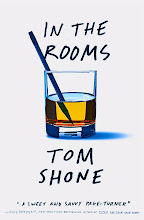
Possible cover for my novel

What do you think? My American publishers just sent me this as a possible cover for my novel In The Rooms (Thomas Dunne Books, January 2011). I think it's terrific, the optical illusion richly suggestive of the book's elegant trompe l'oeil plot — an ever-shifting cat's cradle of sex, intrigue and deception, in which lies entomb the liar in Escher-like regress and only love turns out to be true. The last time I looked, anyway.

Michael Douglas: I want me some movie star

I wanted to see Solitary Man to remind myself of what a movie star looked like. It seemed like I hadn't seen any at the movies for ages. I certainly got what I wanted: Douglas strides through the film, seducing, bamboozling, gesticulating wildly, throwing his arms around the screen as if grabbing up every last spare frame of available space. He's in great shape: trim, with skinny legs, and his hair flows like Lassie's pelt when he walks. I was reminded of Alec Baldwin's superb impersonation of Burt Lancaster on Letterman a while back, soaking up the attention in an elevator: go ahead, check me out, drink me in. Here he plays an aging lothario and struggling car executive called Ben Kalman who chases women the way some men breath: having dinner with his banker, he sends over drinks to a stray woman at the bar, if only so he can better concentrate on the conversation. "Now that's out of the way...." The performance is better than the movie, which is a tad over-impressed with Kalman's shenanigans — there's an almost unwatchable scene in which he discusses the best route to sexual satiation with his girlfriend's daughter, much ickier than the actual sex that follows. You get the impression Douglas sees the role slotting into his rogue's gallery of to-hell-with-it truth-tellers — civility be damned! — but the movie feels edged with menopausal fantasy: the audience gets that this guy is a sad sack way before the script does. It's one long descent: I could have done with a little more of that famous Hollywood uplift. But Douglas hoovers up the screen as if it were his last chance at stardom. What a fascinating creature he is when viewed up close: the jowls, that jaw line, the slackening waistline, the ropy cords of muscle in his back, the strangely tight crevices of his face. I found myself staring at him throughout, marvelling at the access, together with the strange Bizarro-world narcissism that allows actors to cast aside their vanity and play reptiles like Kalman, as long as we are looking at them being reptilian, not the next guy. The piece of shit at the centre of the universe, as they say.

My interview with Ben Stiller: the dervish unwinds

"Stiller has a reputation for being a sombre interview: “intense bloke” reported back one Australian. Onscreen, he is an uptight dervish, scuttling from one humiliation to the next, shoulder hunched, brow scrunched, a man betrayed by his own body, a troglodyte under siege from his own treacherous Id. In person he resembles Ben Stiller’s calmer, better-looking older brother. Dressed in khaki pants, blue t-shirt, sneakers, his hair longish with wolfish grey streaks, he has the slightly matte affectlessness of the off-duty comedian, speaking in gentle, mild sentences from which extreme judgments have been carefully excised, as if the wildness of his comedy had purged him of the need for lesser extremities. Collaborators all tell you the same thing: Stiller is patient, meticulous, detail-oriented." — The Guardian

May 28, 2010

Bring on Hitler's gay nazis!

'Christian conservative group American Family Association's (AFA) Bryan Fischer has likened lifting the policy that bans gay troops from serving openly to Hitler's army of “savage gay Nazis.” Fischer's commentary has been pulled straight from the pages of controversial anti-gay author Scott Lively's The Pink Swastika: Homosexuality in the Nazi Party. In the book, Lively asserts that gays, particularly men, played a key role in elevating the Nazi Party in Germany. “[T]he 'gay' movement I have seen and investigated is neither benign, nor are its members 'victims'. It is vicious, deceptive and enormously powerful. Its philosophy is Machiavellian and its tactics are (literally) Hitlerian,” Lively wrote.'
Just when I was beginning to feel a little — oh disenchanted with my host country, a little listless, uninspired — along comes this news story. Heaven.

May 26, 2010

Why overheard cell-phone conversations annoy

Why is it that people talking on cell-phones is so irritating? It's not irritating when you hear two people having a conversation on the street. In fact, it's generally a treat to eavesdrop on others' chit-chat. It must have something to do with the one-way nature of it — maybe overhearing someone jawing on a cellphone too closely resembles what it is like to be talked at by someone who won't listen. The city seems suddenly populated only by bores and buttonholers, all yakking away and not letting anyone else get a word in edgewise.

The Lost Finale: tolerance is a virtue

As an exercise in DIY surrealism, I watched the final episode of Lost, not having watched any of the previous episode of this season or any others — maybe three or four episodes of the first but that's it. I lost interest once I realised the writers didn't actually have an idea where it was going, though I marvel at the masochism of the fans who stayed the distance, dutifully helping out the show's creators in its efforts to make it make sense. Kind of DIY-dramaturgy. Masochism, but maybe something else too — a kind of benign acceptance of what comes down the tube, together with an almost maternal love for the programme's all-too-evident flaws. It would have driven me around the bend to try and accomodate the series' confusions but blessed are those who tried. Tolerance is a virtue. And patience. The finale seemed very sweet: lots of weeping and white lights and sweet hereafters, like an episode of the X-files in Jungian therapy. Man, though: those are for some of the most boring-looking actors ever to grace the screen, large or small.

May 25, 2010

The secret to Pixar's success: healthy criticism

"Most of the time, a studio assembles a cast of freelance professionals to work on a single project and cuts them loose when the picture is done. At Pixar, a staff of writers, directors, animators, and technicians move from project to project. As a result, the studio has built a team of moviemakers who know and trust one another in ways unimaginable on most sets. Which explains how they can handle the constant critiques that are at the heart of Pixar’s relentless process. Animation days at the studio all begin the same way: The animators and director gather in a small screening room filled with comfy couches. They eat Cap’n Crunch and drink coffee. Then the team begins analyzing the few seconds of film animated the day before, as they ruthlessly “shred” each frame. Even the most junior staffers are encouraged to join in. The upper echelons also subject themselves to megadoses of healthy criticism. Every few months, the director of each Pixar film meets with the brain trust, a group of senior creative staff. The purpose of the meeting is to offer comments on the work in progress, and that can lead to some major revisions. “It’s important that nobody gets mad at you for screwing up,” says Lee Unkrich, director of Toy Story 3. “We know screwups are an essential part of making something good. That’s why our goal is to screw up as fast as possible.” — Wired

May 24, 2010

“When you ask a person to jump, his attention is mostly directed toward the act of jumping, and the mask falls, so that the real person appears” — Phillip Halsman, whose 'Jump' photographs can be seen at the Laurence Miller Gallery at 20 West 57th Street in Manhattan, through Friday

When is asking a question "gotcha" journalism?

"One thing that we can learn in this lesson, that I have learned and Rand Paul has learned now, is don't assume that you can assume in a hypothetical discussion about constitutional impacts with a reporter or media personality who has an agenda, who may be prejudiced before they even get in the interview in regards to what your answer may be or the opportunity that they seize to getch ya," she said. "They're looking for that 'gotcha moment.' That's what it evidently appears to be what they did with Rand Paul."— Sarah Palin
If I understand her correctly — and there is always a fairly large margin of error in any such effort with regards Sarah Palin — I think she is saying that Rachel Maddow asking Rand Paul what his views were on the civil rights act amounted to an instance of 'Gotcha' journalism. Traditionally of course, the term "gotcha" refers to a cunning trap, set by an interviewer, deploying distraction and indirection to back an interviewee into saying something inadvertantely damaging. Simply asking Paul what he thought about something doesn't really count. There's another term for that, far less technical. It's called "asking someone what they think about something." It amounts to "gotcha" journalism only for those ashamed of their views, as Paul appears to be of his willingness to allow racism to flourish in public spaces. (And it is cunning only to those for whom questions what newspapers and magazines she reads and what Supreme Court decisions she disagrees with represent the acme of journalistic nefariousness). One can only sympathise. If you find yourself in possession of a shameful view, you only have two options: 1) you can hide the view, and call it "gotcha" journalism when it is flushed out of you, or 2) you can change your view. Palin and Paul would seem to belong to the former school. A lifetime of prevarication is theirs. How treacherous the world must seem.

May 23, 2010

A historic dump on American shores

"The unfolding disaster is not even prompting a reconsideration of the 75th annual Louisiana Shrimp and Petroleum Festival. “All systems are go,” said Lee Delaune, the festival’s director, sitting in his cluttered office in a historic house known as Cypress Manor. “We will honor the two industries as we always do,” Mr. Delaune said. “More so probably in grand style, because it’s our diamond jubilee. ' Louisiana is an oil state, though and through. A gushing leak off of its coast has not, apparently, changed that" — NYT

Watching this disaster unfold is providing me with one of those stranger-in-a-strange-land moments I get every now again (other reliables: gun control, Twinkies, WWF wrestling). Imagine the situation were reversed. If a company called American Petroleum were disgorging thousands of gallons of oil onto the coast of Normandy, the French would be hauling the Bastille back into fashion. If it reached the British coast, there would be uproar. Newspapers would spontaneously combust. Governments would fall. But such is America's obeisanse to oil companies that everyone is simply sitting back, gazing at the spill going: huh. Well ain't that something. Doesn't anyone care that a foreign company — British no less — has just taken a historic dump on America's beaches? A small boycott would be nice. What we get instead is Rand Paul saying Obama's (extremely mild) criticism of BP is "UnAmerican." Unfathomable. Hilarious even.

REVIEW: Robin Hood (dir. Scott)

Things I liked:—
1. The settings. The cgi is silkenly invisible, the locations seem hand-selected from hundreds, maybe thousands of vale-of-albion wannabes, making this the most beautifully furnished universe of Scott's since Matchstick Men. Or maybe I'm just homesick.

2. The line "I Love You Marion." You can almost seen Brian Helgeland working his way down the options: you complete me, maid of my heart, you are and always will be.... — before realising, hey, what about I-luv-yoo? When was the last time we heard this?

3. William Hurt. Accent good. Unobtrusive hairpiece. Nice to see him.

4. Marc Streitenfeld's score. Almost wholly responsible for the tonal variegation. Still won't be buying it though since I hate lutes.

5. Little John. Don't know the actor. Looks more like a navvie, or oil-rig worker: Thick-set, terrible teeth. Probably RADA's finest Noel Coward impersonator.
And things I disliked:—
1. Russell Crowe and his unflagging devotion to making this the least effeminate Robin Hood in history. It's like Mel Gibson in Braveheart: for the Aussies, all British history is basically gay. Robin Hood is doubly gay.

2. Cate Blanchett. Not comely enough. The movie needs a spot of softness, such as Madeliene Stowe used to provide. You could use Blanchett's bone structure to show a horse.

3. The beach. Russell rising up through the waves going "uuuueeaaarrrgghhhh". Too heavy. Hood is a swinger.

4. The plot about saving of the entirety of the British Isles and becoming Britain's unoffical king-of-people's hearts, like Diana. This the's back-story? What's he doing for main course? Oh that's right: saving Nottingham Forest. What a come down.

5. The weird PG-induced squeamishness about showing us what swords actually do.

May 22, 2010

Watching Treme: we are not worthy

David Simon's new drama series, Treme, alights on post-Katrina New Orleans to find its inhabitants oddly preoccupied with the politics of cultural authenticity. There's a DJ played by Steve Zahn who rails against the corporatisation of the city's music; a bellicose college professor (John Goodman) who appears on TV and calls into radio stations to disabuse them of their preconceived "narratives" about the city; there's even a busker who tears a strip of the visiting church-members from Wisconsin who have turned up to lend a hand ("I bet you didn't even hear of the 9th quarter until the other week"). I have to say: that scene was where Simon lost me. It wasn't just the ingratitude of the busker, but the snarling mean-spiritedness with which the Wisconsin good samaritans were held up for ridicule. So they haven't hard of the 9th quarter until they saw it in the news: so what? Most people have never heard of half of the disaster areas that spring into the public consciousness: does that mean their attempts to help out are to be slapped down? In Simon's New Orleans, nobody can help unless they first understand New Orleans, and the only people who can understand are New Orleaners, and most of them only by constant self-purifying meditation on their irreducible New Orleanishness and its imperviousness to outsiders. Really? The immediate aftermath of Hurricane Katrina and everyone's obsessing about the postmodern precariousness of cultural identity? Wouldn't they be more preoccupied with, you know, the level-five hurricane that had just decimated their city? Simon seems entirely turned in on himself — dramatising the self-conscious rite of passage by which outsiders like himself might give themselves permission to dare to dramatise the city. He treats the ninth quarter with the reverence usually accorded Auschwitz-Birkenau. The show is both self-conscious and snobbish in the manner of tourists who condescend to other tourists. It's enough to make you paranoid: do I measure up? Am I watching it for the right reasons? Am I pronouncing it right? I'm definitely tuning it for the wrong reasons. I'm watching it for some glimmer of the outstanding dramatist who constructed the first four seasons of The Wire. So far he doesn't seem to have shown up.

If America won't do it...

"A judge will investigate claims that British intelligence agencies were complicit in the torture of terror suspects, William Hague, the foreign secretary, said tonight. The move was welcomed by civil liberties campaigners and may put pressure on the Labour leadership candidate and former foreign secretary David Miliband, who was accused by Hague, while in opposition, of having something to hide. Miliband has repeatedly rejected the accusation and broadly indicated that he or his officials may have been misled by foreign intelligence agencies about the degree of British complicity." — Guardian

Meanwhile, back in Bizarroworld:

WASHINGTON — A federal appeals court ruled on Friday that prisoners being held without trial in Afghanistan by the military have no right to challenge their imprisonment in American civilian courts. The decision, overturning a lower court ruling in the detainees’ favor, was a victory for the Obama administration’s efforts to hold terrorism suspects overseas for extended periods without judicial oversight.

Disgusting. Amy Davidson unthreads the logic:

The prisoners in this case were not captured in Afghanistan. They were seized in other countries, where we are not at war... Then we brought them into a war zone. In other words, the government is avoiding judicial review by citing an impediment of its own creation, which sounds—and surely this comparison has been made somewhere—awfully like murdering your parents and asking the court for mercy on the ground that you are an orphan.

May 19, 2010

So glad I don't have to see: Film Socialism

"The parrots are among a handful of animals that appear in the movie, which had its press premiere Monday morning at the Cannes Film Festival, including a pair of hilariously talkative cats (whose meows are, in turn, parroted by a young woman watching them on a laptop), as well as a llama and a donkey. Surrounding these animals is a menagerie of talking, quoting, babbling human beings, speaking in French, German, Russian, English and Arabic, among other tongues.... Wittily, perversely, contrastingly, the final words in the movie are “no comment." — NY Times review of the new Jean-Luc Godard film, Film Socialism
I don't think so. Beautiful still though.

May 17, 2010

On the Critical List: Quotidian

"With its initial unhurried rhythms and emphasis on quotidian details — one gently sexy early scene shows Adam and his wife feeding each other watermelon — the film creates a misleading sense of calm, which makes the coming tragedy all the more devastating."— Manolo Blohnik, New York Times
Add "quotidian" to "limn" and "pitch-perfect" as a great example of a critic using too much cologne. What's the matter with "ordinary?" (A: It's too ordinary.)

May 15, 2010

Quote of the day: Michael Kinsley

'“Personal responsibility” has been a great conservative theme in recent decades, in response to the growth of the welfare state. It is a common theme among TPPs—even in response to health-care reform, as if losing your job and then getting cancer is something you shouldn’t have allowed to happen to yourself. But these days, conservatives far outdo liberals in excusing citizens from personal responsibility. To the TPPs, all of our problems are the fault of the government, and the government is a great “other,” a hideous monster over which we have no control. It spends our money and runs up vast deficits for mysterious reasons all its own. At bottom, this is a suspicion not of government but of democracy. After all, who elected this monster".' — Michael Kinsley

May 14, 2010

Christos Tsiolkas: "The luckiest bastard on earth"

“I think Australian writing has been locked up in the shadow of the English and the Irish,” he says. “In the sense that Australians don’t want to write the Australian novel, they want to write the perfect English novel or the perfect Irish novel. What I love about the Americans is that they have found an English that is distinctly theirs.” He could as easily be talking about his own declaration of independence with The Slap, a tremendously vital book in every sense. Completed at a gallop, it fairly crackles along, juiced up with novelistic license and peeled-eyeball candor, the characters driven by their appetites into a thrilling, vital approximation of what it is to be alive. After handing the book into his editor, she got back to him in just three days, which should have told him something.

“I had no idea it was going to take me to Lexington avenue in the writing of it. I really didn’t. Trying to stand back I’m interested in why it has proved so popular. I wonder what it says about contemporary writing? Can you be popular without being populist? Can you write for a large audience in a way that allows you to do the best work you can that is not condescending?”

He takes another look at that deep cloudless sky as if expecting an answer. None forthcoming, he sits back in his chair, smiles, shakes his head.

“I’m a very lucky man,” he says. “The luckiest bastard on earth.”

— my interview with Christos Tsiolkas in the Sunday Times

May 7, 2010

Miranda rights: a defense against tyrannical kings

'The so-called privilege against self-incrimination emerged in English law during the 1600s in response to the brutalities of royal "justice." By the end of the 1600s it had become not just a privilege, but a basic constitutional right. Moreover, it was a right not only to remain silent, but also virtually a right to be protected against classes of forbidden questions. To effectuate that right, the exclusionary rule forbade introduction of evidence obtained by coercion, threats, promises, or torture. Yet, that rule should be understood not only as a rule of evidence. It was also intended as a prophylactic ban on coercion and torture in interrogations. The Miranda warnings followed in due course as a further prophylactic ban on coercion.' — Professor Bainbridge

May 4, 2010

Touching down on Ebertworld

At the 12th annual Ebertfest the other week — a film festival organised by the estimable American film critic, Roger Ebert, of 'two thumbs up' fame — the host was in fine form. “If I were in charge of things, and I think we all agree I certainly should be, people would have a better time at the movies,” Ebert told the assembled crowd during an audience q & a. “And they’d go see more movies and they wouldn’t be sucked in by gimmicks like 3-D. And a film like ‘Trucker’ would be playing in their town. And the whole world would be like Ebertfest.”

It's a comment often voiced by critics, particularly as we head into the thickets of blockbuster season, during which time it is customary for intelligent cinemagoers to lament the obnoxious monopoloy of big-budget special-effect extravanzas, and lament the neglect paid to small indie movies like Trucker. Like many pieties, it's doesn't bear too much investigation. Martin Amis once wrote a short story called 'Career Move' which imagined a world in which poets and screenplays writers had swapped places: while the screenplays writers huddled in their garrets, collecting rejection slips for tremulous masterpieces like Offensive from Quasar 13, the poets swanked around town taking meetings with overpaid executives about their megablockbusters, like 'Tis He Whose Yesterevening's High Disdain.
Joe calls, and he's like, "We really think 'Sonnet's going to work, Luke. Jeff thinks so, too. Jeff's just come in. Jeff? It's Luke. Do you want to say something to him? Luke. Luke, Jeff's coming over. He wants to say something about 'Sonnet.'"

"Luke?" said Jeff. "Jeff. Luke? You're a very talented writer. It's great to be working on 'Sonnet' with you. Here's Joe."

"That was Jeff," said Joe. "He's crazy about 'Sonnet.'"

"So what are we going to be talking about?" said Luke. "Roughly."

"On 'Sonnet'? Well, the only thing we have a problem on 'Sonnet' with, Luke, so far as I can see, anyway, and I know Jeff agrees with me on this--right, Jeff ?--and so does Jim, incidentally, Luke," said Joe, "is the form."

Luke hesitated. Then he said, "You mean the form 'Sonnet's written in."
As the story made clear, it little mattered which form our culture decided to deify or disparage: there would still be an equal amount of deification and disparagement in the universe. Take Ebert's hypothetical world — let's call it Ebertworld — in which small indie movies like Trucker were crowned king, and filmmakers like Jon Favreau and James Cameron who are exiled to the arthouse. Does anyone seriously imagine that we would be any happier? Then it would be the ceaseless parade of 'gritty,' 'edgy' and 'unflinching' elegies to the death of the American dream, that would induce groans at the multiplex. "Not another sequel to In The Bedroom!" we would cry. "No way am I seeing Wrestler IV: The Ayatolla Lives!" Fed up with sitting supine in front of the latest $100-million-dollar method-acting meltdown involving Sissy Spacek, Halle Berry and an intravenous drip, we would slip away to guiltily seek out James Cameron's latest Chekhovian chamberpiece about vaguely blue-ish people, the blue paint having run out half-way during shooting in order to pay for the red-and-green cellophane glasses after Cameron's credit card maxed out.

Or maybe not. Maybe things are fine just as they are.

my third post for the Daily Telegraph

Faye Dunaway, the morning after

From Vanity Fair's Terry O'Neil Gallery

Why David Edelstein is my favorite movie critic

"In Iron Man 2, the lean, bouffanted Downey toils in crisply tailored shirts amid machines poised to answer every whim, overseen by a computer with the voice of Paul Bettany: English, smooth, sweet-tempered, like C-3PO on chamomile tea, with all the superciliousness expunged. In and out march A-list babes in tight dresses—a gam-off between Gwyneth Paltrow and Scarlett Johansson in which Paltrow wins on length and then disappears in the glare of her opponent’s headlights. Stark’s loyal chauffeur is played by the movie’s director, Jon Favreau, which underlines the sequel’s aim-to-pamper aesthetic, its “You’re so money!” reverence carried over from Favreau’s first film, Swingers. When Stark in his Iron Man suit rockets onto the stage of the Stark Expo—a World’s Fair–like technology showcase spanning the length of Flushing Meadows—and the crowd shrieks and fireworks explode and a kick-line of beauties converges behind him and the egotistical Stark lifts his arms in acknowledgment of his greatness, it doesn’t seem as if Downey is acting. He might truly be signaling, “This is it, folks, the acme of the summer-blockbuster season. And you, a mere moviegoer, are blessed to be in the presence of someone so money.” — New York Magazine

May 3, 2010

The Pregnant Widow: last funny in 1970?

"In evolutionary terms, this guy say,s breasts are there to imitate the arse."
"The arse?"
"The breasts ape the arse. As an inducement to having sex face to face. When women evolved out ofoestrus. You know what oestrus is?"
Keith knew. From Gk oistros 'gadfly or frenzy." Heat.
Whittacker said, "So arselike breasts sweetened the bitter pill of the missionary position. Just a theory. No, I understand about Scheherazade's breasts. The secondary sexual characteristics in their Platonic form. Plan a for the tits. I understand — in principle..... What d'you guys do with breasts> I mean they don;t lead anywhere, do they."
"I suppose that's true. They're sort of a mystery, And end unto themselves."
The Pregnant Widow, Martin Amis
Here's what I think of that. If I heard some male friends having that conversation I might laugh. It is kind of funny to hear clever dicks being clever and dickish sometimes, if they're your friends. If, however, I read that in a novel its humor would decrease at an exponential rate: no longer the momentary flourish of jousting wits, it would instead come across as merely pre-rehearsed, even a little smug. Set the novel in 1970, and the point is definitely beginning to feel past its sell-by date. Sorry to be so down on Amis. I'm sure the book is going to be great. Just needed to clear my throat.

May 2, 2010

REVIEW: Please Give

It's a measure of just how good Nicole Holofcener is that her new movie, Please Give, survives Catherine Keener's one-note central performance. It's not so much that it's one-note so much as the wrong note. Her passive-aggressive deadpan works best when she's the trouble-maker in the pack — in Hololofcener's previous Lovely and Amazing, or Being John Malkovich, where she threw John Cusack wonderfully off balance, but she seemed to be restraining herself from doing the same in The 40-Year-Old Virgin and it came off like smugness, grinning her way through that movie as if at some joke she had yet to share with the class. In Please Give she's playing a rich Manhattanite who cannot stop herself from giving money to men on the street out of guilt from her job taking furniture off the hands of the recently bereaved. She's all wrong for someone overly-concerned about others, even out of misplaced guilt: she delivers the same matte anti-performance she always delivers — that grin is still there, off stage — and her hand-wringing comes off as shtick. No matter. The film is still beautifully done: a string of pearls about Manhattan ethics and real estate, with the biggest laughs coming from a bluntly truth-telling old bird whose apartment Keener is keen to snap up, with Amanda Peet and Rebecca Hall perfectly cast as the old bird's bickering grand-daughters. Peet is tanned and tart, and Hall gets more mesmerising with each role, her heart and hesitancy in constant visible battle on that pale, beautiful face — a Modigliani in nurses' scrubs.

Indiewire reports that — surprise surprise — in a crowded field that includes The Human Centipede, "Tom Six’s much-buzzed about horror film about crazy man named Heiter who attempts to literally connect three very unlucky people via their gastric system," Please Give has emerged triumphant at the weekend box-office. Don't you just love the teeming multitude, sometimes? If I ever make a movie I, too, would like to open opposite a movie about one man's attempt to link three people via their gastric systems.

Apr 30, 2010

Can everyone stop finding things 'pitch-perfect''?"

'Writer/director Nicole Holofcener (Lovely & Amazing) is adept at fashioning credible characters, particularly female. Rebecca (Rebecca Hall) is a mammography technician who is devoted to her crotchety grandmother (Ann Guilbert). Guilbert (who was Millie on The Dick Van Dyke Show) plays 91-year-old Grandma Andra with pitch-perfect comic timing.' — USA Today

I think I've had enough of "pitch perfect." Can everyone stop using it now? Maybe they could junk it the same time they junk "limn." Just typing that word gives me the shivers. Anyone who uses it is a complete scoundrel. It sounds harsh, I know, but in a world otherwise devoid of absolutes, you can rest assured that anyone using the word "limn" is likely to start pouring world-class horse manure into your lap at some point in the not-too-distant future. Just the hard-won wisdom of my tender years. Do with it what you will.

Quote of the day: George Clooney

"This is not the first bomb I've experienced." — upon the finding of a World War II bomb near his property in Lake Como

Fifteen when he was captured

'As detailed in a motion filed by the defense in 2008, Khadr claims in his affidavit that his interrogators threatened him with rape, denied him medical treatment for gunshot and shrapnel wounds he suffered in his July 2002 capture in Afghanistan, and used him as a “human mop” to clean up his own excrement. The interrogator, referred to in the hearing only as “Interrogator #1,” will testify on behalf of the defense that he personally threatened Khadr “with rape” by threatening to render Khadr to an undisclosed Arab country where he would face the abuse' — Washington Independent

If Bill Murray takes you to dinner...

One of my favorite accounts of an encounter with Bill Murray was published in New York magazine yesterday. It's an unmitigated joy — here's the whole thing.

• Murray, who is unfailingly polite, will remember that he has met you and where it happened. You will spend the dinner wondering if he also remembers that he seemed to not like you.

• If you are a lady, he will stand up when you take your seat and remain standing until you pull your chair in. He will do this for every female at his table. You soon will start making an effort to sit down and stand up faster.

• He will commit to memory the name of everyone at the table, making introductions each time a new person sits down.

• He will make friends with the waiters and give them nicknames. “Handsome” will now be your server.

• He will intentionally mishear offhand comments you make about the food and repeat them endlessly. You say, “seafood,” he hears “zebra.” You call the roasted carrots “exciting”; he hears “Poseidon.” As in, “Zebra! I never get to eat zebra! Want some zebra?” or “Have some Poseidon. Some Poseidon. Some Poseidon.”

• He will compliment the chefs by smacking his lips and crying out in mock ecstasy. If roasted duck is involved, he will beat his chest.

• He will take charge of the ordering and the serving of family-style dishes. If you are at Wall & Water, and Handsome brings cranberry chutney instead of the black-currant chutney Murray thinks is just “divine” with pecorino and soppressata, Murray will pull Handsome over, hold the chutneys side by side, and say: “Take a look, Handsome, what’s wrong with this?” If Handsome places the new supply of meats and cheeses with the cheese facing Murray, he will kindly ask Handsome to turn the plate around. “It’s the ladies who really want this cheese, and I just don’t want their nails coming for me when they grab it.”

• He will tell his most animated stories when you have turned away to talk to other people in an effort to make him believe you are not hanging on his every word. You may hear the word “tequila” coming over and over from Murray's direction as he mimes the pouring of a bottle into his mouth, and the tale gets louder and, apparently, more hilarious. When you finally turn back, the story over, and when you ask your laughing dinner companions what you missed, they will say, “Oh, just Bill talking about his early 20s.”

• You may, however, hear some stories about Bill Murray from movie producers also seated at the table. How, for example, he’s superstitious and won’t sign contracts until after a movie is finished, meaning the producers have to secure millions of dollars of financing and insurance on Murray’s word. (Which is apparently unshakable once he’s given it.)

• He might mention the Roebling Tea Room, where his son is a cook, and “they’re very proud of their kale.” He might then discuss how he likes to walk the nearby streets in Williamsburg late at night, and how he shot a movie on the south side when it was just Hasids and hookers, and the Hasids would stand outside late at night telling dirty jokes. (“They weren’t on the street reading the Word, I can tell you that.”)

• If and when the conversation switches to South by Southwest, you may hear the tale of how some random guy joined the Get Low entourage by pretending to be friends with Sissy Spacek’s daughter, Schuyler, and only began to arouse suspicion after several hours of not talking to Schuyler and not knowing anything about Schuyler and insisting on riding in Murray’s car instead of with Schuyler. You may also hear about how Murray engineered an escape plan that involved their entire entourage jumping from the car into rickshaws, and turned around to find the random guy hanging off the back of the rickshaw. And you may hear how the next day, Murray and company faked a letter to Schuyler from said stalker, sticking it under her hotel door and leaving for a day on the town, only to come back and find a worried Spacek and Schuyler consulting with hotel security and/or the cops. You will probably not be surprised to discover that Murray was the member of the group fully committed to continuing the prank for the rest of the festival. If you crack a joke at this point, he will stare at you and say, “Don’t joke; this is serious!”

• And while you are on the subject of South by Southwest, you may mention that you saw this video of Murray tending bar at a random Austin establishment. Murray will at first enjoy talking about this — about how he went to see GZA perform and brought him and RZA to the bar, where the bartenders told Murray they’d make more tips if he helped them serve drinks. He’ll tell you that he forgot that, GZA, as a major stoner, has no tolerance for alcohol, and that the rapper got so wasted after Murray gave him a shot and a half of tequila that GZA didn’t make it to his second performance at midnight. You might become emboldened to ask another direct question, something silly along the lines of, “I heard that you only served tequila, even when people asked for whiskey!” And without answering, Murray will stand up and excuse himself, never to return. The table will grow silent and you will nervously titter to your tablemate (Karen Duffy — Duff from MTV), that you’re worried you just scared Murray off by being too nosy, and she will laugh and say, “Yeah, you probably did.”

Apr 28, 2010

Why prequels leave nothing to chance

Ridley Scott talking to Empire last year:

It's set in 2085, about 30 years before Sigourney [Weaver's character Ellen Ripley]. It's fundamentally about going out to find out 'Who the hell was that Space Jockey?' The guy who was sitting in the chair in the alien vehicle – there was a giant fellow sitting in a seat on what looked to be either a piece of technology or an astronomer's chair. Remember that? And our man [Tom Skerritt as Captain Dallas] climbs up and says "There's been an explosion in his chest from the inside out – what was that?" I'm basically explaining who that Space Jockey – we call him the Space Jockey – I'm explaining who the space jockeys were.

And from the Alien DVD commentary:—
I think the "space jockey" is somehow the pilot and he's part of a military operation – if that's the word you want to apply to his world – and therefore this is probably some kind of carrier, a weapon carrier, a biological or biomechanoid carrier of lethal eggs; inside of which are these small creatures that will actually, fundamentally integrate in a very aggressive way into any society or any place it's dropped.
I always thought the point of the space jockey was that he was a previous carrier/victim of the alien. It was a point about how lethal the alien species were: even other aliens ran scared from them. The eggs in the ship? A trap for the next victim. That's the problem with prequels: they suffer from over determination, and an intolerance for randomness. Tatooine was the point "furthest" point from the centre of the universe, until it turned out to be the radial point around which the whole saga revolved. Hannibal Lecter's mask was strapped onto him by the FBI for transportation to Memphis to see Senator Martin, until it became a favored memento of his sixteen-year-old self. The same with the space jockey. We're either just looking at victim number 237, or we're looking at an important chapter in the evolution of the alien species. It can't be both.

REVIEW: 'Oprah' by Kitty Kelly

"One of the side-effects of sexual abuse can be a notorious boundary-lessness. Their own privacy trespassed against, the victims unwittingly undervalue the privacy of others — almost a job requirement in a chat show host. While Phil Donahue conducted his talk show as if giving a civics class, Oprah elbowed her way into living rooms with a selection of devil-worshippers, transexuals and housewife prostitutes, once asking a porn star “Don’t you get sore?”. Kelly’s attempts to gin up outrage over this feels a little stale; compared to the personalities who were to follow in her wake — the foghorn-lunged Rosie O’ Donnell, the sleek, lethal Tyra Banks — Oprah’s husky warmth feels suspiciously like the real thing. “The therapy I never had,” she said of her show, although just how her guests feel afterwards about confessing their secrets on national television is never known. They are all contractually obliged to keep their silence about the experience — the opposite of therapy, surely." — from my review of Oprah by Kitty Kelly in London's Evening Standard

Apr 27, 2010

The origins of Toothless the dragon

"Panther? House cat? Stealth bomber? Imperial speed bike? Mini? Only one thing is certain: the design of Toothless is the most captivating creature design of the year, managing to combine cuteness and lethal force in one streamlined package that is irrestistable to six-year-olds. Let’s face it: the monsters have been getting a little samey at the movies recently. The screaming red triffid that attacked Jim Kirk in the recent Star Trek would have been scarier still if we hadn’t already met Audrey in Little Shop of Horrors. The insectoid mandibles of the predators in Predator will be less of a shock to anyone who has closely watched the Star Wars movies. And as for the massive lower jaw sported by the Kraken in Clash of the Titans, well it bore a striking resemblance to Godzilla in the 1998 turkey, and both to the gargantuan chin sported by Sky Sport’s Jimmy Hill. You half expected the beast to rise from the ocean depths and start correcting everyone’s sports trivia. Toothless has one more advantage over these caterwauling beasties: apart from the odd purr he is almost entirely silent, thus allowing him to retain his essential dragonishness, and granting him to pass unscathed through some of the script’s purpler passages. Not since Ridley Scott denied his alien eyes, in Alien, has a handicap paid off so handsomely' — from my weekly blog post for the Daily Telegraph

Apr 24, 2010

Late to the party: 2008's 'Bring Me Your Love'

Readers of this blog will know that I am about as far from being an Early Adopter as can be imagined. I come by most of my music through movies, adverts and other people's recommendations and once walked into Tower on Sunset Boulevard, asked what the music playing was, and was pointed to a massive billboard advertising Vanessa Carton's number one hit single 'A Thousand Miles.' So I have no shame in declaring my belated love for City and Colour's 2008 album Bring Me Your Love (here interspersed with tracks from their 2005 album Sometimes). Singer/songwriter Dallas Green is Canadian and has a pure, unusually soulful alto voice with just a touch of Marvin Gaye to it. Singing at the bottom of his register, his voice has the slight wobble of someone trying and failing to get their emotions under control. Only two years late. I'm catching up.

Apr 23, 2010

More falling stars...

"Jim Carrey’s A Christmas Carol and Yes Man were box-office disappointments and indie gay romance I Love You Philip Morris is currently on the shelf, caught in a distribution quagmire. What should the 48-year-old comedian do" — Indiewire
"Movie stars, who not so long ago vied to make $20 million or even $25 million a picture, have seen their upfront salaries shrink in the last several years as DVD sales fell, star-driven vehicles stumbled at the box office and studios grew increasingly tightfisted. Most of the three-dozen or so top-billed actors in the 10 films up for best picture in this Sunday’s Academy Awards ceremony, including blockbusters like "Up" and "Avatar," appear to have received relatively minuscule upfront payments for their work... Peter Dekom, a film industry lawyer who co-wrote the book "Not on My Watch: Hollywood vs. the Future," pegged the general devaluation of movie stars to a lack of interest among younger viewers. "Stars don’t resonate with the ‘what’s next’ " crowd, theorized Dekom. "They attract an over-30 audience, which is going to the movies less in an impaired economy." — NYT

"Land of the Lost"'s dismal box office helped land star Will Ferrell at the top of our annual list of Hollywood's Most Overpaid Stars... Ferrell's 2008 film "Semi-Pro" earned only $43 million. "Step Brothers" did better with $128 million... For every dollar Ferrell was paid, his films earned an average $3.29. Second-worst? Ewan McGregor. The Scottish actor, best known for his work in films like "Trainspotting" and "Star Wars" (where he played a young Obi-Wan Kenobi), doesn't earn as much as some of the higher-profile actors on our list. But his recent movies have performed poorly, making him a terrible investment for producers. For every dollar McGregor was paid, his films earned an average $3.75.

Besides Will Ferrell, other big names on our list include
Eddie Murphy and Tom Cruise. Murphy (who ranks fourth) has commanded one of the highest quotes in Hollywood for his work in family comedies, thanks to the performance of movies like "The Nutty Professor," which grossed $274 million at the worldwide box office. But lately his return on investment has fallen off a cliff. Last year's "Meet Dave" was a box office disaster, earning only $50 million worldwide. This year's "Imagine That" did even worse, bringing in $18 million. Murphy escaped being named the most overpaid star thanks to 2007's "Norbit," which earned $160 million. For every dollar Murphy was paid, his films earned an average $4.43. Cruise ranks sixth with a return on investment of $7.18. The star has worked out unusual deals on past films where he takes nothing up front in return for a large chunk of first-dollar gross -- that means on stinkers like "Lions For Lambs," Cruise earned even if the studio (in this case, his studio, United Artists) didn't recoup its money. These are just the kinds of deals studios are trying to avoid." — Forbes

Apr 22, 2010

Where are the great British political orators?

"Watching Germany rise from its knees after the war and become a vastly more prosperous nation has not been easy on the febrile British psyche. All nations have a cross to bear, and none more so than Germany with its memories of Nazism. But the British cross is more insidious still. A misplaced sense of superiority, sustained by delusions of grandeur and a tenacious obsession with the last war, is much harder to shake off. We need to be put back in our place."— Nick Clegg
Not much to disagree with there, although The Daily Mail seems to think it's damaging. I'm not so sure, but then what do I know: the whole thing seems positively Blefuscun when compared to the last year's epic. As Andrew Sullivan pointed out, America has drifted so far right in the last decade, and Britain left, that the differences between the parties, from this vantage point, seem negligible; the TV debates play out like a disagreement between different factions of the Democratic party. I'm also struck by their shared failings as speakers. What has happened to political oratory in Britain? I notice it more with Clegg, because he peppers his speech with more Obamaesque invocations of "Hope" and "change" than the other two — eeek — when what he excels at is that warm, earthy beside manner that all politicians since Blair have tried to cultivate. Brown has some stentorian gruffness but is resolutely incapable of lifting his listeners more than five feet off the ground. Cameron sounds the most leaderlike, with touches of that old Tory resolve that Thatcher did so well, but he to tries to soften those old Etonian tones too much: it sounds phoney as hell. They all sound like smart, reasonable men — bank managers doing their utmost to sound cuddly, or veterinary surgeons soft talking their way around an outrageous bill. Where is the steel? The punch and fire? Nobody expect a Churchill, but a Tony Benn would be nice.

Why are all my favorite bands Swedish?


My wife and I disagree over the significance of co-incidences. To her, they are evidence of a larger cosmic pattern in the universe — God's daisy chain or some such. To me they're just random events which happen to link cosmically only from one point of view, i.e. the point of view of the person observing the coincidence. From no other vantage point does it look cosmic. What is an amazing mind-bending coincidence to Fred, is just a boring old fact to Bert. "I can't believe you know so and so!" "Why wouldn't I?" "I don't know, but I guess because I knew both of you but I never put the two of you together..." "Not everything revolves around you." "I know that" "When you leave the room we all carry on talking, you do know that don't you?" "No need to get sarcky..." and so on. However, the number of times I've hooked into a new band, raved about them to all and sundry — Kate normally — and then found out they are Swedish is getting to much to ignore. Its the first question Kate asks me now when I say "have you heard this?" she goes "Are they Swedish/" It happened last night in fact. I got five seconds into playing her Loney, Dear's beautiful track Summertime and she said "are they Swedish?" and I went "Yes, isn't that weird?" I don't know how to explain it. Am reluctant to give into the whole God's-daisy-chain thing and more inclined towards theories involving glacier water and the increased freedom of movement within the EU. Or some such.

More here at one of my favorite music blogs, Swedes Please.

Apr 21, 2010

Reversible opinion number 35: Jeffrey Wells

"When I first read about this on Carrie Rickey's Philadelphia Inquirer blog I was reminded that the Rockman-esque influence is one of the biggest reasons why I despise Spielberg these days -- i.e., because his films have been offering allusion after allusion and tribute after tribute to that sentimental notion of small-town America that Rockwell's paintings are more or less synonymous with. I for one have always found this aspect of Spielberg's films to be treacly and un-genuine"— Jeffrey Wells, Hollywood Elsewhere
'Reversible Opinions' is an occasional series devoted not to untruths so much as exact inversions of truths — statements that, if reversed, would be true. People should be allowed to despise who they want, of course, but if you're going to despise Spielberg it's probably best not to do so for his portrayal of small-town America. I can't actually think of a single film of his set in small-town America. I can think of many that are set in the suburbs of large cities: Close Encounters of the Third Kind, which is set in Muncie, Indiana for example, or E.T. The Extra-Terrestrial which is set in the suburbs of Los Angeles. Spielberg is synonymous with romanticising the suburbs, not small towns. Or used to be synonymous, before he started making movies like Saving Private Ryan and Munich. So if by "these days" you mean "thirty years ago" and if by "small towns" you mean "the thing that destroyed small towns," then yes, you have the beginnings of a point. He's very Rockwellian.

Apr 20, 2010

Are you a figment of Leo Di Caprio's imagination?

'Have you ever had a sneaking suspicion that you may be a figment of Leonardo di Caprio’s imagination? Cinemagoers are beginning to wonder. First we had Shutter Island, the events of which may or may not have been taking place inside the actor’s troubled head. Arriving soon in cinemas is Christopher Nolan’s Inception, in which Di Caprio plays a dream thief who plucks secrets from the heads of sleeping tycoons — “an Existential heist movie” according to its maker which plays out in the confines of the human mind. Later this year, Darren Aronofsky will release his latest mind-bender, Black Swan, a psychological thriller in which a ballerina played by Natalie Portman may or may not be imagining the existence of her closest rival. What’s with this sudden burst of solipsism at the movies? Has Descartes Principia philosophiae become the latest bedside reading in Hollywood? Or is it just a case of clever-clog directors retreating into their hi-tech bunkers? The theme has long found favour with the more paranoid, druggier corner of the sci-fi world: Fassbinder’s two-part TV movie, World on Wire (1973) featured a techhead played by Fred Stiller who becomes convinced that the world he inhabits is in fact a computer simulation; Philip K Dick’s Total Recall and Do Androids Dream of Electric Sheep, later Blade Runner, both turned on the notion of implanted memories that are more real than the real thing. Such mazy imaginings have been given a new vigor by the ever-greater encroachments of the internet: with more and more of our daily lives spent with our heads glued to a screen, the possibility that we might permanently disappear into it, like Alice through the looking glass, has come to tantalise us. The Matrix flipped through alternative realitites with the agility of someone taking their new browser for a spin, spearheading a wave of movies in which reality turned out to be if not a complete chimera, then certainly an optional extra— Nolan’s own Memento, Richard Linklater’s Waking Life, Michel Gondry’s Eternal Sunshine of the Spotless Mind. The internat has premanently altered our sense of cinematic space, punching through the fourth wall into infinite, Escher-like regress, through which the camera is now free to rush, although as the Matrix sequels made clear, too many wormholes in the space-time continuum can turn filmmakers brains to swiss cheese. For every Matrix, there is a Vanilla Sky, or an eXistenZ, films in which an intensely cultivated interest in alternative reality acts as handy cover for a dramatist’s inability to establish any kind of reality in the first place. If it all turns out to be a dream, then who can complain about illogical plots and unbelievable characters? Moreover, if I turn out to have been a figment of Leonardo di Caprio’s imagination all along, have I foregone my right to a refund' — my first post for the Daily Telegraph's film pages