Apr 3, 2011

REVIEW: Source Code (dir. Jones)

Source Code is energetic nonsense, and for about 90 minutes it's energetic nonsense of the kind that I was more than happy to go along with: the kind set on a train, with a good-looking girl in the seat opposite, a bomb several carriages down, and a score that plunders Bernard Hermann at every available opportunity. "Don't think.... do," Vera Farmiga instructs Jake Gyllenhaal when he starts to ask too many questions as to why he is reliving the same eight minutes, over and over again, wearing another man's face, before that bomb destroys him and the pretty girl opposite, played by Michelle Monaghan, who looks very similar to the way Michael Jackson used to look in his dreams. "The more seconds we waste talking, the more innocent lives are put at risk," chides Farmiga. That's how I like my exposition. Brutish, passive-aggressive and guilt-inducing — positively Cheneyesque. Duncan Jones has chosen to follow up his haunting Moon with a pacey bit of neo-noir, of the kind that so seizes the nation's youth these days and which consists primarily of flattering them that their frontal lobes contain a mazy warren of plot options, alternative futures and other assorted extras, of the kind that used to be located down the dark alleyways and mean streets of Chandler and Hammett. Call it MRI noir. Down these neural passages a man must go who is not himself neural, who is neither tarnished nor afraid. And that man shall be Jake Gyllenhaal, whose gifts of bug-eyed perplexity never quite eclipse the doe-eyed callisthenics of his smooth-operator routine; waiting to be obliterated by a fireball, he bats his lashes at Monaghan like a man chalking his pool cue. If great-looking eyeballs are your thing, then this is your movie, in fact. Source Code appears to have been cast on the principle that the bigger the plot-holes the more saucer-eyed the actors required to negotiate them. There's another great set of eyeballs on Farmiga, her liquid-azure irises seeming to contain and reflect back whole skies and universes, some of them alternate no doubt, giving her the slightly distracted air of someone who once looked in a mirror, self-hypnotised and never quite snapped out of it. Best of all, though, is Jeffrey Wright who delivers the kind of slithering bureaucrat that Alec Guinness used to be so good at: all slothlike movement, unctuous manner and gelid morals. You half expect to see a glistening trail out back. I'm not going to try to summarise the plot, except to say that comprehension beckoned, danced a little minuet, curtsied, made her excuses and finally departed at around the 92-minute mark, at which point the filmmakers made the unwise decision to try and make sense of the preceding movie, the net effect of which was to make the heads of all 200 people in the audience explode simultaneously. I cannot readily recall another scene from a movie that snatches defeat so deftly from the jaws of victory. Never mind. Source Code has a nice clip to it, a toothsome score, a couple of emotional bits, Wright and peachy Monaghan. B-

Calling Upper-West Siders

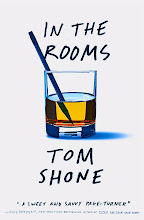
Apologies for using this blog to such whorishly self-promoting ends but any readers in the vicinity of the Upper West Side Barnes & Noble (Broadway @ 82nd Street) on the 13th April are forthwith invited to a 7pm reading I'll be giving of my novel In The Rooms — not the whole thing, just a small portion of it. I am a strong believer in the division of labor when it comes to books.

Apr 2, 2011

Donald Sutherland —  An Appreciation

The director's cut of my run-down of Donald Sutherland's career for Intelligent life:—
M.A.S.H. (1970) – ‘Hawkeye’ Pierce. No war-zone had seen anything like him: lanky, lugubrious, his pursuit of the nearest piece of ass matched only by his quest for the perfect Martini. Sutherland had made two war pictures before M.A.S.H, Kelly’s Heroes and The Dirty Dozen, but it was Robert Altman’s raucous, Rabelaisian barnyard comedy that plucked him from the ranks of character actors and made him a star. The director never found a more Puckish front man for his own deep instincts for mischief. All the picture’s looseness seems to flow through Sutherland’s 6’4” frame, all the mordancy pooling in those powder blue eyes, all its lasciviousness lodged in that cock-eyed grin. Despite his height, there’s nothing upright about his Hawkeye, a man made for the great horizontals: sex, death, booze.

Klute (1971) — John Klute. Sutherland has to be the least pushy private eye in the history of movies in Alan J Pakula’s mesmeric masterpiece. He’s all ears and eyes, boyishly impassive, a soft empath who lets Jane Fonda do the talking. It’s Fonda’s picture, no question; she won an Academy Award for her portrayal of the high-end call girl, Bree Daniel, brittle with boredom at the maulings and pawings of men, glancing at her watch mid-fake-orgasm. “Did we get you a little? Huh?” she taunts Klute. “Just a little bit? Us city folk? The sin, the glitter, the wickedness?” Sutherland just listens, and watches and pushes her hair back from her face. He makes love to her like a man defusing a bomb. Soon, she tags along behind him, tugging at the hem of his coat like a daughter. A lovely performance drawing on seemingly bottomless reserves of gentleness.

Don’t Look Now (1973) — John Baxter. After training at the London Academy of Music and Dramatic Art, Sutherland started his career in British horror films such as Castle of the Living Dead (1964) and Dr. Terror's House of Horrors (1965), which shouldn’t surprise: that elongated face, with its outsized features, is never far from dawning horror, or outright terror. The key is not to push him. Both Fellini and Bertolucci squeezed Sutherland into bug-eyed caricature; Nic Roeg uncovered a much subtler disquiet in his Borgesian thriller about a bereaved couple haunted by glimpses of their dead daughter around Venice. Not that Sutherland doesn’t show range, from inchoate grief to mortal transfixation, but best of all is the portrait of a marriage he and Julie Christie rustle up: soft, warm, weary, fond. Roeg cuts back and forth between their sex scene and its post-coital aftermath: the ravishing of bodies and the dressing of those bodies for dinner. It’s tender and spooky in equal measure. They could almost be ghosts themselves.

Invasion Of The Body Snatchers (1978) — Matthew Bennell. Given the premise –—alien pollen seeking to replicate and replace human beings with pod-grown versions of themselves — the appearance of Sutherland as a sardonic public health inspector seems less a matter of casting and more an urgent moral imperative: of all the human beings the aliens could have run into they get the elegant Canadian with the indolent smile, long lashes and excellent stir-fry technique. Try replicating that. The first time we see Sutherland he’s removing a rat turd from a soup tureen. “Peppercorn,” insists the restaurateur. “No, rat turd,” replies Sutherland, taking great pleasure in separating his ‘t’s. Pauline Kael found the film perfect proof of Simone Weil’s thesis that it wasn’t the upright citizens that resisted the Nazis — it was the dreamers, the cranks and the kooks. In one scene, Sutherland finds a whole vegetable patch of pods growing in his back garden, but can’t quite bring himself to destroy the ones that look like his friends, only the one that looks like him — an inspired, unexpectedly touching detail.

Ordinary People (1980) — Calvin Jarrett. Sutherland is easily the best thing in Robert Redford’s dreary Oscar-winner about a family attempting to recover from the death of their eldest son. It’s one of those films where everybody takes turns to feel terrible about themselves: a self-boxing bout. The winner by a mile is Mary Tyler Moore, almost unwatchable as the emotionally repressed mother who cares most about who wears what to the funeral; Timothy Hutton is the pale, sleepless younger son, fighting his way through a fog of guilt; Sutherland is the jovial peace-maker, trying to draw everybody back together and finally — thankfully — giving up. His startling night-time admission to Moore, followed by his scene with Hutton on the porch, are the one-two punch that took the audience down and earned everybody but Sutherland their Oscars.

Backdraft (1991) – Ronald Bartel. The eighties were not kind to Sutherland, as they were not to many actors. In Hugh Hudson’s misbegotten Revolution, he seemed upstaged by the huge hairy mole plastered to the side of his face; opposite Brando in A Dry White Season, his performance was, said Kael, “one long whimper”. No wonder his hair turned white, but what a beautiful snowy white it turned, one of the best things to happen to him as an actor. His arsonist in Backdraft seemed to have petrified himself with his own thoughts. “What did you do to that little girl, Ronnie?” de Niro’s cop asks him. “I burned her,” says Sutherland, with a bashful bat of those lashes. “What do you do to old ladies Ronnie?” asks De Niro again. Sutherland grins. “Burn them.” “What would you like to do to the whole world?” Pause. “Burn it,” he says, giggling like a schoolboy boasting about his stamp collection. Svelte malevolence, expertly done.

Pride And Prejudice (2005) — Mr Bennet. Mr Bennet is one of those Austen characters who changes with the season. We’ve had bullying, authoritarian Mr Bennets; we’ve had warm, rosy-cheeked Mr Bennet’s closer in spirit to Dickens than to Austen — a frequent misattribution on Hollywood’s part. Opposite Brenda Blethyn’s chatterbox in Joe Wright’s 2005 version of Pride and Prejudice, Sutherland gets the balance of warmth and world-weariness — the “mixture of quick parts, sarcastic humour, reserve, and caprice,” as Austen put it — exactly right. His hair long and snowy white, his jaw unshaven, his soft voice so soft he seems to be speaking from somewhere deep inside his chest, Sutherland’s Bennet is a picture of mordant long-sufferance, a man who married foolishly and has since resigned himself to sitting out the household skirmishes that erupt around his heels, nevertheless rousing himself to save his daughter when threatened with a similar fate.

Mar 31, 2011

THOUGHT FOR THE DAY: Kenneth Tynan

"Give a camera a good, steady look at almost any exterior in less-than-perfect weather with nobody about, put something poignant (preferably a solo wind instrument) on the soundtrack, ad the odds are that what you have in the can is a lyrical comment on the bleakness and aridity of human existence. A stretch of damp beach, a block of flats at dawn, a garden in drizzle, a deserted square with yesterday's papers blowing about — it doesn't matter what the setting is as long as it is more or less depopulated. One or two people may be present (two is the maximum, and one of them had beter be a girl who looks plangent in close-up), in which case the comment stands a fair chance of becoming poetic" — Kenneth Tynan, reviewing Jean-Luc Godard's Les Carabiniers (Tynan Right & Left, Athenuem, 1967)
I often have a similar thought when taking in my fellow passengers at airports, all of whom seem to wear a look of uniform, uncomplaining drudgery, so richly suggestive of their poor, blank prolish lives, escape from which has landed them only as far as the overlit, muzak-filled prefab in which they now sit, slumped, contemplating the microwave chicken that awaits them upon their return. I sometimes try and look at them and think "that guy just found out he's a grandfather," or "she's thinking about her new boyfriend" and for a second, that glum expression seems to cordon off an internal firework display of joy so unbounded that expressionalness seems the only safe option, for fear they might otherwise burst with happiness. But it doesn't last long. Soon, they go back to looking like they have a microwave chicken waiting for them when they get home.

REVIEW: Mildred Pierce (dir. Haynes)

So I'm going to try not to get too embroiled in the whole "My much loved Joan Crawford film classic beats your HBO miniseries" contretemps — an asymmetric non-starter. The Crawford version is as grooved with familiarity as the face of a family member; by comparison, the new Mildred Pierce cannot but seem a rank imposter — somebody impersonating your mother. But it's got some interesting things to say about class that are largely absent from the Curtiz version, largely because of changes wrought to the character of Veda — a sleazy lounge act in the Curtiz, a "cheap little tart" in Cain's words, rather than the coloratura soprano he envisaged as the embodiment of Mildred's dreams and then some, the moral of the tale being: be careful what you wish for. Cain:
"The book simply says perhaps a dream come true may be the worst possible thing that can happen. But before the story has any point at all, there must be a dream and it must come true. Your Mildred dreams of ham sandwiches. My Mildred, although it is constantly stated that ham sandwiches are the limit of her talent, dreams tall dreams for Veda and then has the egregious misfortune to have them come true."
But let's not get ahead of ourselves. The Haynes version certainly doesn't. It is much slower — 45 minutes even to get to the cafe, and another 30 to meet Monty Beragon — although I like the soft, slow grind this lends the action. You can almost catch the falling dust motes in Haynes's wide, Hopperesque compositions. Plus it accords a more seemly grieving period for the death of Mildred's youngest daughter — a trauma which I seem to remember Joan Crawford recovering from in the time it took her to down a single shot of whiskey. Kate Winslet's performance at its strongest in these early scenes, I think, registering all the small assaults on Mildred's pride, the quick gulps she performs before soldiering on. Guy Pierce's Monty is, I think, outstanding: a man so gigoloishly devoted to his own pleasure that he brings a blush to the cheek of every scene he's in ("what this evening needs is the crime of rape"). Hayne's wholesale airlift of much of Cain's dialogue works very well at nailing down that cut-the-mush depression-era tone — especially startling when set beside today's doughy Oprahisms. I wish people would get through the current recession with a few more cries like Veda's "cut the penny-dreadful dramatics." Little Veda will, of course, grow up into Evan Rachel Wood, an enamalled spitfire, visiting scalding arias of rage upon Mildred's poor head in what amounts to a terrific sequel to Wood's breakout performance in 2003's Thirteen. She is now just 23, God help us, and in many ways she out-Winslet's Winslet, loosing the same air-and-fire polyphony that propelled Winslet to fame in Heavenly Creatures, all those years ago; their head-to-heads are like seeing Winslet go twelve rounds against a younger version of herself — and losing. For the same thing has happened to Winslet that happens to many actresses who win an Oscar: the fight goes out of them, followed by a lofty, far-reaching search for roles befitting their new pedigree as Oscar winners — or, as here, they play roles which won other actresses their Oscars. I don't think Winslet has given up completely, but she does look genuinely perplexed in her scenes with Wood, trying too hard to look like the innocent wronged when we needed to see more of that crazy-making maternal love bubbling through her veins, and which so broiled Holly Hunter's skull in Thirteen. Winslet looks merely at a loss for words. The result is that it's Wood's show, by and large. The climax is seared into my retinas as irremovably as a denouement from Sophocles: Veda walking past her mother, naked and defiant, followed by a mad, furious flight downstairs, her eau de nil gown billowing out behind her, the snake revealed. Haynes crestores the jewel of Cain's novel to its original lustre: Vida is a creature smelted from Mildred's own dreams, her own snobberies, an engine of destruction forged from nothing more than a mother's desire that her daughter live a life better than her own. B-

The key to De Niro: people are bad actors

The 35th anniversary of Taxi Driver, together with the publication of Richard Schickel's thrilling book of Conversations with Scorsese, has prompted the following thought about De Niro's collaborations with the director and how his performances rest on a single insight: people are bad actors. Just listen to the flat, affectless delivery with which he reads Travis Bickle's dimestore-Dostoevsky diary entries in Taxi Driver ("All my life needed was a sense of someplace to go. I don't believe that one should devote his life to morbid self-attention, I believe that one should become a person like other people"). Or the imploded powers of projection he gives Rupert Pupkin, every joke fizzling just inches from his face; or — best of all — the dud epiphany of Jake La Motta delivering Marlon Brando's I-coulda-been-a-contender speech to a mirror at the end of Raging Bull ("Some people aren't that lucky... like the one Brando played in On the Waterfront, an up and comer whose now a down and outer. Remember the scene in the car with his brother Charlie? It went like this..."). It's the same tone a construction worker might use to recite a self-penned poem about his wife (with apologies to construction workers, but you know what I mean). In each case, De Niro resists the temptation to give his lines any kind of flair, or lift, or affect, or charisma. He doesn't invest the characters with his own powers of projection or acting ability — which are, after all, those of a professional actor. I've often noticed this very blind spot with other actors, who when their character is asked to lie, or improvise or pretend, bring the full weight of their abilities to bear on the task, as if thinking "this, I can do. This it would be embarrassing of me not to get right," all the while forgetting what crummy fabulists most of us are. Not de Niro. He hangs us out to dry! He's trying to catch his humans in the act of imposture — to show the gap between who they think they are and who they really are — and he does it by subtracting his own skills entirely from the equation. His performances are extremely skillful acts of self-abnegation. He gives us anti-actors, over-actors, creative duds, amateur stylists, hams, showboats and bores, their heads rattling with cheap cliche and secondhand poetry, all of which sounds to them like Shakespeare at his most fluting.

Mar 30, 2011

QUOTE OF THE DAY: Andrew Sullivan

"If America's ideals are universal, they cannot be reduced to the ownership of one country.... What I see here is far from exceptional. It is the routine pattern of the rise and fall of all republics that become empires. It is what happened to Rome and Spain and Britain: Success, over-reach, hubris, bankruptcy and decline. And the withering of the sinews of a republic's body - as in the supine, divided, incompetent Congress, and a court so deferent to the emperor's unrestricted power in waging war wherever he pleases." — Andrew Sullivan

Mar 26, 2011

Scorsese curates the 2011 Port Eliot festival

"Even legendary Hollywood director Martin Scorsese has never had a set like this to play with – a giant screen by a river under the stars, with a backdrop of trains rumbling across a towering viaduct designed by Isambard Kingdom Brunel... It was a considerable coup for one of the summer's most eclectic festivals to persuade Scorsese to take a break from editing his first 3D film, The Invention of Hugo Cabret, filmed at Shepperton and starring Jude Law and Sir Ben Kingsley, to programme four themed double bills. All Scorsese's film choices are vintage. He is a passionate film historian and has worked with the British Film Institute (BFI) to secure the prints for his season. He has not chosen any of his own films, but that gap will be filled by discussions of his work chaired by the film writer Tom Shone. The festival organisers are working hard to create an environment which lives up to Scorsese's vision: the Paradiso will have a cocktail bar in an Airstream campervan, some seats in cardboard Cadillacs designed by the Ballet Rambert designer Michael Howells, and will also be serving hot chocolate and providing blankets and umbrellas just in case."The idea of a cinema by the river came last year when I was lying on the grass one night at last year's festival. It felt like the first time I'd lain down in days – and I thought what I'd really like now is to watch a lovely movie, right here, without having to move," Cathy St Germans said" — The Gaurdian
'Tis true. I will be chairing a discussion of Scorsese's work, and also delivering a talk on some of my favorite movie title sequences, one of which will be from a Scorsese film, though I haven't decided which one yet. It's between Mean Streets, Casino, Raging Bull, and Alice Doesn't Live Here Anymore. Scorsese's own choices will include Murder on the Orient Express (1974), North by Northwest (1959), The Leopard (1963), The River (1951) The Red Shoes (1948), and All About Eve (1950). My favorite Scorsese pictures, in turn, are:—
1. Goodfellas
2. Taxi Driver
3. Mean Streets
4. Alice Doesn't Live Here Anymore
5. Kundun
6. Raging Bull
7. The King of Comedy
8. After Hours
9. The Departed
10. The Age of Innocence

Mar 25, 2011

SO GLAD I DON'T HAVE TO SEE: Sucker Punch

Slant's Jaime N. Christley:—
"You're just a regular guy who likes to look at porn on the Internet...you run a quick census of your two most prized entertainments: (a) barely-legal girls taking it in every conceivable hole, and (b) epic fantasies of limitless awesomeness, violence, and spectacle. Two great things that go great together, right? You ask yourself, can't someone, anyone, with limitless funding and all the latest developments in computer-generated special effects, make one movie that combines both of my passions? Since there isn't enough spatial coherence (or narrative coherence—it's 300 and Gunsmith Cats in a blender) to warrant a plot synopsis that remotely respects the shape of the film in question, the best I can do is a shopping list:
  • Spinning in the air 360 degrees and shooting out a robot's skull (countless iterations, sometimes not a robot but an undead German soldier)
  • Explosions and other pyrotechnic imagery (countless)
  • Cleavage (lots); tits (zero)
  • Idiotic, non-sequitur platitudes issued by Very Special Guest Star Scott Glenn (4)
  • Layers of inception (3, including the film itself)
  • Blood spray/spatter (0); network television-safe wounds (2?)
  • Sex (ha! None); fear and loathing at the thought of sex (all-encompassing)
  • Grotesque, skeevy men (all, with the exception of 0.5 Don Drapers)
  • Extremely ill-advised cover songs (many…bring earplugs)

Mar 24, 2011

REVIEW: Win Win (dir. McCarthy)

"Amy Ryan has the least showy role and ends up giving the movie its moral center. At first, for fear of her daughters’ safety, she nuttily tries to lock the door to the basement where Kyle is crashing—only to be brought back from the brink by her husband’s soothing tones. When she learns of Kyle’s terrible life, she announces he’s not going home and that she’s “going to go to Ohio and beat the crap out of his mom.” It not facetious—she really wants to go. Ryan’s voice has an edge that cuts through Giamatti’s fatty resonance and tugs him out of the realm of self-pity. Who wouldn’t want parents so perfectly matched? I guess that’s the win-win." - David Edelstein, New York
Very true. One of the thing I loved about the movie is the slow reveal of Kyle's integrity, together with the unravelling of Giametti's. Ryan stays dead centre while the men move around her. When we first see Kyle he is sat on his grandpa's porch, his peroxide thatch, ferrety and adenoidal mutter lending him the affect of your typical teenage drifter — a lost cause, his mother in rehab. What is revealed is not just his superb wrestling skills, but a keen, low-slung integrity — a straight-arrow sense of right and wrong that sends him across town to look after his grandfather, or out of the back window to avoid his mother. One of the funniest things about this wondrous movie is the neat inversion of the usual inspirational coach cliches. This kid doesn't need any coaching. He's already creaming them on the mat. And his coaches, all three of them, are terrible coaches – X-rated, overexcitable, sick for their lost youth, their pain as visible as chest hair. The cliche "they're getting more out of this than he is," isn't a cliche here. It's quite literally true. This kid has flown into their lives like the proverbial golden goose and it's all they can do to hang on for the ride. I loved this film, loved the way it patiently established the weight pinning these characters to the mat, loved the release it grants them. Wrestling is about right: this film is all about weight, counterweight, staying afloat, wriggling free. But for some plot points that could have done with some punching up, it's pretty much unimprovable, it's uplift as close to the real thing as can be got from American movies right now. It moves mountains, by a few inches. A-

Finished copies!

I will say this: the dimensions of my book are well nigh perfect. Going into it, I was unusually absorbed by getting the length of the book right, having read too many novels that felt either padded out or undernourished. I don't mean in terms of the content so much as physically, although the two have a relation to one another. I wanted it an inch across the spine, just a bit over 300 pages — and by some miracle I seem to have hit that target bang smack in the bullseye. 342 pages. Just over an inch. Perfect.

Mar 23, 2011

A sixteen-year-old Liz Taylor, as featured in the recent exhibition With Love From London

Mar 22, 2011

REVIEW: Certified Copy (dir. Kiarostami)

Things I liked about Certified Copy:—
— Juliette Binoche's array of suppressed smiles and smothered laughs, so the laugh has nowhere to go except into her eyes and the muscles around her mouth

— Her extremely low-centre of gravity when walking

— The town reflected in the car windshield

— William Shimmell's hair, and the way he says "... or maybe not" after a failed joke

— The foot massage on the steps (but couldn't he have offered?)

— The kid's teasing of his mother

— The Italian tourist who tells Shimmell that all Binoche wants is his hand on her shoulder. So insightful it made me laugh out loud. (Boy, does he need that guy in his life on a more regular basis)
Things I did not like:—
— William Shimmell's cold, self-obsessed intellectual, almost wholly silent unless prompted to repeat one of his willowy pensées. How on earth did he ever charm such a vibrant woman?

— The central theme (copies are as good as originals, or more interesting, or supplement/supplant them in some Derridean fashion). No more persuasive this time round than the last dozen times I've heard it, even less so on the lips of an Englishman. Shimmell at least does us the courtesy of not seeming to believe his own theory. So make that, willowy, unconvincing pensées.

— The endless restating of the central theme. Does Kiarostami think this is what his film is about? Would that it were so easy.

— The way they slip from flirtation to bickering without going via anything suggesting reciprocal love. A major deficit when compared to Viaggio in Italia and Before Sunrise.

— The line "there are no immutable truths to fall back on." Hard to tell if true. If true, gauche. Likewise, "its hard to be simple." Try harder.
C+

Most Anticipated Movies of 2011: Cronenberg, Fincher, Spielberg, Abrams, Scorsese, Van Sant

The Tree of Life
(d: Terrence Malick, Brad Pitt, Sean Penn, Jessica Chastain)
Fox Searchlight
May 27th

Super 8
(d: J.J. Abrams, Elle Fanning)
Paramount
June 10th

Larry Crowne
(d: Tom Hanks, Julia Roberts)
Universal
July 1st

Tinker, Tailor, Soldier, Spy
(d: Thomas Alfredson, Gary Oldman, Tom Hardy, Colin Firth)
Working Title
Sept 16th

Moneyball
(d: Bennett Miller, Brad Pitt, Philip Seymour Hoffman)
Sept 23rd

Contagion
(d: Soderbergh, Matt Damon, Gwyneth Paltrow, Kate Winslet)
Warner Bros
October 21st

Hugo Cabret
(d: Scorsese, Chloe Moretz, Ben Kingsley, Sasha Baron Cohen)
Sony
December 9th

The Girl With The Dragon Tattoo
(d: David Fincher, Rooney Mara, Daniel Craig)
Sony
December 21st

We Bought A Zoo
(d: Cameron Crowe, w: Aline Brosh Mckenna, Matt Damon, Scarlett Johansson)
December 23rd

War Horse
(d: Steven Spielberg, David Thewlis, Emily Watson, Peter Mullan)
December 28th

The Adventures of Tin Tin: Secret of the Unicorn
(d: Steven Spielberg, Peter Jackson)
Paramount
December 28th

A Dangerous Method
(d: David Cronenberg, Viggo Mortenson, Michael Fassbender)
To Be Announced

Restless
(d: Gus Van Sant, Mia Wasikowska)
Columbia
TBA

The Descendents
(d: Alexander Payne, George Clooney)
TBA

Damsels In Distress
(d: Whit Stillman, Greta Gerwig)
Castle Rock
TBA