Mar 31, 2012

Once Upon a Time in America

How American is the American film industry? Blockbusters like Avatar scoop up 70% of their revenue overseas, these days. Most young directors groom their sensibilities online, in hyper-space, in bullet-time.  Even the alt-auteurs like Aronofsky and Fincher are headcases, in the best sense of the word, furnishing  Brueghelian innerscapes that feel only tangentially tethered to identifiable quadrants on the map. Tarantino long ago abandoned Los Angeles to jet off into a pulp movie-verse of the his own imagining, while  Wes Anderson jet-sets around Paris, India and the Pacific rim, before stopping off for tea with the Dahls. The task of national historian has fallen to HBO. Scorsese's connection to the streets is fully excavated. Nobody will give Spike Lee any money to make a movie. Woody Allen long ago left New York to send pretty postcards from Paris, Rome.  Michael Mann can be the Homer of urban Kevlar-vested America, when he puts his mind to it in. James Gray is the Dostoevsky of Brighton Beach — Neil Simon minus the mawk.  Alexander Payne and Jason Reitman takes aerie snap shots of middle-America from the mile-high-club. Amongst Hollywood's A-List, it is the Coens, of all people, show the most consistent fascination with the country in which they were sired, pulling together a patchwork quilt covering  New York in the 1950s (The Hudsucker Proxy), Los Angeles in the 1940s (Barton Fink), Mississippi in the 1930s (Oh Brother Where Art Thou?) and 1990s (The Ladykillers), Texas in the 1980s (Blood Simple) make that twice (No Country For Old Men), Minnesota in the 1960s (A Serious Man) and 1990s (Fargo), Arkansas in the 1880s (True Grit). Their latest, Inside Lewellyn Davies, sets down in the Greenwich Village folk scene of the early sixties. I may be looking forward to this film more than Wes Anderon's Moonrise Kingdom and Tarantino's Django Unchained, if for only this reason. American filmmakers' greatest resource — America herself — may get a little attention. 

Mar 25, 2012

On my iPod: March 24th 2012


Rizzle Kicks - When I Was A Youngster from TobyLoc on Vimeo.
1. Some Nights — Fun.
2. Pull of the Eye — Donkeyboy
3. Holland — Cold Specks
4. When I Was A Youngster — Rizzle Kicks
5. No Way Down — the Shins
6. Garden — Miike Snow
7. Silent Song — Daniel Rossen
8. Out Of The Game — Rufus Wainwright
9. Myth — Beach House
10. Into Giants — Patrick Wilson
A quarter of the way through 2012 and my favorite albums are, thus far: Fun's Some Nights,  The Shin's Port of Morrow, and Kathleen Edwards' Voyageur. Best film: The Grey. Best novel: Billy Lynn's Long Half-Time Walk by Ben Fountain. If only all criticism were this brief. Leavis was a windbag.

Mar 24, 2012

They're going to put me in the movies


 'In 1968, while meditating with the Maharishi in India, John Lennon was seized by a great idea. The Beatles had been looking for a third film with which to follow up the success of A Hard Day’s Night and Help!. How about an adaptation of J R R Tolkien’s The Lord of the Rings? McCartney could play the hero Frodo, Ringo his devoted sidekick Sam, George Harrison would make a great Gandalf and who else for the grasping Gollum but Lennon himself? Hadn’t he already warned against the siren pull of all-powerful rings (“I'll buy you a diamond ring my friend / If it makes you feel all right”) in Can’t Buy Me Love? Accounts differ as to what happened to the project. According to director Peter Jackson, who brought his own version of The Lord of the Rings to the screen in 2001, it was J R R Tolkien who nixed the idea. According to Apple film chief Dennis O’Dell, McCartney and Lennon approached Stanley Kubrick to direct the film, having lunch with the director at EMI studios, where he told them the book was “unfilmable”. The Beatles turned instead to making Magical Mystery Tour, pilfering some left-over cloud footage from Kubrick’s Dr Strangelove for a sequence depicting an acid trip. 
It’s hard to imagine Buddy Holly or Elvis taking a meeting with Stanley Kubrick to discuss film projects. Pop acts had broken into the movies before, but The Beatles were the first to establish the idea of a multi-platform ‘brand’ which is still the Holy Grail of today’s entertainment industry. The Beatles were good at the movies for the same reason they were good at being Beatles: they were each gifted collaborators, their four-way synergy an echo of the rough, collaborative magic that powers the film business. If anyone was going to get the movies it was going to be the band with two lead singers, three song-writers and a drummer who was also a star. 
Of the five films the band made together, A Hard Day’s Night (1964) is definitely the jewel in the crown — “the Citizen Kane of jukebox movies” in the words of critic Andrew Sarris, and certainly the only rock musical with an Oscar-nominated script. Writer Alun Owen spent a day with the Beatles in Dublin in 1963, when their touring schedule was at its most chaotic, catching perfectly the mix of sarcasm, wordplay and absurdism with which the Beatles twitted their fame: “How did you find America?” “Just turn left at Greenland.” The band would experiment with surrealism throughout their film career, from the Dadaist cut-up of Magical Mystery Tour to the child-like vers libre of Yellow Submarine, but arguably their instincts for the absurd were at their sharpest when recording the day-to-day existence of being a Beatle, Dick Lester’s scuffed black-and-white photography capturing a Beatles-eye view of Beatlesmania which threw the conventions of the rock musical up in the air and made a dash for it — into the future, to MTV, and the faux-documentary aesthetic of reality TV. 
Help! (1965) cost twice as much — “like ordering up your holidays” said McCartney of the Bond-like fly-past of exotic locations — but felt out-of kilter with the band’s mood, the title track a howl of anguish from an increasingly out-of-it Lennon: “I was fat and depressed and crying out for help.” Magical Mystery Tour (1967) remains “the only film to have been written, financed, produced and directed by a pop group,” writes Bob Neaverson in The Beatles Movies, and that dearth of collaborators — and, as it turned out, appreciative audiences — tells you all you need to know about the film, a slipshod psychedelic collage which seemed intent on effecting a divorce between the Beatles and their public. Interestingly, it was Yellow Submarine (1968), a project which the group shunned initially as a cash-in for kids, that retapped the Beatles unique blend of innocence and subversion — which restored their ‘brand’. Even though the band were dubbed by actors, the film’s mash-up of Op Art exuberance and fond Edwardiana made the strongest case yet for the Beatles being the missing link in English comedy between The Goons and The Pythons. 
Monty Python’s Flying Circus began broadcasting just as the Beatles broke up. Ringo made a brief cameo in a 1972 edition of the show, which Paul McCartney used to stop recording sessions to watch; and it was ex-Python Eric Idle with whom George Harrison teamed to produce Time Bandits, The Life of Brian and The Meaning of Life, the two men’s fond, sparky collaboration captured in the recent Martin Scorsese documentary about Harrison, Living in the Material World. 
Not all post-Beatles collaborations were so blessed. Dogs still bark at Ringo Starr’s appearance alongside Harry Nilsson in the 1974 horror spoof Son of Dracula, and they curl up whimpering in the corner when shown VHS copies of 1984’s Give My Regards to Broad Street Paul McCartney’s portrait of the artist as groovy billionaire. The Beatles seem to have been unusually dependent on finding collaborators — Eric Idle, Dick Lester — who reignited something of the old four-way electricity they enjoyed together. There is no sweeter moment in the Beatles oeuvre than the scene in A Hard Day’s Night where the band enjoy a quiet game of Euchre in the baggage car while singing ‘I Should Have Known Better.’ They don’t break into song, in the usual, slightly awkward Let’s-put-the-show-on-here segues of jukebox movies. They just play cards, not even bothering to lip-sync, as if the song were just a daydream. And then, after a few bars, they gently slip into it, the way you slip into a pair of old slippers, or conversation with a friend.' 
— my piece about The Beatles on film for Newsweek

Mar 16, 2012

SPRING 2012 SCREENGRAB: Actresses

From Top: Marion Cotillard in Rust And Bone; Rachel Weisz in The Deep Blue Sea; Anne Hathaway in The Dark Knight Rises; Emily Blunt in Salmon Fishing In the Yemen; Eva Green in Dark Shadows; Analeigh Tipton in Damsels in Distress; Emma Stone in The Amazing Spiderman.

Mar 15, 2012

The Science of Celebrity Break-ups

"The equation’s variables included the relative fame of the husband and wife, their ages, the length of their courtship, their marital history, and the sex-symbol factor (determined by looking at the woman’s first five Google hits and counting how many show her in skimpy attire, or no attire)... The 2006 equation correctly predicted doom for Demi Moore and Ashton Kutcher; Pamela Anderson and Kid Rock; and Britney Spears and Kevin Federline. It also forecast that Will Smith and Jada Pinkett would probably not make it to their 15th anniversary, in December 2012; so far, they’re still married, but gossip columns are rife with reports of a pending split... It turns out that overall fame doesn’t matter as much as the flavor of the fame. It’s tabloid fame that dooms you. Sure, Katie Holmes had about 160 Enquirer hits, but she had more than twice as many NYT hits. A high NYT/ENQ ratio also explains why Chelsea Clinton and Kate Middleton have better chances than the Kardashian sisters... Besides the wife’s tabloid fame, the crucial ones are the spouses’ combined age (younger couples divorce sooner), the length of the courtship (quicker to wed, quicker to split), and the sex-symbol factor (defined formally as the number of Google hits showing the wife “in clothing designed to elicit libidinous intent”).” — New York Times

Mar 13, 2012

INTERVIEW: Werner Herzog

“Do not got too far,” says Werner Herzog on the phone when I ask for directions to his house. “If you end up in Coldwater Canyon you will have gone too far.”

“I have a GPS”

“The GPS will not help you.”

Trust Werner Herzog to make a visit to his home sound as fraught with peril as a Werner Herzog film. The first surprise is that he even has a home. Asked to nominate a point on the map most likely to contain the itinerant German filmmaker, most fans of his films might say something like “halfway up the Amazon, dodging spears.” Or “an Igloo.” In fact, his house is located on a small, steep, winding road off Laurel Canyon, in the wildest and most jungle-like part of the Hollywood Hills, wreathed in foliage, fragrant with honeysuckle, home only to the most reclusive species of rock-star and raccoon. “That figures,” says a friend familiar with his work when I tell them where I am going.

Herzog is often to be found trekking in the trails off Mulholland Drive, where crystal clear creeks snake through the undergrowth, unseen from the road, although his taste for walking everywhere on foot raises eyebrows in downtown Beverley Hills or Bel Air, where you don’t go to the grocery store unless borne aloft by a Humvee. “I have been asked by police. ‘What are you doing?’” he says. “’Just walking.’ They will ask a few questions then drive ahead of me just a few hundred yards I had to pass hem, just to let me know they are watching me.”

He seems to relish the vague air of dispreputability this lends him. The only auteur of world cinema who might conceivably be picked up for vagrancy, he spends little time at home. “I am always somewhere else,” he explains. “I live on the sets of my films.” Indeed, his living room looks more like the living room of an explorer than a film director, filled with artefacts and archeological curios from his shoots. Propped up against the mantlepiece are a set of spears from the long-lost Amondauas tribe of Brazil, documented in his short film, Ten Thousand Years Older. On the coffee table, a book about Ancient Greek hieroglyphs for a lecture he is giving at the New York Public library. Curled up in front of the bookshelves is a long-haired and contented-looking black-and-white cat.

“I never really planned to have a cat but my wife rescued that one from a coyote,” says Herzog casually while fixing me a cup of coffee in the kitchen. “The coyote almost ate him.”

It is traditional among Herzog’s interviewers to note the disconnect between the man and the filmmaking legend — you come expecting cinema’s answer to the wild man of Borneo, who threatened to have actor Klaus Kinski shot and who once hypnotized his entire cast to shoot a movie — and you get a tall, gentle presence, now 69, with soft, pillowy bags beneath eyes which nevertheless retain a kindly sparkle. He one of those soft German accents you might expect to hear on a Viennese psychiatrist. After the Paris premiere of Harmony Korine’s 1999 film Julien Donkey Boy, in which Herzog played a tyrannical, abusive father, his third wife Lena got frantic calls from a Parisien friend of hers, asking “‘is this man really your husband? We are only one flight away, we can give you shelter.’” Herzog, chortles with laughter at the memory. “Which means I was convincing. My wife firmly believes that I am a fluffy husband.”

‘Fluffy’ might be pushing it. Beneath the soothing bedside manner lurks mordancy, and both cloak an unusual bluntness, which he used to great effect while interviewing prisoners on Death Row for his new documentary Into The Abyss. It is no coincidence that he took up smoking again while editing the film which he calls “the most intense of all my films so far.” Meeting with one prisoner, Michael Kelly, a buck-toothed 29-year-old eight days away from being executed for a triple homicide, Herzog wore a suit to the interview, “out of respect” but told him, “It does not necessarily mean that I have to like you.” For a few seconds, Kelly was too stunned to respond.

“I knew the film might be over after 120 seconds,” recalls Herzog, “You have to take that risk. But he really liked it and it turned towards me because he saw I was a straight shooter. Everyone is phony on Death Row — the attorneys, the family, they are always phony — and they see from miles away if someone is talking straight to them.” More than just an indictment of capital punishment, Into the Abyss explores a despoiled Texan landscape of trailer parks, guns and bar-room sociopathy, the interviews warmed by small, unexpected inlets of sympathy from Herzog, and buoyed by his gift for oddball questions. Very few interviewers, it’s safe to say, would think to interrupt a Disneyesque tribute to God’s Creation from a prison chaplain with the question, “Tell me about an encounter with a squirrel.” Still less, move the man to tears.

“I knew I had to break him open,” explains Herzog. “And it does. You see a journalist wouldn’t have that in his or her arsenal. You have to know the heart of men. More than anything I’m trying to look very deep into our human condition, into the deep recesses of our soul. I’m curious about us, about myself, on the other side of this bulletproof glass. This is why quite often I would ask them: how would you conduct your life if you could step back to 1969 or 1977 when your crime spree started, and it’s very fascinating: in all cases its no family values, how they raise their children.”

As the old Nietzsche maxim has it: stare into the abyss and the abyss stares back into you. Into the Abyss could easily be title of any of Herzog’s films, with their air of cracked prophecy and moonstruck divination, their penchant for probing inaccessible landscapes and equally inaccessible souls. Herzog himself is largely absent the urge to examine the pathologies that tug him halfway across the globe. “I don’t really question myself about how or when or why,” he says of his films. “I don’t want to look at myself with too much intensity. There’s no such thing as career planning. It just comes at me. There is noise in the kitchen in the middle of the night, something is stirring and I surprise five burglars and I have to deal with them. Uninvited guests. These are the subjects of my movies, and they are coming at me swinging.”

Nonetheless, it is hard to resist the temptation to trace his comfort levels around levels of danger that would fry the nerves of the average person, back to Herzog’s experience growing up amid the rubble of post-war Germany. The day after Herzog was born in Munich in 1942, an allied bomb destroyed the house next door to the family home; they fled to a remote mountain village in Bavaria, where the young Herzog never saw any films, television, or telephones; to this day, he refuses to carry a cell phone. “We were only forced to be self-reliant very quickly,” he says. “We were forced to invent our own toys and our own games. We had to invent. And of course I was not completely settled in this village in the mountains because my family — my mother and my brother — were refugees. We were in a way outsiders.”

“My earliest memories as a child is my mother wakes me my older brother abruptly and carries us up the slope behind the house and says ‘boys, you have to see this because the city of Rosenheim is burning and Rosenheim is 35 km away but the entire horizon out there was yellow and orange and pulsing. And we knew the world out there was burning. The cities were burning. So growing up you know there was something out there. The biggest of all questions which is still haunting me is this: how is it possible that such a civilized nation as Germany with such great poetry and composers and philosopher and writers and painters, within a very few years turns into sheer barbarism. How is it possible? I still do not have a real answer. I only know the alarm signs out there. It can happen easily and it may happen to others, maybe not as radically as it happened to Germany but my sensory organs are very, very alert.”

Certainly that flight — from ruined city to arborial idyll — prefigures the journey of many of his films, all of them fraught with the suspicion that civilization is a thin mask, easily cracked to reveal the snarl of savagery beneath. They also harbor an unfakeable horse-whisperer sympathy for the marginalized, dispossessed and spiritually orphaned, from young Kaspar Hauser, released into the community after the forced isolation of his childhood in The Enigma of Kaspar Hauser, to Timothy Treadwell the crackpot environmentalist seeking communion with bears in Grizzly Man, to Dieter Dengler, the German pilot whose remarkable survival story in Vietnam Herzog traces back to his experience growing up as a child in bombed-out Berlin in first Little Dieter Needs to Fly and then again Rescue Dawn. Clearly the story means something to him: he shot it twice. How much Dengler’s story was smuggled autobiography?

“Only partially,” he answers. “We were both very hungry as children and we both grew up fatherless. In his case his father perished in Stalingrad. My father simply did not return from the war, until finally [my parents] divorced. So there was no father around.” Herzog’s abandonment by his father, who left the family when he was still a young child, is by far the most striking trauma of his childhood, although he doesn’t see it that way. “It was anarchy in the best sense of the word,” he wrote in Herzog in Herzog. “There were no ruling fathers around and no rules to follow. We had to invent everything from scratch.”

Herzog’s Oedipal wound matched Germany’s own. To watch the five films Herzog made with Klaus Kinski — Aguirre the Wrath of God (1972), Woyzeck (1978), Nozferatu The Vampyre (1979), Fitzcarraldo (1982), Cobra Verde (1987) — is to be driven to the inescapable conclusion, reached by so many Germans of that generation, that the man in charge is out to lunch. His films occupy a fatherless universe of fervid spoliation and energetic chaos, populated by petty tyrants and false prophets, and plagued with the lingering suspicion that not only have the lunatics taken over the asylum, but the even more radical suggestion that we might all be better off that way.

“I qualify as a survivor,” says Herzog of his collaboration with Kinski, caught in all his full-throttle dementia in the 1999 documentary, My Best Fiend. “Neither was he mad or am I mad. I am clinically sane, although sometimes people who were with us believed that I was the dangerous one and he was just the barking dog. Because I was so quiet. That happened on Fitzcarraldo, when Kinski would throw his tantrums, all the native Indians, the warriors hunters — they proposed to kill him and I mean seriously. It isn’t a joke. In their culture, it is all very softly spoken never a loud word, they touch your hand very, very softly they would only whisper, they would huddle and whisper and then fall silent. One of the chiefs said to me, ‘they are not frightened of the madman who was yelling.’ They were frightened of me because I was so silent.”

Post-Kinski, Herzog’s films give the impression of an imagination in recovery, getting its puff back. He shot several operas, but didn’t direct a feature film for a decade, and while he has since returned to the fray — most recently a feverish remake of Abel Ferrara’s Bad Lieutenant starring Nicolas Cage — it is with his documentaries, most notably 2005’s Grizzly Man, that he has scored his greatest successes. Herzog’s reputation as the patron saint of the dispossessed has, meanwhile, made him a hero to a younger generation of filmmakers, who sign up for tuition at his Rogue Film School, which shuns the impartation of technical prowess for ephiphanal truths (“Follow your vision. Form secretive Rogue Cells everywhere. At the same time, be not afraid of solitude.) Occasionally, he even gets a call from Hollywood.

“I don’t participate in red carpet events, parties and such, but I somehow have a very pleasant relationship with the industry. They do not need me and I do not need them either, so that makes a very good platform of contact,” says Herzog, clad in a fleece from his recent role in the forthcoming thriller One Shot. Someone despicable? “Of course. That’s what I’m good at. Apparently the production company, and the director Chris McQuarrie and the actor…. what’s his name….. the leading man who did Mission Impossible…. Tom Cruise! Yes Tom Cruise believes I am a very dangerous man.”

“I read it all the time — that I am some sort of maverick filmmaker. No. I am not a maverick. All the rest of Hollywood or the film industry worldwide — these are the mavericks. I am dead centre. Everyone else is eccentric. I occupy the centre, the centre of our time, the centre of our cultural climate, the centre of vision, the centre of storytelling in every single aspect, I know I am dead centre. When you look at the academy awards last night you know that this is rather eccentric. And then you look at me.”

"You may have a point,” I say, not sure whether the gleam of megalomania in what Herzog has just said is genuine, exaggerated for camp effect, or simply the honest truth of the way he sees it.

“Not 'may'. Do Have,” he insists. “ In capital letters. I DO HAVE a point.”

— my interview with Werner Herzog for The Daily Telegraph. Since we're on the topic, my top ten Herzog films are as follows:—

1. The Enigma of Kaspar Hauser
2. In The Land Of Silence and Darkness
3. Aguirre The Wrath Of God
4. Grizzly Man
5. Woyzeck
6. Fitzcarraldo
7. Little Dieter Needs To Fly
8. My Best Fiend
9. Nosferatu The Vampyre
10. Encounters at the End of the World

Mar 10, 2012

REVIEW: John Carter (dir. Stanton)


"Hollywood is in a tizzy over the early tracking which just came online this morning for Walt Disney Studios‘ John Carter opening March 9th. “Not good. 2 unaided, 53 aware, 27 definitely interested, 3 first choice,” a senior exec at a rival studio emails me. Another writes me, ”It just came out. Women of all ages have flat out rejected the film. The tracking for John Carter is shocking for a film that cost over $250 million. This could be the biggest writeoff of all time.” — Deadline Hollywood
Rich, strange and intermittently stirring. The strangeness comes in the antiquarian fidelity to Burroughs books, or more particularly to the fusty, 19th-century peculiarity of his imagination, with its little fillips of cruelty and absurd, teetering taxonomies — it could be an alien world as described by Darwin. The flying machines look like huge dragonflies and the Tharks are not cute, or easily anthropomorphised, and their edgy, ever-changing relationship with Carter has something of the old, mutually suspicious Imperial squint between England and its subjects. It leaves a modern audience a little off-balance. Are we supposed to like these critters? Ewoks they are not. The script could as well have been in swahili for all I understood of it — it's like the verbiage in Star Wars without Han Solo to cut through the crap — why on earth did they not have John Carter do the same? — but as the first 20 minutes of WALL-E suggested, Stanton really, truly understands landscape and how to make it sing; there are moments of great Vistavision grandeur here, with the actors reeling off gobbledy-gook with great intensity against deserts of vast eternity, all wrapped in another piece of symphonic loveliness from Michael Giacchino — the score hits a sandy sublime. Taylor Kitsch is a little hard to read — tousled, male-modellish and humorless — but Lynn Collins, who plays the bronzed, leonine princess opposite him... who knows whether Collins is a good or bad actress — she could easily be either — but she finds a husky declamatory style that is just perfect for this film. She gives the audience a reason to go back to Mars. C+

Mar 9, 2012

Close Encounters of the Auteurist Kind

"What’s fascinating about Spielberg’s early shorts (judging both from descriptions of them and from clips that have been posted, appropriately, on YouTube) is that they are utterly derivative of the pop culture that he had been consuming. They’re amazingly precocious genre films, made by someone who, though still a minor, could have walked onto the set of a TV series and done, at least for some shots, a creditable and even an impressive job of duplicating the old hands’ results. He wasn’t spoofing or subverting genre filmmaking; he was expressing the id-free side of what was on his mind: the movies he loved and the kinds of emotions he got from them. It’s the most impersonal sort of personal filmmaking. He was, in effect, America’s oldest young filmmaker." — Richard Brody, The New Yorker
Leave aside the rather Anton Ego-ish asymmetry of judging a 17-year-old's film "utterly derivative" the judgment also happens to be wrong. I haven't seen the entirety of Firelight but even from the short segment Brody posts certain preoccupations of the young Spielberg, both thematically and stylistically, are immediately apparent. The dawning recognition on the faces of his onlookers; the emotional progress from fear and horror to enraptured, wordless fascination; the rear-view mirror shot, which appears in every Spielberg film; the presentation of his extra terrestrial visitors as a pure light source, as bright and haloed as Milton's God, or Tinkerbell; the suburban setting, and the final landing place of the UFO, amid the toys of a playing child. It's hard to know what else Spielberg could have done, besides commissioning a five-note John Williams theme, or give an entrance to a T Rex, before someone criticized him from the opposite flank for being too self-parodically Spielbergian. Faces, music, light, toys, children: if you can't see Spielberg in that lot then you haven't been watching closely enough.

Back in the saddle again: Intelligent Life's new film critic

The Economist's award-winning Intelligent Life magazine has invited me to become their new film critic and I have gladly accepted. “I am delighted that Tom has agreed to join us,” said Intelligent Life’s editor, Tim de Lisle. “He is admired on both sides of the Atlantic as a writer with a deep love of the movies and one of the sharpest voices in arts journalism.” Readers of this blog will know that I've written — and linked to — pieces for them in the past, most recently a travel piece about New York: Being There and an article about what happens When Novelists Sober Up. I've also written career profiles of Gary Oldman, Donald Sutherland, Martin Scorsese, Philip Seymour Hoffman and Matt Damon. I urge American readers to check out this "terrific" (Tina Brown) and "fabulous" (The Daily Telegraph) magazine here.

Mar 8, 2012

The first great pop song of spring


My favorite Norwegian pop group, Donkeyboy, have a new album — Silver Moon — out in a couple of weeks. There will be those who think this sort of thing close to genius and those who those who think it's like chewing someone else's bubblegum. I think it's genius — effervescent and bold and perfectly produced — these guys know pop songs from the inside out. The lyrics are the usual Euro gobbledygook about sideways glances, catching fire, feeling good and being someone, but somehow it's touchingly reminiscent of that time in your early teens when catching someone's eye at the school disco felt as fraught with significance, emotional freight and epiphanal splendor as actual sex. Or as close to sex as you imagined sex to feel like, not knowing for sure since you hadn't actually done it yet. Which is quite a burden of expectation to place on catching someone's eye at the school disco — presumably why being a teenager was so exhausting. But not this song. It's a honey.

Feb 29, 2012

Werner Herzog on the 2012 Academy Awards

The day after the Oscars, I interviewed Werner Herzog for The Daily Telegraph about his death row documentary, Into the Abyss. The acclaimed German filmmaker had some words of praise for the ceremony which I thought worth posting in full; they came midway through a discussion of his reputed eccentricity.

"I read it all the time — that I am some sort of maverick filmmaker. No. I am not a maverick. All the rest of Hollywood or the film industry worldwide — these are the mavericks. I am dead centre. Everyone else is eccentric. I occupy the centre, the centre of our time, the centre of our cultural climate, the centre of vision, the centre of storytelling in every single aspect, I know I am dead centre. When you look at the academy awards last night you know that this is rather eccentric. And then you look at me.”

"You may have a point.”

“Not 'may'. Do Have. In capital letters. I DO HAVE a point. It’s the pageantry of the industry, the self-celebration of the industry. It's always better if it gets really eccentric. The more eccentric it gets the better the academy awards are. Yesterday wasn’t so bad. The previous year was kind of boring. This year was really good — much, much better. If the presenter doesn't sing or do some hoofing*, some tap dancing, it's off-target somehow. Hugh Jackman singing and dancing, that was a good one. To see Cirque du Soleil flying around representing the collective fantasy of show-business — Cirque du Soleil has nothing to do with movies, and yet it was exactly right. And the tearful speeches. If anything it wasn’t tearful enough. But there is something very enjoyable about it. Its not a coincidence that the entire world watches it — I say 'entire' in quotes. I see the importance in every day culture, before the Oscars even start: who is wearing what, who is in company with whom. It's just good stuff.”

"It reminds me of an old quote of yours: 'Movies come from the country fair and circus, not from art and academicism'."

“Yes, the country fair and circus. Its an integral part of the cultural climate of the movies. Yesterday night's was quite a good show. I've seen some nagging reports in the German press that it was vulgar, the singing presenter and so on, and I thought that was the good part of it."

* To get the full sardonic effect, your best Werner Herzog impression will be required for the word "hoofing", substituting a soft 'k' for the 'g'—"hoofink"

Feb 28, 2012

MOST PROMISING FILMS of 2012


May 11

Dark Shadows
Warner Bros.

The Dictator
Paramount


May 18

Hysteria
Sony Classics


May 25

Moonrise Kingdom
Focus Features
Amour Michael Haneke
June 8
Prometheus
Fox

June 15

Rock of Ages
Warner Bros.

June 22

Brave
Disney
IFC Films


June 29

Magic Mike
No distrib.
Take This Waltz
Magnolia


July 6

Savages 
Universal Pictures


The Amazing Spider-Man, Marc  
July 20

The Dark Knight Rises
Warner Bros.


August 3

The Bourne Legacy
Universal Pictures


August 10

Great Hope Springs
Columbia


Sony Pictures


August 31

The Wettest County
Weinstein Co.


Sept 7
Anna Karenina, Joe Wright  
Sept. 14

Argo
Warner Bros.


October 19

Not Fade Away, David Chase
Gangster Squad
Warner Bros.


To Rome With Love
October 26

Rust And Bone, Jacques Audiard
November 9

Skyfall
Sony


November 21

47 Ronin, Carl Rinsch
Gravity
Warner Bros.

December 7
Hyde Park on Hudson, Roger Michell

December 19

Zero Dark Thirty
Columbia


December 21

Life of Pi 
Fox 2000


This is Forty, Judd Apatow
December 25

Django Unchained
Weinstein Co.

The Great Gatsby
Warner Bros.

No release date yet:

The Master, Paul Thomas Anderson (TBA)
On the Road, Walter Salles (TBA)
Untitled Terrence Malick Film (TBA)
Only God Forgives, Nicolas Winding Refn (TBA)
The Place Beyond the Pines, Derek Cianfrance (TBA)
Fork in the Road, Alexander Payne (TBA)
Nailed, David O. Russell (TBA)
Gotti: Three Generations, Levinson (TBA)
My Wild Life, Noyce, Kidman (Universal, TBA)
Take This Waltz — Rogen, Williams (Magnolia, TBA)

Feb 27, 2012

REVIEW: The 2012 Oscar telecast

Something about the coy, deep-suction wonder with which Meryl Streep greets the attention being paid her makes it almost impossible to actually pay her that attention without feeling beside the point somehow, like a crack-dealer watching their customer get high. Maybe in 30 years time Emma Stone will be exactly the same way but last night, her bright, vivacious presentation was easily the highlight of the show — a vivid flash of adorable flesh tones. But it's weird how the Academy's fierce determination to win the all-important youth demographic translates — by some infernal game of chinese whispers — into a droopy, rheumatic telecast hosted by an over-rouged Billy Crystal, whose face is so round and lifted this days it looks like one of those optical illusions that would register as a human face equally well hung upside-down. Count in wins for Christopher Plummer (82), Meryl Streep (her third), two cinematic tributes to the silent era, a fabulously long 'In Memoriam' section, and it was hard to shake off the odor of camphor and mothballs clinging to the whole enterprise. You felt like getting up and walking around in the ad breaks just to check your circulation, or that no-one had died. Imagine what would happen if the producers ever decided to 'go old.' Thank God for Stone, Chris Rock and Sacha Baron Cohen, the win for A Separation, for the editing Oscar given to The Girl With the Dragon Tattoo's Kirk Baxter and Angus Wall, the clips from Bridesmaids, for Dujardin's sacre-bleu freak-out, for Plummer's poise, Gwyneth's dress, Angelina's leg, and the electrical pulses that seemed to shoot between Colin Firth and any of the female nominees he happened to be addressing, but particularly Michelle Williams. I half expected her to bat her eyes and reveal the words "I-love-you" stenciled on her eyelids in Chanel mascara.

Feb 26, 2012

Oscar Predictions 2012: The Artist

Best Film: The Artist
Best Director: Michel Hazanavicius
Best Actor: Jean Dujardin
Best Actress: Viola Davis
Best Supporting Actor: Christopher Plummer
Best Supporting Actress: Octavia Spencer
Best Screenplay: Woody Allen
Best Adapted Screenplay: The Descendants
Animated Feature: Rango
Art Direction: Hugo
Cinematography: The Tree of Life
Costume Design: The Artist
Film Editing: The Artist
Foreign Language Film: A Separation
Original Score: The Artist
Original Song: Man or Muppet
Documentary Feature: Undefeated
Documentary Short: Saving Face
Animated Short Film: The Fantastic Flying Books of Mr. Morris Lessmore
Live Action Short: The Shore
Sound Editing: Hugo
Sound Mixing: Hugo
Visual Effects: Rise of the Planet of the Apes
Best Make-Up: The Iron Lady

Feb 20, 2012

QUOTE OF THE DAY: Marilynne Robinson

"Modern discourse is not really comfortable with the word "soul," and in my opinion the loss of the word has been disabling, not only to religion but to literature and political thought and to every humane pursuit. In contemporary religious circles, souls, if they are mentioned at all, tend to be spoken of as saved or lost, having answered some set of divine expectations or failed to answer them, having arrived at some crucial realization or failed to arrive at it. So the soul, the masterpiece of creation, is more or less reduced to a token signifying cosmic acceptance or rejection, having little or nothing to do with that miraculous thing, the felt experience of life, except insofar as life offers distractions or temptations." — Marilynne Robinson

Feb 19, 2012


I'd almost forgotten this note – of fond-fraternal foxy-paternal Costner-patented chivalry. But now it all comes back to me — high fibre, good Scotch, Oswald acting alone, the small of a woman's back, long, slow, deep, soft kisses, etc etc

Jan 30, 2012

INTERVIEW: Ethan Hawke on 'Before Sunrise', 'Before Sunset' and beyond

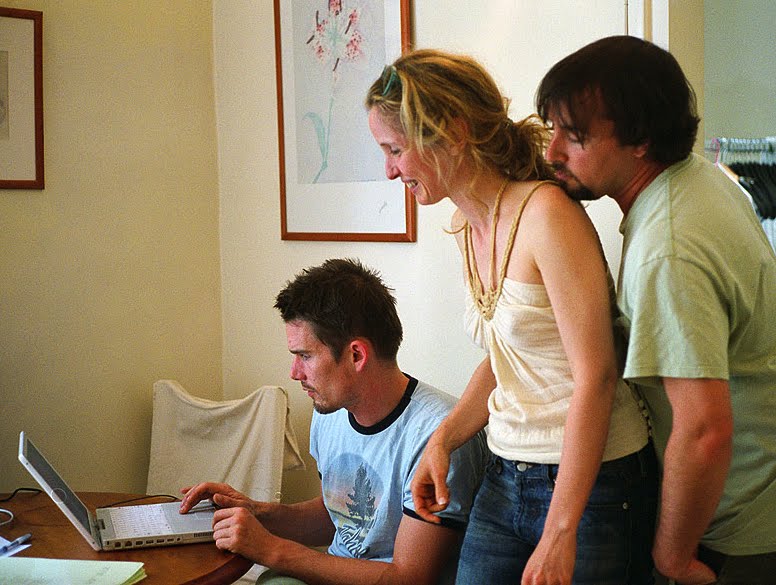
In a recent interview with Ethan Hawke for The Guardian, I talked a lot about the making of Before Sunrise, Before Sunset and the plans for a third film, which is currently in the "daydreaming" phase. We first talked first about the period in the early nineties when Hawke first met Linklater. "I was obsessively watching Five Easy Pieces, Antonioni movies, and obsessively studying Jack Nicholson's career 1970-80. I was almost two full decades late. I was a little behind. The one person I met me who was like-minded was Richard Linklater. I thought if Fassbinder were working today or Godard were working today they'd work together, they'd be in a band so to speak. Working with Rick was the smartest thing I ever did.”

He made you audition, is that right? “I was expecting an offer. I had offers for all these other things. We met one night. He came to see this play. We were each other's foil. We talked all night and had a great time. You know you have that feeling like when you might have made a friend: wow I really got along with that guy. He sent me the first script for Before Sunrise which at that time was a wildly different film — it took place in San Antonio, the guy was a rabid film fanatic who talked all the time about film — I read it and I was about to give him all my notes bout it, when I realised that it wasn’t an offer, that he wanted me to audition. So I came in with everybody else and auditioned. And then he wanted me to do it. And then I gave him all my notes about the screenplay."

The level of naturalism is exceptional, from the writing through the performances. How did you achieve the illusion of spontaneity? “What's great about Rick at his best is you just can't see him working at all, as opposed to a lot of other great directors — David Fincher, whoever — who are very popular right now. Rick has another set of abilities and one of them is: in the text of those movies, like real conversations, we often will bring up [topics of] conversation that get dropped. Rick used to joke that we would fail every screenwriting class in America. None of the rules work. But the major, major thing about those movies that Rick was onto was that, if people see you acting at all, then they're going to notice that there's not a plot. The whole game rests on that this is really happening: that’s the achievement. So we don’t need a fancy shot, we don't need the light to be great; we don't need anything except what it feels like to connect with another human being. What that feels like. That feels magical. And it happens not as much as we want. And that’s what the movie is. So as soon as Julie or I posture or pose or do a really funny line reading the air goes out of the sails a little bit. I used to joke that Rick taught me not to do what every other director wanted me to do: look intense, look broody, look this way, concentrate on the lighting... It was the first time I'd heard someone speak that way: 'it looks like a fucking Heineken ad, get it out of here. Real light is good enough...' I remember Julie saying, I think the movie needs to be funnier, I think I need more jokes, you need to write more jokes. And Rick said to her, 'I've been working with you for nine weeks. I find you absolutely and completely intriguing, beguiling and hypnotic. If we can get the real essence of you in front of a camera and they can't give a shit for two hours then I'm not interested in them as an audience.' She was like 'okay but its going to be bor-ing….”

Jessie performs for her, after a fashion. “We had to keep a little of the Tom Sawyerish, performance aspect in the movie. Boys do that. They perform for girls and girls are always kind of sitting still going: really? When are you going to stop doing that? One of the most fun [experiences] I ever had in my life was working on the scene where I was talk her into getting off the train. How does that happen? Julie was going 'I would never get off the train with some guy.' We had this long day of doing controlled improvs about what a person might say that would work and it was just: gong, gong, gong, gong. Because you can't come on too strong but if you're too much a eunuch, she's never going to go with it. You have to be self-depracating but upfront, do you know? It captures all these things. She was finally like ‘he would have to show me that he was really smart, he has to be smart and funny, that's the only way I would get off the train.’ We finally came up with this idea that I was a time-traveller*. She was like….. 'okay that I would get off the train for.' We were like: yaay. We knew we had it.”

* The filmed speech goes like this: "Think of it like this: jump ahead, ten, twenty years, okay, and you're married. Only your marriage doesn't have that same energy that it used to have, y'know. You start to blame your husband. You start to think about all those guys you've met in your life and what might have happened if you'd picked up with one of them, right? Well, I'm one of those guys. That's me y'know, so think of this as time travel, from then, to now, to find out what you're missing out on. See, what this really could be is a gigantic favor to both you and your future husband to find out that you're not missing out on anything. I'm just as big a loser as he is, totally unmotivated, totally boring, and, uh, you made the right choice, and you're really happy."

Did you have second thoughts about putting all the stuff about Jessie contemplating adultery in the second movie, given what had happened in your personal life? “I had all these thoughts. I wasn’t sure, Rick wasn’t sure. I ultimately feel that for the performance and writing to have something to offer you have to stumble cross something true. I had to make it real for myself. Selfishly as a writer, I felt like the movie needed an obstacle. They couldn’t be free to get back together. It's too easy. The funny thing about those movies is people have this idea that Julie writes Julie's part and I write mine and Rick oversees it. It’s a little bit like that and it’s a little different than that; it's much more like playing in a band. There are huge aspects of Julie's character that she writes but she also has terrific insight into Jessie. And Rick and I also provide that for Julie and Rick gets to use aspects of himself in both Celine and Jessie. So it’s not like I had some personal agenda, wanting to put autobiography into the movie. But [Jessie] kinds says my theory on it: we all have such a limited viewpoint that almost anything we write, even if its about elves and dwarves, is going to be autobiographical. You just need to use it to reach something universal.”

The second film was interestingly downbeat. Their idealism has taken a few knocks. “Its a hard line to walk. You know the Seven Up movies? One of the fascinating things about the Seven Up movies is that everyone seems to get worse. And one of the things that we wanted to do — we were daydreaming about whether or not there would be a third one and what it would be, and it's this thing of wanting to tell the truth about “nobody gets out for free.” Even when things go very well there's usually a price to pay; and when things go badly there's usually something gained. The trick is figuring out how to put that truth into the film. It's almost like there’s this third character in the movie, which is time.”

Does it feel different, third time around? "Certain people had discovered the first one, it had it's own little cult following but really it’s the smallest grossing film of all time to ever garner a sequel. We were doing it for us, as part of a life project, and because of that we felt no pressure, we weren't really worried about ruining the first movie. Now we feel those two movies are part of our lives work. Its important to us if we do a third one, that it not be because the three of us can't forget it, that we have something to say. A lot is happening in all our lives. If we're going to make a third one, I want it to be be the best, like the first two were prologues. Rick wants to treat it much more like John Updike's Rabbit books: Each one should work on its own, should be it's own thing. The dream is: someone's going to see the third movie, flip the fuck out, and someone's going to say 'Aah I didn’t like it as much as the first two'. And they're going to go 'what first two?' That’s the dream. That’s what we want to do.”

A lot of people seem to have a lot of opinions about what to put in the third film. “We're trying to tune out of the rest of the world and figure out what we want to say. That was easy 8,9 years ago, and now its hard. I'll go meet some fancy-pants director for a movie, they’ll go ‘oh this guy wants to meet you for this, that, or the other.' Okay I meet the guy and we start talking about his movie briefly and then they go: ‘I know what the third film should be.’ And he'll go on and on abbout what the third film should be. On one level its flattering and on another we have to tune it out.”

Where might you go with it? "The first two play a lot on projections — mutual shared fantasy. They're not in reality. They're ghosts wandering through: could it be real? Could it be good? They're connecting and everything but they don't have to deal with taking their wives to work or their wife's mother has TB or whatever the hell it is. The stuff that wears people down. It's not the fantasy stuff. I don’t think you can do it a third time. We all love the idea that someone is going to sweep in, but the one thing that sucks about falling in love is eventually falling out of love. One of the great blessings of an arranged marriage in the past was that nobody ever fell out of love. You just generally grew to appreciate the person more. As opposed to being disappointed that they're not who you thought they were. You know? Which is invariably what happens to most of us. I think its one of the things I want to get into the film is an acknowledgement of — and this is everybody's struggle — how do you keep your innocence alive. How do you keep your sense or romance alive? Your sense of joy alive. But match it with realism, to get rid of all the fake naivete. To see the world for what it is, reality for what it is. It’s a very difficult aspect of life. What do you do?”

That sounds like they get together at the end of the second film and the third one starts nine years into their relationship! "I've got to stop talking about this. I got an email from Rick. I've got to shut the fuck up. He thinks it's a real problem. People can't walk into the movie knowing too much — people who love it. We want to hit them with the real thing.”